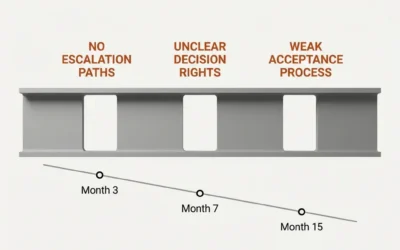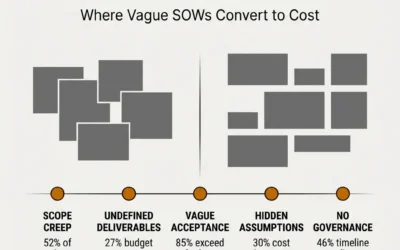
I've spent years watching software projects fail before a single line of code gets written. The culprit? A document most executives sign without reading closely enough. Your Statement of Work determines whether your $500K investment becomes a success story or a...
Thought Leadership in Software Project Risk
Our consultants explore the structural drivers behind software project failure—and how to prevent them. We publish practical analysis on IT contract risk, RFP design, governance frameworks, delivery feasibility, vendor dependency, and pre-signature decision control.
Decision Latency: Why Your Team’s Slowness Is a Contract Risk and How To Fix It
I've watched a $2 million software implementation grind to a halt because the client couldn't decide who owned the approval process for user acceptance testing. The vendor was ready. The system worked. The timeline was intact. But the client's internal decision...
Is Your Software SOW Too Vague? How to Fix a Weak Statement of Work Before It Becomes a Cost Overrun
Software proposals often look inflated—but reacting emotionally destroys leverage. This post explains how executives should analyze a suspected overestimated software development proposal using structure, not accusation. It walks through evaluating staffing models, role allocation, contingency padding, vague discovery phases, duplicated effort, and unrealistic effort multipliers. Readers learn how to request transparency around assumptions, delivery mechanics, and dependency sequencing without triggering vendor defensiveness. The article also explains when a proposal is genuinely high due to risk concentration versus artificially padded. The goal is simple: reduce cost exposure while preserving delivery integrity and negotiation control.
Change Orders Are Not Surprises: How to Predict Cost Overruns Before the Contract Is Signed
I've reviewed hundreds of contracts that ended in cost overruns. The pattern is always the same. The overrun wasn't caused by bad luck or unforeseen circumstances. It was engineered into the contract from day one through ambiguous language, undefined deliverables, and...
Proof in the Plan: Why Work Breakdown Structures Matter in Software Proposals
I've reviewed hundreds of software proposals over the years. The ones that fail share a common trait. They skip the work breakdown structure. Not because they forgot. Because they're hiding something. The Real Cost of Vague Proposals Large IT projects run 45 percent...
When Embedded Tools Become Hidden Tax: How Vendor Tooling Choices Drive Cost and Lock-In
I've watched too many executives sign vendor contracts that looked clean on paper, only to discover three years later they're paying 40% more than expected. The problem wasn't the core service. It was the tooling. Vendors bundle proprietary tools, frameworks, and...
Red Flag Architecture: How Weak or Missing Technical Architecture In RFP Responses Predicts Delivery Failure
I've reviewed hundreds of RFP responses over the years, and I can tell you exactly when a project will fail. It's not in the timeline. It's not in the budget. It's in the architecture section. Or more accurately, in what's missing from the architecture section. Most...
Stalling Tactics: How To Detect Phantom Delays Hidden In Proposed Project Plans
I've reviewed hundreds of software project plans over the years. The ones that failed always had the same hidden mechanisms built in from day one. These weren't accidents. They were structural features that guaranteed delays while giving vendors perfect cover. The...
The Executive’s Pre-Signature Checklist: 25 Questions to Ask Before Hiring a Software Development Vendor
I've watched executives sign contracts based on polished demos, glowing references, and competitive pricing. Then I've watched those same executives explain to their boards why the project is six months behind schedule and 40% over budget. The problem isn't the...
The Heat Map Approach: How I Stopped Trusting “Everything Looks Good” and Started Seeing Software Contract Risk
I've sat through enough software contract reviews to recognize the pattern. The vendor presentation is polished. The sales team answers every question with confidence. The legal team confirms the terms are standard. Finance signs off on the budget. IT says the...
FREE GUIDE: 10 SOW Secrets Every Executive Should Know
This PDF guide exposes the hidden SOW risks that decide success or failure before work even starts—and shows you exactly what to look for, what to challenge, and what to fix while you still have leverage.