
I’ve reviewed hundreds of software proposals over the years. The ones that fail share a common trait.
They skip the work breakdown structure.
Not because they forgot. Because they’re hiding something.
The Real Cost of Vague Proposals
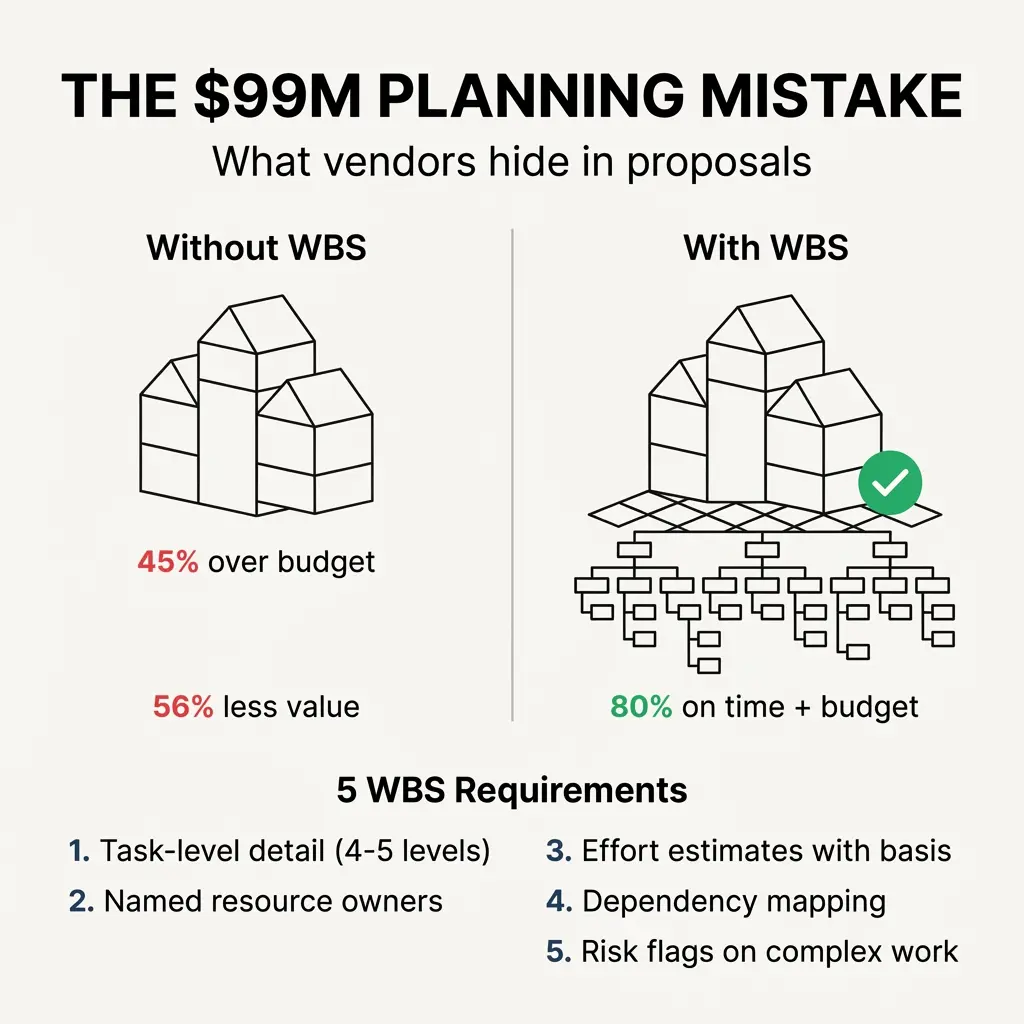
Large IT projects run 45 percent over budget and 7 percent over time while delivering 56 percent less value than predicted. That’s not a rounding error. That’s a pattern.
When I dig into why these projects derail, the answer surfaces quickly. The vendor never mapped the actual work.
A proposal without a detailed work breakdown structure (WBS) is a promise without a plan.
You’re buying a story about what they’ll deliver. But you have no visibility into how they’ll deliver it, who will do what, or what dependencies exist between tasks.
The WBS reveals all of that. Which is exactly why some vendors avoid it.
What a Real WBS Shows You
A work breakdown structure breaks the entire project into smaller, manageable components. It shows deliverables, tasks, responsibilities, and dependencies in a hierarchical format.
Here’s what you should see:
Deliverables: The tangible outputs at each phase. Not “Phase 1: Discovery” but “Discovery Phase Deliverable: Requirements Document with 47 validated user stories, technical architecture diagram, and risk register.”
Tasks: The specific activities required to produce each deliverable. “Conduct stakeholder interviews” becomes “Interview 12 department heads (30 minutes each), synthesize findings into requirement categories, validate with steering committee.”
Responsibilities: Who owns each task. Not “the team” but “Lead Business Analyst: Sarah Chen” with backup resources identified.
Dependencies: What must happen before other work can start. “API integration testing depends on completion of authentication module and staging environment setup.”
When vendors provide this level of detail, they’ve done the hard thinking. They know what they’re building.
When they don’t, you’re funding their learning process.
The Scope Creep Warning Sign
Research shows that 80% of failing software projects trace back to an inability to manage scope creep. Organizations without scope management experience scope creep in 66% of projects, compared to 33% for those with formal scope controls.
The WBS is your first line of defense.
It creates a shared reference point. When someone requests a new feature, you can point to the WBS and ask: “Which tasks does this impact? What dependencies does it create? How does it affect the timeline?”
Without a WBS, every request feels reasonable in isolation. With one, you see the ripple effects immediately.
I’ve watched projects add “just one more integration” that seemed simple. The vendor agreed because they hadn’t mapped the work. Six months later, the project was 40% over budget because that integration touched 23 other tasks across four work streams.
The WBS would have shown that on day one.
How to Evaluate WBS Quality in Proposals
Not all work breakdown structures provide equal value. Some vendors submit a high-level outline and call it a WBS.
Here’s how to separate the real plans from the performance art:
Level of Detail
A quality WBS breaks work down to the task level. You should see 3-5 hierarchical levels minimum.
Level 1: Project
Level 2: Major deliverables or phases
Level 3: Sub-deliverables
Level 4: Work packages
Level 5: Individual tasks
If the vendor stops at Level 2, they haven’t planned the work. They’ve outlined it.
Estimation Basis
Each task should include effort estimates. Not just duration (“2 weeks”) but actual hours or days of work.
Ask the vendor: “How did you calculate these estimates?”
The best answers reference historical data from similar projects, team velocity metrics, or complexity factors they’ve quantified.
Weak answers sound like “based on our experience” without supporting evidence.
Resource Assignment
Every task needs an owner. Not a role. A person.
When you see “Developer” assigned to 40 tasks, that’s a red flag. Which developer? What happens if they leave? Who backs them up?
Vendors who know their teams well assign specific people and identify backup resources.
Dependency Mapping
The WBS should show which tasks must finish before others can start. These dependencies determine your critical path and reveal scheduling risks.
I look for finish-to-start dependencies (Task B starts when Task A finishes), start-to-start dependencies (Task B starts when Task A starts), and finish-to-finish dependencies (Task B finishes when Task A finishes).
If the vendor hasn’t mapped dependencies, they can’t build a realistic schedule. They’re guessing.
Risk Identification
A mature WBS flags high-risk tasks. These might involve new technology, external dependencies, or complex integrations.
When vendors mark certain work packages as high-risk, they’re showing you where problems might emerge. That’s valuable intelligence.
When they present everything as low-risk, they haven’t looked hard enough.
What to Demand in Your RFP
You control the quality of proposals you receive. Your RFP sets the standard.
Include these requirements:
Mandatory WBS submission: Make it a requirement, not optional. Specify the minimum level of detail you expect (I recommend 4-5 hierarchical levels).
Format specification: Request the WBS in a standard format (Microsoft Project, Smartsheet, or even a detailed spreadsheet). This lets you compare proposals directly.
Effort estimates: Require vendors to show hours or days of effort for each task, not just elapsed time.
Resource loading: Ask for named resources assigned to major work packages, with their roles, experience levels, and allocation percentages.
Dependency documentation: Request a separate view or report showing task dependencies and the critical path.
Risk assessment: Require vendors to flag high-risk tasks and explain their mitigation strategies.
When you make these elements mandatory, you eliminate vendors who haven’t done the planning work. That’s a feature, not a bug.
Using the WBS to Build Your Schedule
The WBS feeds directly into your project schedule. It’s not a separate artifact.
Start with the work packages from your WBS. Add duration estimates based on effort and resource availability. Map dependencies. Identify the critical path.
Now you have a schedule grounded in actual work, not aspirational timelines.
Research from PMI shows that project success connects directly to WBS use, while poorly constructed work breakdown structures lead to repeated re-plans, unclear assignments, scope creep, budget overruns, and missed deadlines.
I’ve seen this play out repeatedly. Projects with detailed WBS documentation hit their milestones. Projects without them slip from week one.
The schedule tells you when. The WBS tells you how.
Building Risk Models from Your WBS
Your WBS contains your risk profile. You just need to look at it correctly.
Tasks with multiple dependencies create schedule risk. If any predecessor task slips, everything downstream moves.
Tasks assigned to external vendors or contractors create delivery risk. You control less of the work.
Tasks involving new technology or unproven approaches create execution risk. You’re betting on unknowns.
Tasks on the critical path create timeline risk. Any delay directly impacts your go-live date.
When you analyze your WBS through these lenses, you see where to focus your risk mitigation efforts.
I build a simple risk matrix. High-dependency tasks get extra buffer. External vendor tasks get tighter SLAs and more frequent checkpoints. New technology tasks get proof-of-concept phases before full implementation.
The WBS shows you where to look. Your risk model tells you what to do about it.
Creating Governance Checkpoints That Protect You
The WBS gives you natural governance checkpoints. Each major deliverable becomes a stage gate.
You don’t pay for the next phase until the current deliverable meets acceptance criteria. The vendor doesn’t start new work until you’ve validated what they’ve completed.
This protects both parties.
You avoid funding work built on a flawed foundation. The vendor gets clear feedback before investing in the wrong direction.
I structure payment milestones around WBS deliverables. Not calendar dates. Not vague progress percentages. Tangible outputs you can inspect.
“Discovery Phase: 15% of contract value, payable upon acceptance of requirements document, architecture design, and risk register.”
“Development Sprint 1: 10% of contract value, payable upon acceptance of authentication module, user dashboard, and automated test suite with 80% code coverage.”
When payments tie to deliverables, vendors focus on completion, not activity. Your governance becomes objective, not subjective.
The Questions That Reveal Planning Depth
During vendor presentations, I ask specific questions about their WBS. The answers tell me everything.
“Walk me through the three most complex work packages in your WBS. What makes them complex?”
Strong vendors explain technical challenges, integration points, or dependency chains. Weak vendors give generic answers about “careful planning” or “experienced teams.”
“Show me your critical path. What tasks create the most schedule risk?”
Strong vendors pull up their schedule and trace the critical path, explaining why certain tasks drive the timeline. Weak vendors claim everything is equally important or can’t identify the critical path at all.
“What tasks did you originally include but then remove from scope? Why?”
Strong vendors describe the scoping decisions they made, explaining what they left out and why. Weak vendors insist they included everything, which means they haven’t made hard choices.
“Which tasks have the highest estimation uncertainty? How did you account for that?”
Strong vendors identify specific work packages with estimation risk and explain their buffering strategy. Weak vendors claim high confidence in all estimates, which is never realistic.
These questions separate vendors who planned from vendors who pitched.
What Happens When You Skip the WBS
I’ve seen the pattern enough times to predict it.
Month 2: The first “unexpected” complexity appears. The vendor requests a change order.
Month 4: Three tasks that should have been sequential are now blocking each other. Nobody identified the dependency.
Month 6: A key resource leaves. The vendor scrambles because they never documented what that person was doing.
Month 9: You’re 30% over budget with 60% of the work remaining. The math doesn’t work.
Organizations with poor project management lose $99 million for every $1 billion invested, while companies that complete 80% of their projects on budget and on time waste only 1.4% of every dollar.
The WBS doesn’t prevent all problems. But it prevents the predictable ones.
Making the WBS Work for You
The work breakdown structure is not a document you review once during procurement and then file away.
It’s your project roadmap. Your scope baseline. Your governance framework.
Update it when scope changes. Reference it in status meetings. Use it to evaluate change requests. Build your payment schedule around it.
When vendors try to skip tasks or compress timelines, point to the WBS. When stakeholders request new features, show them the impact on the WBS.
The WBS makes the invisible visible. It transforms abstract promises into concrete commitments.
Demand it in your proposals. Evaluate it carefully. Use it to protect your investment.
Because the vendors who avoid detailed planning are the same ones who deliver detailed excuses later.
The proof is always in the plan.