I’ve spent years watching software projects fail before a single line of code gets written.
The culprit? A document most executives sign without reading closely enough.
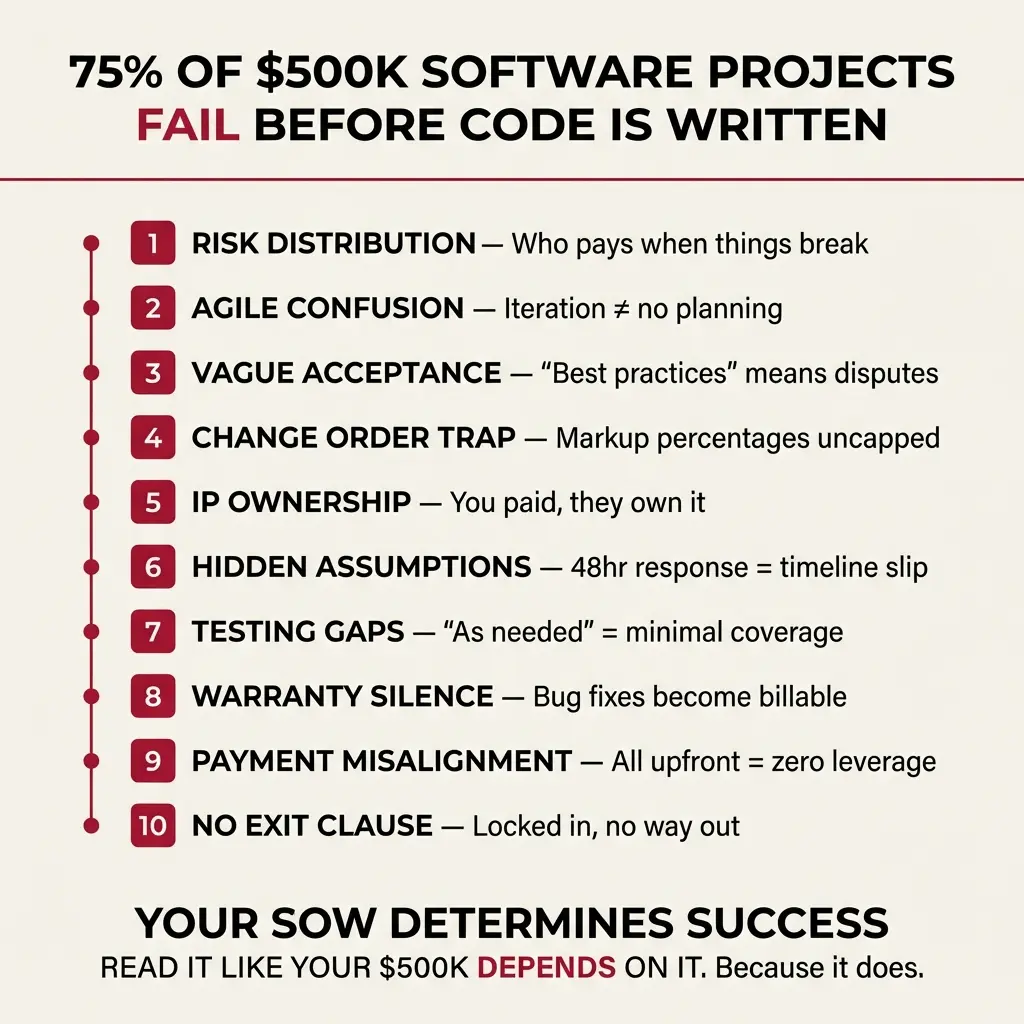
Your Statement of Work determines whether your $500K investment becomes a success story or a cautionary tale. Yet 75% of respondents think their projects are doomed from the start.
They’re right to worry. But they’re looking in the wrong place.
The problem isn’t your development team. It’s what you agreed to before they started working.
Here’s what I’ve learned about the hidden risks in software development SOWs—and exactly what you need to look for while you still have leverage to change things.
#1: Your SOW Is a Risk Document, Not a Project Plan
Most executives treat SOWs like formalities.
Sign it. File it. Move on.
But your SOW isn’t just describing the work. It’s distributing risk between you and your vendor.
Every vague requirement shifts risk to you. Every missing acceptance criterion creates room for dispute. Every undefined deliverable becomes a negotiation point later when you have less leverage.
Poor requirements are the #1 cause of failure. Research shows that 48% of developers point to changing or poorly documented requirements as the leading reason for project failure.
The numbers get worse. Studies reveal that 51% of project dollars are wasted due to poor requirements management.
Read your SOW like a contract lawyer, not a project manager. Because that’s what it is.
#2: “Agile” Doesn’t Mean “We’ll Figure It Out Later”
I see this pattern constantly.
An SOW arrives with minimal detail and a note: “We’re using Agile methodology, so we’ll refine requirements as we go.”
That’s not Agile. That’s abdication.
Agile means iterative development with continuous feedback. It doesn’t mean starting without a clear vision of what success looks like.
Your SOW should define:
- The business problem you’re solving
- The users who need the solution
- The outcomes that define success
- The constraints you’re working within
The implementation details can evolve. The destination cannot.
If your vendor can’t articulate these four elements clearly, you’re not being Agile. You’re being reckless.
#3: Acceptance Criteria Determine Who Wins Disputes
Here’s a sentence that should terrify you: “The software will meet industry best practices.”
Who defines “best practices”? Who measures compliance? What happens when you disagree?
Vague acceptance criteria are expensive.
I’ve watched projects where the client expected one thing and the vendor delivered another—and both sides were technically correct based on the SOW language.
Your acceptance criteria should be:
- Measurable: “The system will process 1,000 transactions per minute” not “The system will be fast”
- Testable: “Users can complete checkout in three clicks” not “The checkout process will be intuitive”
- Binary: Either it meets the criterion or it doesn’t—no room for interpretation
Every acceptance criterion without a clear pass/fail test is a future argument waiting to happen.
#4: Change Order Processes Reveal True Partnership
Changes will happen. That’s not the question.
The question is: How does your SOW handle them?
Look for these red flags:
- No defined process for requesting changes
- No timeline for vendor response to change requests
- No cap on change order markup percentages
- No distinction between vendor-caused changes and client-requested changes
A vendor confident in their process will document it clearly. A vendor planning to profit from chaos will leave it vague.
I’ve seen change orders that cost more than the original project. The SOW allowed it.
#5: Intellectual Property Clauses Have Long-Term Consequences
You’re paying for custom software development.
Do you own what you paid for?
Many SOWs include language that gives the vendor ownership of core components, frameworks, or even business logic. You get a license to use it. They retain ownership.
This creates three problems:
First: You can’t modify the software without vendor permission.
Second: You can’t switch vendors without rebuilding from scratch.
Third: You’re locked into maintenance agreements with no competitive alternative.
Your SOW should clearly state that you own all custom-developed code, designs, and documentation. The vendor can retain ownership of their pre-existing tools and frameworks. But anything created specifically for your project belongs to you.
This isn’t negotiable unless you’re getting a substantial discount in exchange for shared ownership.
#6: Timeline Assumptions Hide in Plain Sight
Your SOW says the project will take six months.
But read the fine print.
That timeline assumes:
- You’ll provide feedback within 48 hours
- You’ll make decisions within one week
- You’ll provide access to systems immediately
- You’ll assign dedicated resources throughout the project
Miss any of these assumptions and the timeline extends. The budget increases. The vendor isn’t at fault—you agreed to the terms.
Only 16.2% of projects are completed on time and within budget.
I’ve watched executives sign SOWs with timeline assumptions they couldn’t possibly meet. Then they’re surprised when the project runs late.
Review every assumption in your SOW. If you can’t commit to it, negotiate it before signing.
#7: Testing Responsibilities Determine Quality
Who tests the software?
This seems like a simple question. The answer determines whether you get production-ready code or an expensive prototype.
Your SOW should specify:
- Unit testing: Does the vendor test individual components?
- Integration testing: Does the vendor test how components work together?
- User acceptance testing: Do you test whether it meets business needs?
- Performance testing: Who verifies the system handles expected load?
- Security testing: Who identifies vulnerabilities?
If your SOW says “testing will be performed as needed,” you’re in trouble.
That usually means the vendor will do minimal testing and expect you to find the problems. By the time you discover issues, you’re past the warranty period.
Define testing responsibilities explicitly. Include test coverage requirements. Specify what happens when tests fail.
#8: Maintenance and Support Terms Start on Day One
Your project launches successfully.
Three months later, a critical bug appears. You contact the vendor.
They send you a quote for fixing it.
This happens because your SOW didn’t define the warranty period or what’s covered under it.
Common gaps I see:
- No warranty period defined
- No distinction between bugs and enhancement requests
- No response time commitments for critical issues
- No transition plan to ongoing support
Your SOW should include a warranty period (typically 90 days) where the vendor fixes defects at no charge. It should define what constitutes a defect versus a new feature.
It should also outline the transition to ongoing maintenance. What’s included? What costs extra? How do you exit the relationship if needed?
These questions are easier to negotiate before the project starts than after you’re dependent on the vendor.
#9: Payment Terms Align Incentives or Create Conflict
How you pay shapes how your vendor behaves.
Pay everything upfront and you have no leverage. Pay everything at the end and your vendor has no security.
The right payment structure ties compensation to progress and quality:
- Milestone-based payments: Tied to completed, tested deliverables
- Holdback provisions: Final payment after warranty period
- Performance incentives: Bonuses for early delivery or exceeding targets
- Penalty clauses: Reductions for missed deadlines or quality issues
I prefer milestone-based payments with a 10-15% holdback released after the warranty period. This keeps both parties motivated throughout the project.
Your payment terms should match your risk tolerance and the vendor’s track record.
#10: Termination Clauses Protect Your Exit Options
You need a way out.
Maybe the vendor isn’t performing. Maybe your business priorities changed. Maybe the project isn’t viable anymore.
Your SOW should include:
- Termination for cause: What happens if the vendor fails to perform?
- Termination for convenience: Can you end the project without cause?
- Transition assistance: Will the vendor help you move to another provider?
- Asset delivery: What do you receive if the project ends early?
- Payment obligations: What do you owe for work completed?
The best vendor relationships never need these clauses. But having them changes the negotiation dynamic.
A vendor who resists reasonable termination terms is telling you something about their confidence in delivering value.
What This Means for Your Next Project
The data is clear. 70% of digital transformations still fail, even as global spending reaches $3.4 trillion.
The problem isn’t technical capability. It’s strategic oversight.
McKinsey research shows that executives need to make software development a strategic priority, not an afterthought.
That starts with your SOW.
Before you sign your next Statement of Work, ask yourself:
- Can I measure whether each requirement is met?
- Do I understand what I’m agreeing to provide?
- Is the risk distribution fair?
- Do I have leverage if things go wrong?
- Can I exit this relationship if needed?
If you can’t answer yes to all five questions, don’t sign.
The SOW you negotiate today determines the project you’ll manage tomorrow.
Most executives realize this too late—after they’ve committed budget, set expectations with stakeholders, and lost their leverage to negotiate better terms.
You still have time to get it right.
Your move.