
I’ve sat through enough software contract reviews to recognize the pattern.
The vendor presentation is polished. The sales team answers every question with confidence. The legal team confirms the terms are standard. Finance signs off on the budget. IT says the technology fits.
Everyone agrees: everything looks good.
Then I ask: “Where exactly is the risk concentrated in this deal?”
Silence.
The problem isn’t that people miss obvious red flags. The problem is that traditional contract review spreads risk assessment so thin across so many stakeholders that nobody owns the complete picture. You get comfort from averages and aggregated opinions, but averages hide danger.
I learned this the expensive way. Three years ago, I watched a company sign a $2.3 million software contract that checked every box in the approval process. Eighteen months later, they were locked in a vendor dependency nightmare with scope creep that doubled costs and a governance structure so weak they couldn’t enforce a single contract term.
The warning signs were there. They just weren’t visible.
Why Standard Contract Review Fails
Most organizations evaluate software contracts through a checklist mentality. Legal reviews terms. Finance reviews budget. IT reviews technical specs. Procurement reviews vendor credentials.
Each department gives a thumbs up or thumbs down.
This approach creates what I call “false green” optimism. When you ask each stakeholder if their area looks acceptable, they’ll usually say yes. The contract moves forward because no single person raises a blocking concern.
But risk doesn’t work that way.
Consider the data: 66% of enterprise software projects have cost overruns. A study of over 5,400 IT projects found they had a total cost overrun of $66 billion. That’s more than the GDP of Luxembourg.
These aren’t failed projects that got rejected in contract review. These are approved projects that looked good enough to sign.
The gap between “looks good” and “actually safe” is where companies lose money.
The Heat Map Method: Visualizing Risk Concentration
I started developing a different approach after that $2.3 million disaster. Instead of asking each stakeholder for a binary yes/no, I needed a way to visualize where risks concentrate across multiple dimensions.
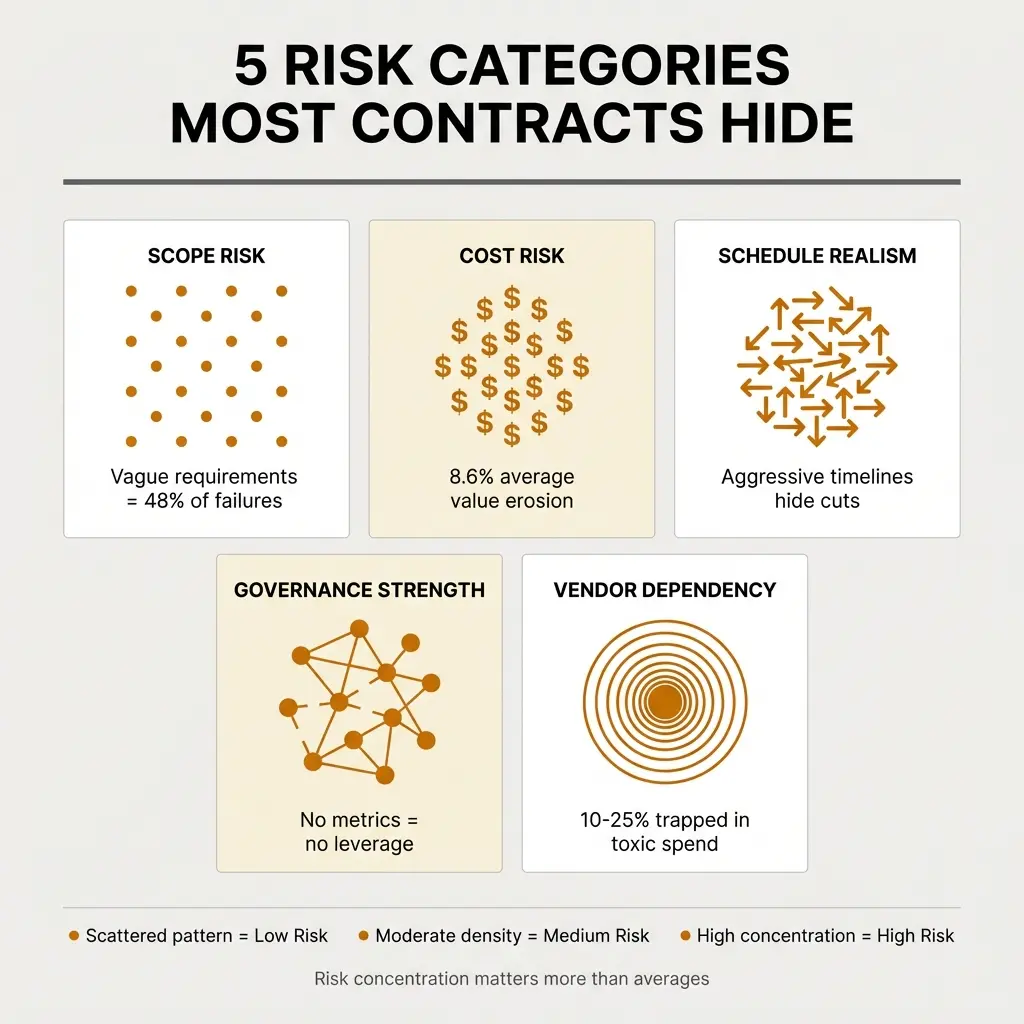
The heat map method evaluates five critical risk categories:
1. Scope Risk
How clearly defined is what you’re buying? Vague requirements are the leading cause of software project failure. Research shows that 48% of developers point to changing or poorly documented requirements as a primary reason for project failure, while mismanagement of requirements causes 32% of failures.
I score scope risk by examining:
- Specificity of deliverables in the contract
- Definition of acceptance criteria
- Process for handling scope changes
- Clarity on what’s explicitly excluded
A contract that says “implement CRM system” scores high risk. A contract that specifies “migrate 47,000 customer records with 23 defined fields, integrate with existing email platform via API, train 15 users across 3 departments” scores lower risk.
2. Cost Risk
What can change the price after you sign? I’m not talking about the base contract value. I’m looking for cost escalation mechanisms hidden in the terms.
I examine:
- Variable pricing tied to usage or volume
- Professional services rates for changes
- Annual increase clauses
- Penalties for early termination
- Costs for data extraction if you leave
The data validates this concern. Average contract value erosion is pegged at 8.6%, with 40% of contract leakage attributed to poor management. That’s money disappearing after the signature.
3. Schedule Realism
Does the timeline make sense? Overly aggressive schedules create pressure that leads to corner-cutting, poor testing, and technical debt you’ll pay for later.
I look at:
- Implementation timeline versus industry benchmarks
- Dependencies on your team’s availability
- Vendor resource commitments
- Consequences of delays
If a vendor promises a six-month implementation for something that typically takes twelve months, that’s not efficiency. That’s risk.
4. Governance Strength
Who enforces the contract terms when things go wrong? Weak governance is invisible until you need it.
I evaluate:
- Defined escalation paths
- Performance metrics and SLAs
- Reporting requirements
- Change control procedures
- Dispute resolution mechanisms
A contract without clear governance is an agreement to negotiate everything twice.
5. Vendor Dependency
How locked in will you be? This is the risk category most organizations underestimate until it’s too late.
I assess:
- Data portability and export capabilities
- Integration dependencies
- Proprietary versus standard technologies
- Contract term length and renewal terms
- Switching costs
Organizations discover that 10% to 25% is commonly found in “toxic spend” from vendor lock-in. Licenses assigned but never used. Expensive tiers purchased when lighter versions would suffice. The dependency accumulates contract by contract, renewal by renewal, until switching becomes more expensive than staying.
Building Your Heat Map: The Scoring Framework
I use a simple 1-5 scoring system for each risk category:
1 = Low Risk (well-defined, protected, manageable)
3 = Medium Risk (some gaps, requires monitoring)
5 = High Risk (significant exposure, needs mitigation)
The visual representation matters. I create a matrix that shows all five categories with their scores, color-coded:
- Green (1-2): Acceptable risk level
- Yellow (3): Requires attention and monitoring
- Red (4-5): Unacceptable without mitigation
The power of this approach is risk concentration becomes visible. You can immediately see if you have one critical red flag or multiple medium concerns that compound into serious exposure.
A contract with a score of 2, 2, 2, 2, 5 tells a different story than a contract scored 3, 3, 3, 3, 3. Same average risk, completely different risk profiles.
Red Flag Indicators I Never Ignore
After applying this method to dozens of contracts, certain patterns consistently predict problems:
The Scope Vagueness Pattern
When the statement of work uses phrases like “best practices,” “industry standard,” or “reasonable efforts” without defining them, scope risk is high. These terms sound professional but mean nothing enforceable.
The Hidden Cost Escalator
Watch for contracts where the base price looks competitive but professional services are billed at $300/hour with no cap. The vendor knows the base contract is incomplete. They’re planning to make money on changes.
The Aggressive Timeline Promise
If the vendor’s proposed timeline is 40% shorter than your internal IT estimate, someone is wrong. Usually, it’s the vendor. They’ll hit the timeline by cutting scope or quality.
The Governance Vacuum
Contracts that lack specific performance metrics or consequences for missing them create a governance vacuum. You have no leverage when the vendor underperforms.
The Proprietary Lock-In
Any contract that makes data export difficult or expensive is building a cage. If the vendor charges $50,000 to extract your own data, you’re not evaluating software anymore. You’re evaluating a long-term relationship you can’t easily exit.
From Heat Map to Decision: Sign, Fix, or Walk
The heat map doesn’t make the decision for you. It makes the decision visible.
I use this framework:
Sign: No scores above 3, total score under 12. The contract has acceptable risk levels that match the value and strategic importance of the deal.
Fix: One or two scores at 4-5, or total score between 12-18. The deal has value but requires specific amendments before signing. I return to the vendor with targeted requests that address the high-risk categories.
Walk: Multiple scores at 4-5, or total score above 18. The risk concentration is too high. The deal structure needs fundamental rework, or the opportunity isn’t worth the exposure.
This framework transforms vague board discussions into clear recommendations. Instead of “we have some concerns but overall it looks okay,” you can say “we have a score of 4 in vendor dependency and 5 in governance, creating unacceptable risk concentration in our ability to enforce terms and exit if needed.”
That’s a conversation that leads to action.
Why Visual Risk Communication Matters at the Board Level
I’ve presented both traditional contract reviews and heat maps to boards. The difference in engagement is dramatic.
Traditional reviews generate questions like “did legal approve this?” or “is this in the budget?” These are checklist confirmations, not risk discussions.
Heat maps generate questions like “why is vendor dependency scored so high?” and “what would it take to move governance from 4 to 2?” These are strategic conversations about risk tolerance and mitigation.
Research confirms this. Risk heat maps serve as an effective tool to communicate risks in a simple, visual way that eliminates technical jargon, building trust and understanding. You can make better, more strategic decisions about which mitigation strategies to implement based on probability and likely impact of risks.
The visual format does something else important: it distributes accountability. When the CFO sees a cost risk score of 5, they own that conversation. When the CIO sees a vendor dependency score of 5, they own that conversation. The heat map creates clear ownership of risk categories across the leadership team.
Implementation: Making This Practical
You don’t need expensive software or consultants to start using heat maps for contract evaluation. You need a structured approach and consistent application.
Here’s how I implement this:
Step 1: Create Your Scoring Rubric
Define what constitutes a 1, 3, and 5 for each of the five risk categories in your organization’s context. Write it down. Make it repeatable.
Step 2: Assign Evaluators
Each risk category needs a primary evaluator who understands that domain. Legal typically owns governance. Finance owns cost risk. IT owns vendor dependency and schedule realism. Business owners own scope risk.
Step 3: Score Independently
Have evaluators score their categories before group discussion. This prevents groupthink and anchoring bias.
Step 4: Review and Calibrate
Bring the team together to review scores and discuss disagreements. This is where the real insights emerge.
Step 5: Visualize and Decide
Create the heat map visualization and apply the sign/fix/walk framework. Document the rationale for the decision.
Step 6: Track Outcomes
Six months and twelve months after contract signing, review the heat map against actual performance. Did high-risk categories create problems? Did low-risk categories stay stable? This feedback loop improves your scoring accuracy over time.
What I’ve Learned From Applying This Method
I’ve used heat maps to evaluate 47 software contracts over the past three years. The results changed how I think about contract risk.
First, scope risk predicts more problems than cost risk. Contracts with vague scope consistently generate disputes, delays, and dissatisfaction even when the price is fair. Clear scope with higher cost outperforms vague scope with lower cost.
Second, governance strength is the multiplier. Weak governance makes every other risk worse. Strong governance can partially compensate for higher risk in other categories because you have mechanisms to address problems.
Third, vendor dependency risk compounds over time. A score of 3 at contract signing becomes a 5 after two years of integration and customization. If you’re accepting medium vendor dependency risk, plan for it to increase.
Fourth, the heat map creates better vendor negotiations. When I show a vendor their contract scored 5 in cost risk because of uncapped professional services rates, they often propose a cap. They’d rather win the deal with better terms than lose it to a competitor.
Finally, walking away is underrated. I’ve recommended walking from eight contracts based on heat map scores. In six of those cases, we found better alternatives within 90 days. In the other two, we built internal solutions that cost less and gave us more control.
The opportunity cost of a bad contract is higher than the opportunity cost of continued searching.
The Real Cost of “Everything Looks Good”
Poor software quality costs US companies upwards of $2.08 trillion annually. That includes costs from operational failures, unsuccessful projects, and software errors in legacy systems.
These aren’t random failures. These are the downstream consequences of contracts signed because everything looked good enough.
The heat map approach doesn’t eliminate risk. It makes risk visible, measurable, and manageable. It transforms “we think this is okay” into “we know exactly where the exposure is and we’ve decided it’s acceptable given the value.”
That’s the difference between hope and strategy.
I still sit through vendor presentations where everything looks polished and professional. I still hear stakeholders say the terms seem reasonable and the technology fits.
But now I ask a different question: “Show me the heat map.”
Because averages hide danger. Risk concentration exposes it.
And exposure is the only thing worth measuring before you sign.