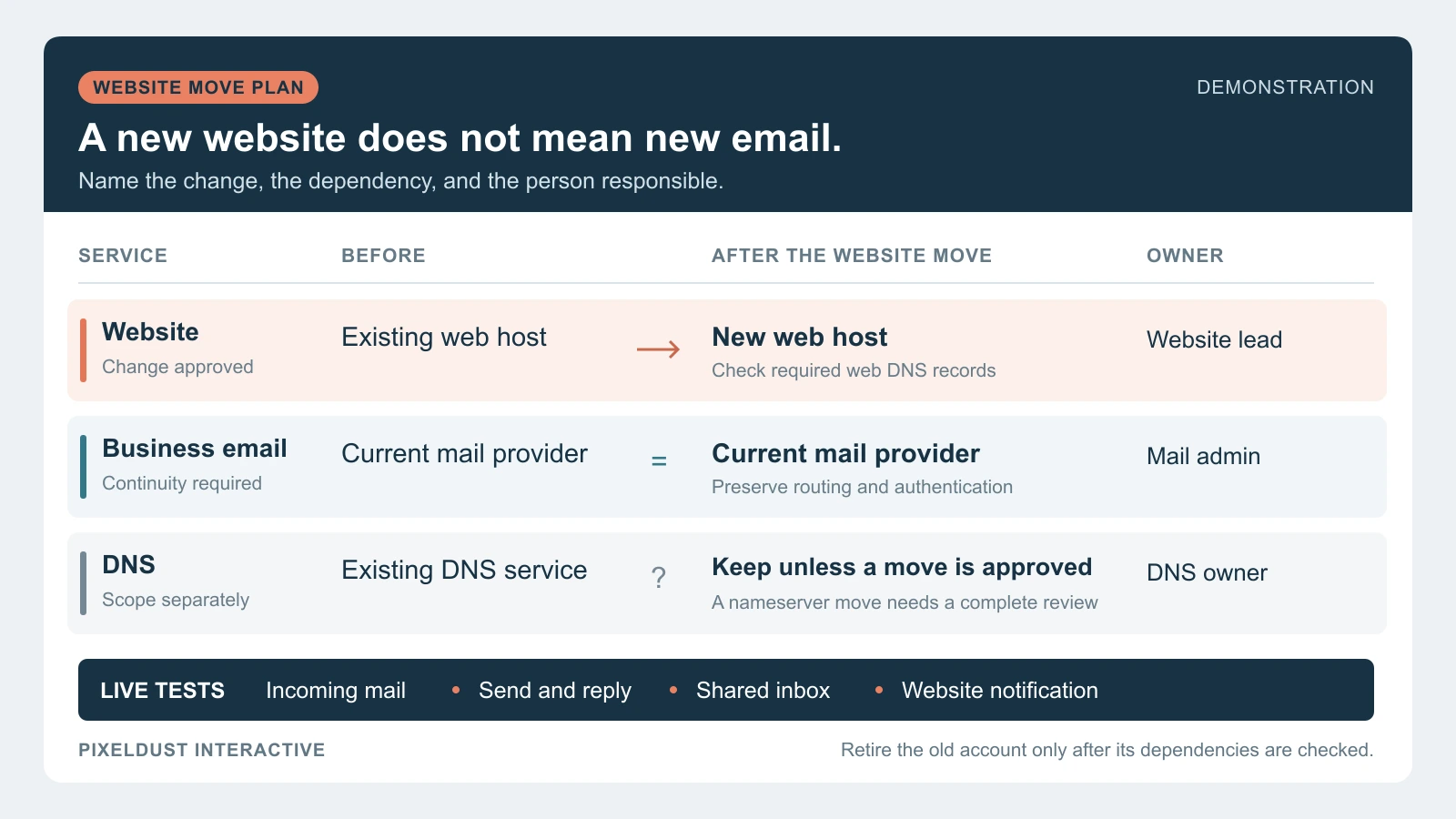
Moving a website should not turn a normal workday into a search for missing email. Before I approve a launch plan, I want to know where the website lives, where the mailboxes live, and which account controls the domain's DNS. Those can be three different services even when one company sends the invoice.
I would separate the website move from an email migration unless the business has deliberately commissioned both. Keeping that boundary clear makes the work easier to test and gives the owner a precise answer to a reasonable question: what are you actually changing?
I start with the email the business already relies on
The Bryan-College Station Chamber's civil engineering directory identifies a real local professional-services segment. Consider a hypothetical College Station engineering consultancy refreshing its website while continuing to exchange project correspondence through its existing email provider. This example does not describe a listed firm's technology or experience.
The new website may be ready, but the owner's main concern is whether staff can still receive a client's message and send a reply. I would include that concern in the acceptance criteria. A successful homepage launch is not evidence that email still works.
My starting inventory includes ordinary staff mailboxes, shared addresses, aliases, forwarding, and the systems sending messages on the firm's behalf. A proposal application, scanner, or website notification can use a different sending service from the staff mailbox. I need to understand those dependencies before deciding which records are unrelated to the move.
Four account names are worth writing down
I ask who controls domain registration, authoritative DNS, website hosting, and email administration. Registration keeps the domain owned and renewed. DNS publishes the directions other systems consult. Hosting serves the website. The email provider maintains the mail service and its accounts. One supplier can perform several roles, but I would still document each role separately.
The business should retain ownership and a supported way to recover access. I prefer named, appropriately limited access for the people doing the work rather than passing one shared password around. I also want an authorized decision-maker available during the agreed change window.
Before cancelling an old hosting package, I would inspect what the subscription actually includes. It may still provide DNS, working mailboxes, forwarding, or a sending service. Removing the visible website does not prove that the rest of the account is disposable. Any account retirement needs its own evidence and approval.
A web address change and a nameserver change have different reach
Cloudflare's DNS record reference explains the different roles of address records, aliases, and mail records. A and AAAA records identify IPv4 and IPv6 addresses. A CNAME identifies another hostname. MX records direct incoming mail. The letters matter because a request to point the website somewhere new does not identify every record that should change.
If the existing DNS service can publish the new host's required web records, I would consider that narrower change before moving DNS administration. Changing authoritative nameservers moves responsibility for the domain's DNS answers. The replacement must contain the necessary records, not just the new homepage destination.
I would also trace the mail destination itself. If an MX record points to a hostname whose address is being changed or removed, leaving the MX text untouched may still break delivery. Similarly, an old IPv6 website record can send some visitors somewhere different from the updated IPv4 destination. I check the actual dependencies rather than rely on record labels.
My change plan lists each proposed edit, its reason, its approver, and how it will be verified. If nameservers must move, I would compare the complete existing configuration with the prepared replacement and have the provider account for DNSSEC and other dependent services. An automatic record scan is a starting aid, not my proof of completeness.
Receiving mail is only half the check
I also want messages from the business to remain recognizable to receiving systems. Microsoft's Microsoft 365 DNS documentation distinguishes incoming-mail routing, client discovery, and SPF sender authorization. The appropriate records must come from the actual provider and account, not a copied configuration from another domain.
SPF identifies permitted senders. DKIM signs messages using a domain identity. DMARC evaluates authentication aligned with the visible From domain and expresses a handling policy. Microsoft's DMARC guidance explains that relationship. During a website move, I would preserve the approved arrangement and verify any necessary change with the mail administrator.
I would not add a second competing SPF record or tighten a mail policy merely because a new website is launching. A new form sender may need authorization, while existing business applications still need to send. Those changes deserve a complete sender inventory and deliberate testing, not a guess that the mailbox provider is the only sender.
I keep the old service until the checks justify retiring it
Before cutover, I want a verified copy of the existing records, a tested website preview, known working mail tests, and a written recovery path. DNS caching means changes and reversals are not instantaneous everywhere. I would agree on monitoring and escalation rather than promise a universal completion time.
After the change, I test incoming mail from an independent account, an outgoing message and reply, relevant shared addresses, and an actual website notification. I ask the mail administrator to inspect authentication results and delivery records where available. A staff member confirms that the test arrived in the expected inbox and can be answered.
Ask your provider who owns DNS, which exact services depend on the old account, what triggers recovery, and who signs off on cancellation. Pixeldust Interactive's website migration and redirect service reviews DNS, email, hosting, and ownership according to the agreed scope. I would make email continuity explicit rather than assume it is included.
If the business only needs clearer content or a small design correction, I would first see whether the current host can support it. A move introduces work that an in-place edit may avoid. Tell me what you want to move and which email service must keep working, and I can help define a migration with a clear boundary and verifiable result.