Pixeldust Interactive field guides
Get found. Get chosen. Skip the folklore.
Practical guidance for College Station, Bryan, and Brazos Valley businesses that want a more useful website and stronger local visibility—written by the person who does the work.
Measure leads—not applause from a traffic chart.
A practical plan for measuring calls, texts, forms, bookings, and qualified inquiries without confusing clicks with customers.
Read the guide →Mobile website fixes that help local customers act.
A phone-first checklist for clearer calls to action, easier forms, useful speed, stable layouts, and measurable local responses.
Read the guide →Improve your local reach online in College Station.
A practical, no-magic checklist for helping nearby customers find your business, understand what you do, and take the next step.
Read the guide →What belongs here
Useful before impressive.
These guides focus on questions local owners can act on: service-page structure, Google Business Profile alignment, mobile conversion, reviews, accessibility, speed, and sensible uses of AI.
When we examine a public local website, we separate what can be observed from what would require private analytics. No imaginary traffic numbers. No public shaming. No 1,000-word weather balloon inflated around a single keyword.
See local SEO servicesNeed eyes on your site?
Get a personal website review.
Tell us what is not working. We will look at the business, the site, and the local search path—and recommend a sensible place to start.
Explore our services
Five useful ways into the work.
Choose the category closest to the problem. Each one opens a focused page with every related service and a clear next step.
Websites, redesigns, stores, landing pages, and local content built to turn attention into action.
Purpose-built portals, mobile apps, SaaS products, booking systems, and business software.
Connected business systems, dashboards, databases, APIs, payments, and dependable reporting.
Practical AI and automation for intake, research, publishing, follow-up, and operations.
Search visibility, measurement, accessibility, repairs, recovery, migration, and ongoing quality.
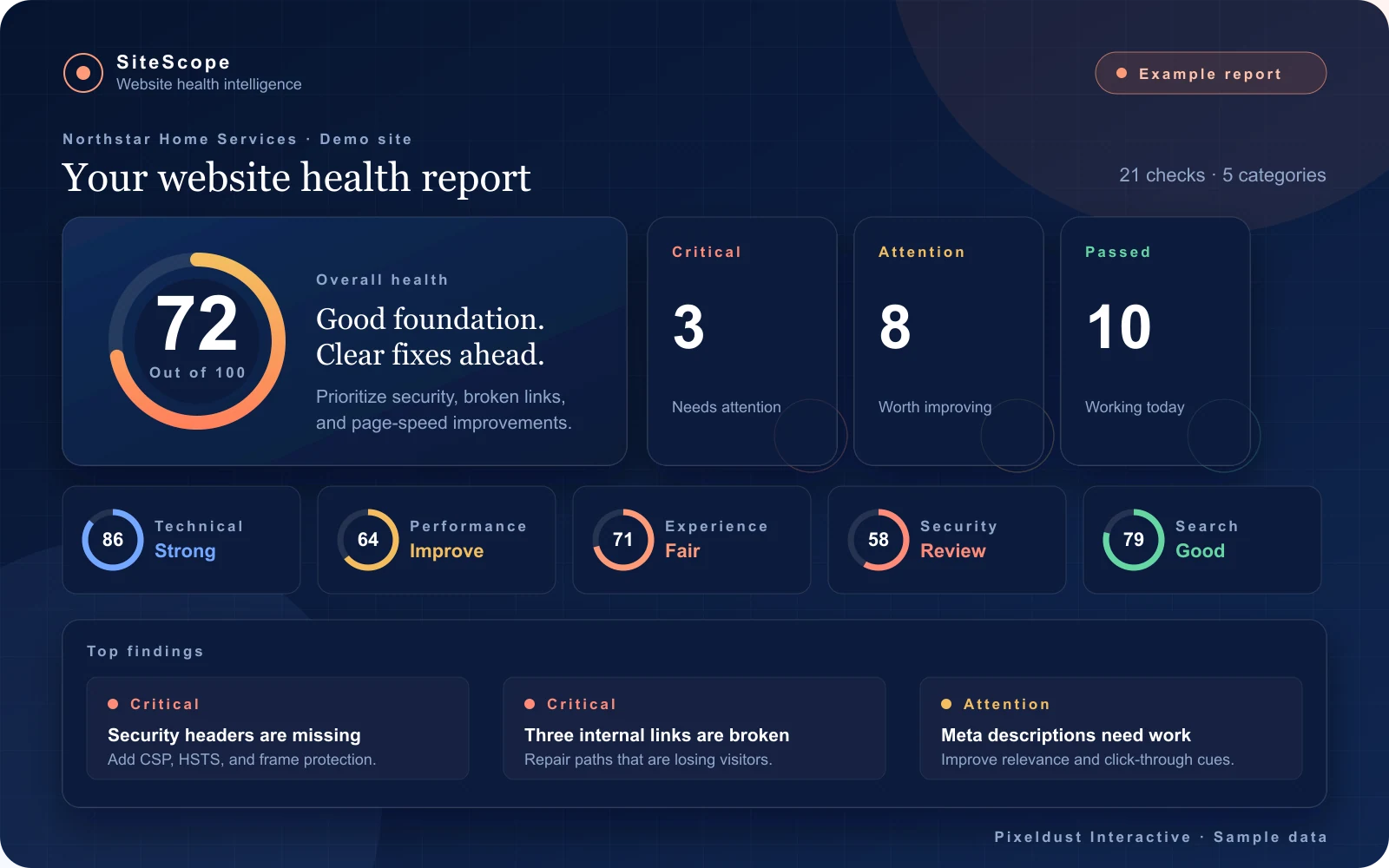 Explore the full 21-point report →
Before you spend another dollar
Give your website a 21-point reality check.
Check technical health, layout, links, security, performance, and search visibility in one prioritized report.