If your website and sales counter can both change stock, I want to know which system settles a disagreement. Connecting the two is not enough. A connection that repeatedly copies yesterday's count can make an inaccurate number look impressively synchronized.
For a plant nursery, I would start with one practical question: what quantity can the website responsibly offer for sale now? Answering it means accounting for sales, customer holds, damaged plants, deliveries, and the time it takes those changes to reach the store.
A plant catalog is not a live stock promise
The local distinction is visible on Brazos Valley Tree Farm's nursery page. The College Station business asks customers to confirm availability because products sell and new shipments arrive frequently. I see that as a clear statement of the page's limits, not evidence that its systems are failing.
The following example is hypothetical. Imagine an independent Bryan garden center selling the same containers online and at the counter. Its website reads an exported stock list every evening. Staff also make daytime holds for customers. The question is whether that information is current enough to support online payment, rather than simply helping a visitor plan an inquiry.
I would not add Buy Now to the entire catalog until that question has a defensible answer. A smaller collection with reliable counts can be a better first online range than a complete list that staff must correct after every order.
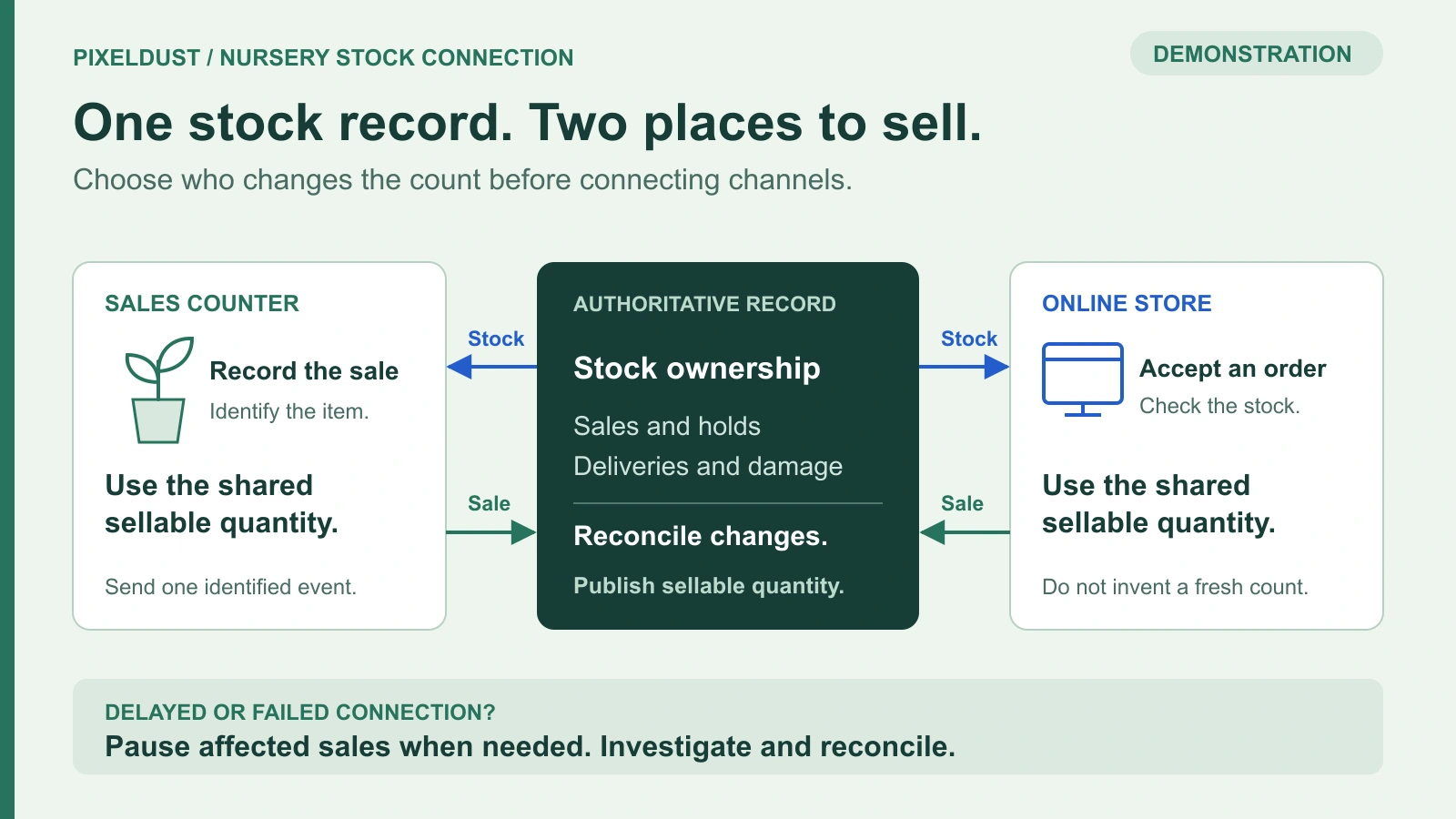
I assign authority before choosing a connector
I ask staff to show me where they receive a delivery, record a counter sale, remove an unsellable plant, and release a customer hold. If those events belong to different systems, I write down which one owns each decision and how the other systems learn the result.
The authoritative stock record might already be the point-of-sale platform. In a larger operation, it may be an ERP, the business system that manages stock and related records. The website can display its result without becoming a second independent authority for physical counts.
Every exchange also needs the same product and location identifiers. A three-gallon shrub at one branch is not interchangeable with a one-gallon version elsewhere. I would resolve mismatched codes and units before importing quantities. An accurate count attached to the wrong item is still a wrong promise.
Pixeldust Interactive's ERP integration service covers those ownership rules, mapped exchanges, monitoring, and recovery. I would connect only the necessary records first rather than synchronize every field because an API happens to expose it.
I distinguish physical stock from sellable stock
Counting ten containers on a bench does not establish that ten are available. Some may already belong to accepted orders, be held for inspection, or be set aside. Incoming deliveries are another category: expected plants have not necessarily arrived in a condition the business can sell.
Shopify's inventory-state documentation distinguishes on-hand, available, committed, unavailable, and incoming quantities. I use that kind of separation to explain the business rules, even when the actual nursery uses another platform. I would map its terms rather than assume every vendor defines them identically.
A modest online buffer may help when physical counts change before software catches up. I would choose it with the owner and review the effect on missed sales. It reduces exposure; it does not repair an unreliable connection or guarantee that overselling cannot happen.
An old count must not erase a newer sale
Consider an illustrative failure: an export says eight are available, a counter sale changes the current count to seven, and a delayed import writes eight back. Nothing was physically added. The integration has overwritten a valid change with an older observation.
That is why I distinguish a stock adjustment from replacing an entire quantity. Shopify's quantity-setting API is intended for the authoritative system and supports a conditional check against the current value. Its documentation warns that bypassing that check during concurrent changes can create inaccurate quantities.
I would require the connector to preserve transaction identifiers, recognize a repeated event, and handle delayed updates. A retry of the same sale must not deduct another plant. Equally, when the ERP returns an updated balance, the website must not deduct the online order again from a number that already includes it.
Two channels can still compete during a delay. I ask exactly when the platform checks and commits stock, whether both channels use that mechanism, and what happens offline. If the systems cannot coordinate that moment, I would reduce the online range, use an appropriate buffer, or require confirmation instead of promising certainty.
The connection needs a reconciliation routine
I want staff to see when the last exchange succeeded, which items failed, and who owns the exception. An integration dashboard showing Connected is not enough if a particular product stopped updating yesterday. The response to stale stock should be agreed before launch.
For the hypothetical garden center, I might pause online sales for affected items after an agreed failure threshold. After recovery, I would reconcile pending orders and adjustments before replaying a backlog. Blindly pushing a fresh total could conceal the very difference the team needs to investigate.
Physical counts remain useful. I would schedule a small rotating count of important products and record why discrepancies occurred. Software cannot infer that someone moved plants to a display, wrote down the wrong size, or forgot to record a damaged batch.
I would prove one product group before expanding
My acceptance test includes a counter sale, an online order, a cancellation, a hold release, a delivery, duplicate messages, and a disconnected channel. I want the final balance and the sequence of changes to agree. I would also test two buyers attempting the last available unit.
Ask the provider which system owns quantities, how stale updates are rejected, how a repeated sale is recognized, and who repairs failures. During a pilot, I would compare unexplained count differences, stock-related cancellations, correction time, and the age of failed exchanges. Those measures show whether the connection earns its upkeep.
A small College Station retailer may need disciplined use of its existing platform rather than an ERP. I would examine the current point-of-sale system's supported online stock connection, counting tools, and adjustment process before recommending another system to maintain.
If your website and counter disagree about availability, tell me where each count comes from and which sales cause corrections. I would start by tracing those changes, then recommend the smallest dependable connection.