If a customer calls the wrong branch or drives to a counter that does not offer the service they need, I would start with the website's location information before buying more traffic. Being found locally is useful only if the next step leads to the right place.
A business with two real locations needs more than the same paragraph with a different city name. I want the customer to understand which branch can help, how to reach it, and which details apply there. That is the job I would give a location page.
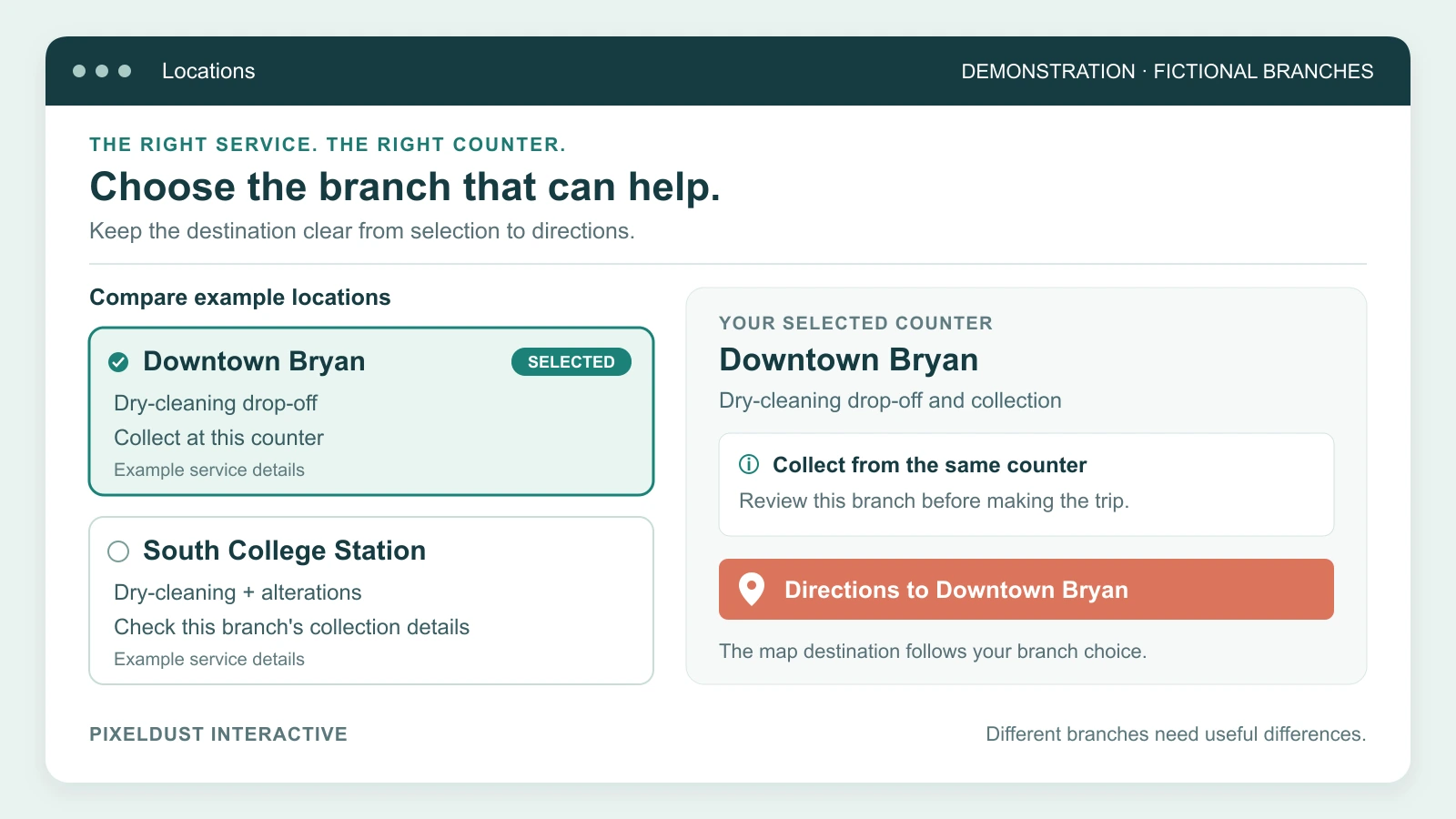
Can the customer choose before asking for directions?
The Bryan-College Station Chamber lists dry cleaners and laundromats, confirming a real local business segment. My example is a hypothetical company with separate Bryan and College Station counters. It does not describe the listed business, its locations, or its website.
Suppose the Bryan counter accepts dry-cleaning drop-offs, while the College Station branch also handles a particular alteration service. A customer searching for help with a garment needs to choose by service as well as distance. If both cards say Full service and link to the same general contact form, the site has concealed the decision.
I would begin by asking staff which location questions they repeatedly have to correct. Wrong-counter calls, uncertainty about collection, and confusion between the processing facility and the public entrance are different problems. Their answers should determine the page content. I would not invent a location strategy from a list of search keywords.
I give each real branch a record it can own
For each public location, I would confirm the actual name, complete address, suite if relevant, direct or shared phone arrangement, customer-facing hours, available services, and collection instructions. I also need someone responsible for approving those facts. A designer cannot infer operating rules from a map.
Shared company information can remain shared. The explanation of garment care or the company's service policy does not need three slightly different versions. Branch-specific facts should be maintained separately so an editor does not accidentally change every counter's hours while updating one location.
In the hypothetical example, I would ask whether an item dropped at one counter must be collected there. If the answer is yes, that fact belongs near the collection information. A vague statement about serving the Brazos Valley does not answer it. Small operational details often matter more than another paragraph describing the city.
My preferred starting point is a simple location record in the existing content system, used by both the branch page and the location selector. Separate manually typed copies can drift apart. I would keep editing straightforward enough that the approved owner can maintain it without depending on a developer for every correction.
The page should represent a place, not a keyword variation
When two branches have genuinely different addresses, services, contact details, or customer instructions, I would normally give each a stable, descriptive URL. A location overview lets visitors compare them; the individual page lets someone arrive directly at the right branch from a saved link or search result.
I would use the branch's real name and place naturally in the title and main heading. The page should link to related service explanations, while preserving the location context around calls, directions, and any request form. Each substantive branch page should have its own canonical URL rather than declaring that both distinct destinations are the homepage.
There is no reason to manufacture additional locations where the business has no customer-facing presence. Google's doorway-abuse policy describes pages created to capture similar searches and funnel visitors onward. My practical test is whether the page helps someone complete a different local task. Swapping Bryan for College Station in otherwise identical sales copy does not achieve that.
Pixeldust Interactive's local SEO service connects useful website pages with accurate public business information. For this problem, I would prioritize the branch decision and its supporting facts. More pages or longer copy would not be my success criteria.
I follow the call and map buttons all the way
A button labeled Directions to Bryan must open the intended branch, not a general search for the company name. I would check the destination, map pin, and arrival information on a phone. An official street address and a useful explanation of the public entrance can work together; neither should contradict the other.
I also test the phone link and ask who actually answers. A central number can be appropriate if staff identify the requested location. If the site promises a direct branch line, the destination should behave that way. The label is part of the promise.
For forms, I would carry the selected branch into a visible field or confirmation. A hidden identifier alone is not enough: the customer should see where the request is going. Switching branches must update related service choices. The interface should not keep an alteration option that the newly selected counter cannot provide.
I would let visitors choose another location without forcing device-location permission. Automatically redirecting someone to the apparently nearest branch can interrupt a deliberate choice, especially when they are arranging a collection for somebody else. A location suggestion is useful only if it leaves the customer in control.
Keep public profiles aligned, then judge the result
Google's Business Profile guidelines call for accurate real-world business information, customer-facing hours, and a website or phone connection representing the individual location. I would check eligibility and existing ownership before proposing any new profile. A new website page is not permission to invent another storefront.
Ask a provider to demonstrate the complete path from each existing profile to its relevant website destination, then to a correct call or directions action. Ask who approves branch changes and how the overview, individual page, and profile are reconciled. An attractive map embedded on the homepage is not evidence that these paths agree.
After the correction, I would review misrouted calls, requests assigned to the wrong counter, and staff reports of customers arriving at the wrong place. Branch-page visits and direction clicks provide context, but a click cannot prove arrival. I would not promise a ranking improvement from this work.
If you have one public counter and a wider service area, one accurate location page may be enough. I would improve that page before commissioning a collection of city pages. Tell me where customers get confused between your locations, and I can help define the smallest useful correction.