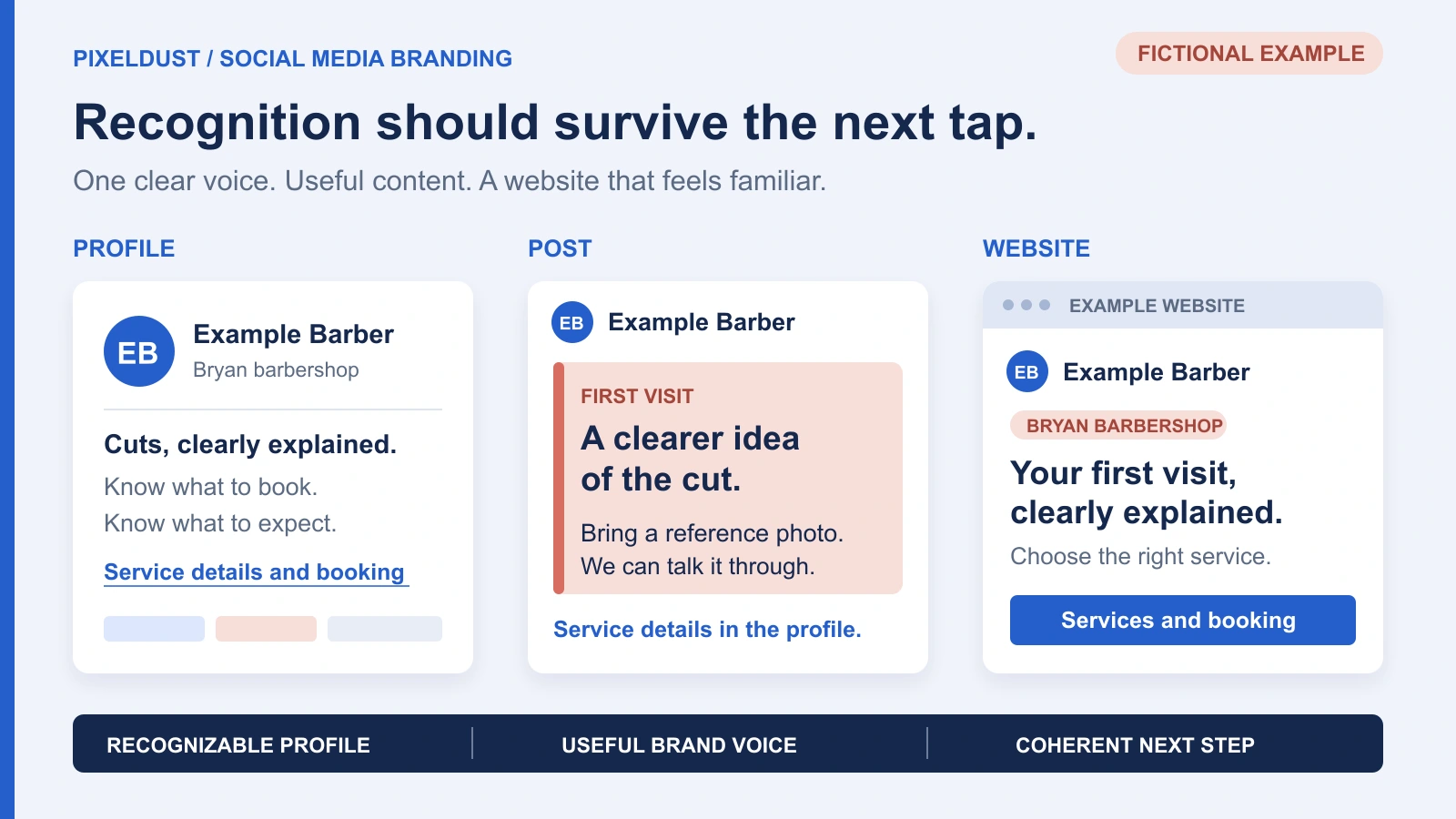
A customer can encounter your business through a short video, a shared photograph, or a profile they have never seen before. I want each encounter to feel connected to the shop they eventually visit. If the name, tone, and presentation keep changing, the customer has to work out whether they have found the same business.
Social media branding is how I make that recognition dependable. It includes the profile, the writing, the choice of subjects, the visual treatment, and the page a customer reaches next. A matching logo helps, but it cannot do all of that work.
I begin with the profiles a stranger would find
The Bryan-College Station Chamber's barber-shop directory confirms a real local service segment. The example here is a hypothetical independent Bryan barbershop, not an assessment of any listed business or a claim that it is a Pixeldust client.
I would put its active profiles beside the website and the shop's own materials. Is the business name consistent? Does the profile photograph remain recognizable at a small size? Can someone tell where the shop is and what kind of service it provides? I also check whether an older account creates confusion about which profile is current.
I would preserve an established mark that customers already recognize if it still works. The immediate correction might be a cleaner profile crop, a useful description, and the right website link. Replacing the identity is a larger decision, not the admission price for improving social media.
I write the voice in sentences the owner would actually use
For the hypothetical shop, I would ask the owner how they explain a first visit and how they respond when someone is unsure what to book. Those answers give the writing a practical character. Three adjectives such as friendly, professional, and authentic are too vague to guide the next caption.
Instead, I would record examples: explain the service before naming the trend; welcome questions without mocking inexperience; state booking conditions plainly; avoid claims that every cut suits every customer. The owner can judge those choices because they describe how the business treats people.
A caption explaining what a beard service includes should sound like the same shop as a reply to a first-time customer's question. It can be shorter and more conversational than the website without becoming a different personality. I would revise a clever line if staff would feel uncomfortable saying it across the counter.
Choose subjects that make the shop easier to understand
I would start with a few recurring customer questions rather than a daily quota: what the services include, how to prepare for a visit, what reference photographs help, and how to choose an appointment type. The owner supplies the actual answers. I would not invent a technique, staff credential, or customer result to fill the calendar.
Work photographs can show the shop's approach, with the customer's permission and honest context. I would avoid editing that conceals the result the image is supposed to demonstrate. A recognizable photographic treatment should make the work easier to inspect, rather than make every haircut look like a promotional composite.
Each subject needs a format that suits its job. A short vertical video might explain a preparation tip. A sequence of still images might clarify service differences. A concise text-and-image update can answer a timely question. I would adapt the opening, framing, and amount of explanation for the platform instead of pasting the same crop and paragraph everywhere.
I keep the recognizable parts and vary the useful parts
For this shop, a small working set might include a service explainer, a staff introduction, and an ordinary update. Each uses the existing brand's compact mark, readable type, and consistent treatment of headings. The photograph and message change because the posts have different jobs.
I test the templates at the size customers will actually see. A delicate wordmark may disappear inside a profile circle. A paragraph pasted into an image can become unreadable on a phone. I would simplify the asset before asking the audience to zoom in.
W3C's accessible-writing guidance recommends meaningful image alternatives, captions for multimedia, clear instructions, and descriptive link text. I apply those principles to the material we prepare: explain an informative photograph, caption speech, and keep essential service information in readable text as well as the graphic.
Consistency does not require every post to be a branded card. Real work, a direct explanation, and a clear response can be recognizable through the shop's voice and photographic choices. I would rather give the owner three useful formats than twenty nearly identical layouts that discourage posting.
The website should continue the same conversation
If a post explains a particular service, the next page should help the customer understand that service and choose the appropriate action. A profile link labeled Services and Booking should arrive somewhere that delivers both. I would check the route from inside the actual social app on a phone.
The destination should retain the same business name, visual cues, and plainspoken explanations. I would also compare the promises. A social caption welcoming walk-ins and a website requiring appointments create uncertainty that a coordinated color palette cannot fix. The owner needs to approve one accurate answer.
When a booking provider opens, I want the handoff to remain understandable. Does the customer still know which shop and service they are choosing? I would correct a confusing destination or outdated profile link before recommending more posting. Sending additional people into the same ambiguity is not a branding improvement.
The useful deliverable is a system the owner can keep using
Pixeldust Interactive's brand development service can connect business messaging, voice, profile assets, and reusable guidance. For social branding, I would define the actual channels and deliverables: approved bios, profile exports, a few editable formats, writing examples, and a short source of current business facts.
I would ask a provider who owns the editable files, what imagery and fonts require licensing, how staff learn the formats, and who approves changes to service claims. The owner should be able to produce the next ordinary post without reconstructing the designer's decisions.
To judge the result, I would ask someone unfamiliar with the shop to move from a post to the profile and website. Can they recognize the same business, explain the service, and find the right next step? I would also review misdirected messages and staff editing time. Follower growth alone cannot answer those questions.
If your College Station or Bryan business feels different on every channel, send me the profiles and website you want customers to recognize as one business. I would begin with the useful pieces you already have and the points where that recognition breaks.