
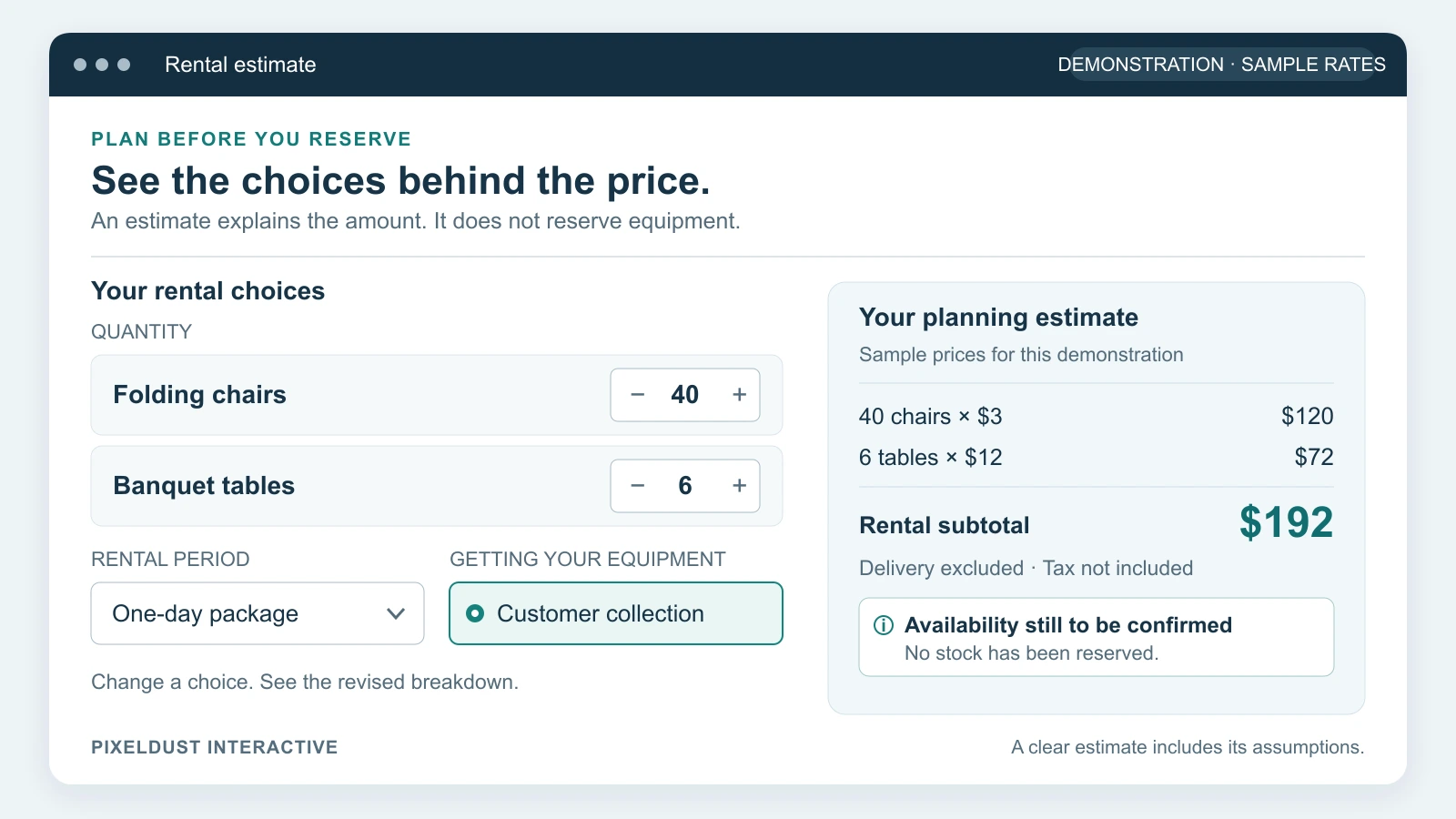
A customer asking what it costs to rent equipment is not necessarily ready to reserve it. They may be deciding whether to collect it themselves, shorten the rental, change the quantity, or abandon the idea. I want the website to help with that decision before it asks for a name and phone number.
A useful calculator explains the price it produces. If it hides the assumptions or implies that equipment is reserved, I would rather publish a clear rate table. Adding arithmetic to a website should reduce uncertainty, not make an uncertain answer look official.
The price and the reservation are different questions
The Bryan-College Station Chamber directory includes event equipment rental, establishing a real local business segment. Texas A&M's Outdoor Adventures rental information also shows how equipment prices can vary by rental duration and customer category. Those sources provide context, not evidence of a problem with either organization.
Consider a hypothetical independent Bryan rental business supplying tables and chairs for a College Station gathering. A visitor wants a planning amount for a quantity, a date range, and either collection or delivery. The website can calculate a useful estimate without claiming that stock has been checked or an order accepted.
I would label those boundaries beside the result: estimated rental charge, selected dates, what is included, and availability still to be confirmed. A heading that says Your reservation is ready would be wrong unless the reservation system has actually accepted it. A calculated price does not establish that a particular item exists in inventory.
I ask for the rate sheet before the screen design
My first working document would be a small set of approved pricing examples, prepared with the person who quotes rentals. I need to know what a rental period means. Is it a calendar day, a specified number of hours, or a weekend package? When does another charge begin? The website should use the business's actual answer.
Next I separate charges that customers often confuse. Equipment rental, delivery, setup, optional accessories, applicable taxes, and a refundable deposit may affect the amount someone needs to plan. I would show their treatment explicitly. A deposit should not quietly appear as part of the rental price, then be described differently during collection.
For the hypothetical business, delivery might depend on an approved zone and order minimum. I would not invent a distance formula simply because mapping software can calculate mileage. If the dispatcher works from a zone schedule, that is the rule to implement. Locations outside those zones can receive a clear request for staff review.
Pixeldust Interactive's custom website quote calculator development starts with those pricing factors and exceptions. I recommend building the smallest set of dependable rules first. A polished interface cannot repair a rate sheet that staff interpret differently.
Let the customer see what changed the amount
I would let a visitor adjust quantities and rental dates, then see the revised breakdown without losing their selections. Each question should earn its place by changing the estimate or its eligibility. Asking for the event's entire history before showing a planning amount defeats the purpose.
The result should repeat the choices in ordinary language. For example, show the selected chair quantity, rental period, collection choice, and any excluded service. This is an illustrative configuration, not a price for an actual supplier. If setup is excluded, I would say that beside the amount rather than bury it in a footer.
Where an unknown genuinely changes the cost, I prefer a defensible range or a request for clarification. A range should reflect defined alternatives, not an arbitrary percentage added to look cautious. If access conditions require an inspection, the page can explain that and preserve the customer's other answers for the conversation.
On a phone, I want readable quantities, persistent labels, and a breakdown that does not disappear below a sticky button. I would keep the estimate available without requiring an email address. Contact details become useful when the customer chooses to request confirmation, not as the admission price for understanding the service.
The browser can preview; the server must verify
Fast updates in the browser make comparison easier. Before an estimate is stored, emailed, or connected to payment, I would have the server validate the inputs and calculate the result again from approved rules. A price submitted by a browser is information to check, not an amount to trust.
OWASP's input-validation guidance distinguishes valid formats from values that make sense together. For this calculator, I would check permitted item identifiers, quantities, dates, and valid combinations. Negative quantities, an end before the start, or an unavailable delivery choice need understandable correction.
I also want one owner for rate changes and a version recorded with each saved estimate. Otherwise, a customer can return with yesterday's amount while staff see today's rules and neither side can explain the difference. The record should retain the inputs, rule version, breakdown, and stated limitations without collecting unnecessary personal information.
Prove the arithmetic, then prove the usefulness
Before launch, I would compare the calculator with staff-approved examples: one item, a large quantity, the minimum delivery order, a longer rental, an invalid date, and a combination requiring manual review. I would test rounding and rate changes deliberately. The expected answer should be written down before the software supplies its answer.
Ask a provider who updates rates, how old estimates remain explainable, whether availability is connected, and what happens when that connection fails. I would measure how often staff correct the displayed estimate, which assumptions customers misunderstand, and whether requests arrive with useful configurations. More calculator starts alone would not persuade me that the feature is helping.
For a College Station business with a handful of fixed packages, I might recommend a comparison table and a clear contact path. A custom calculator earns its cost when repeatable combinations create real quoting work and someone can maintain the rules. That is the business decision I would settle before adding more software.
Would a calculator make your pricing easier to understand? Send me the rental or service choices your customers struggle to price. I can help decide whether a rate table, a guided estimate, or a more connected quoting system is the sensible next step.