
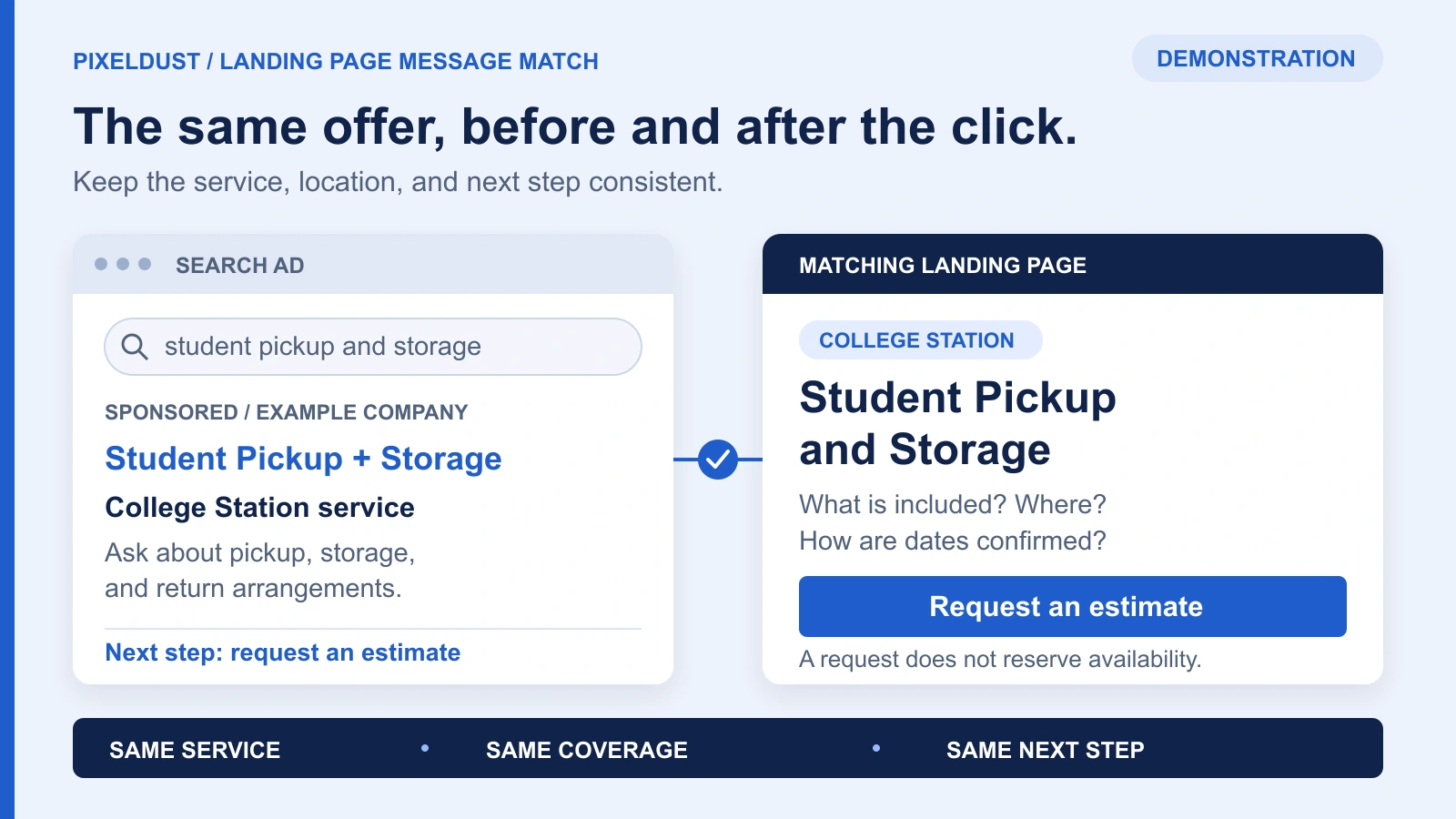
If you are paying to advertise student moving, I want to see the page a student reaches after the click. A homepage that says you handle every kind of move may be accurate. It still leaves someone asking whether you handle their particular combination of boxes, dates, pickup, and storage.
I call this message match: the page continues the specific promise that earned the click. My first job is to find where that promise changes, becomes vague, or asks the customer to start the search again.
I put the advertisement beside the page
I begin with a plain comparison. What service did the advertisement offer? Where? What did it say would happen next? Then I open its actual destination on a phone and look for those same answers. A visual redesign comes later, if it is needed.
Google's landing-page guidance recommends aligning the destination with the advertisement, keywords, and requested action. That supports a practical distinction: repeating a search phrase is not enough. The page must let the customer pursue the offer they understood.
For the following hypothetical example, imagine a College Station moving company advertising pickup and short-term storage. Its advertisement leads to a general page headed Residential and Commercial Moving. Storage appears much farther down, and the main button says Book Your Move. I would question that handoff before changing the campaign budget.
The local calendar is a reason to be precise
Student moves provide a useful local example, but the academic calendar must not become an invented emergency. Texas A&M's current winter-break guidance says residence-hall students do not need to remove their belongings for the break, although access closes and students should take what they need.
I would therefore reject an advertisement suggesting every resident must arrange winter storage. The business may have a useful service for someone changing accommodation or arranging a genuine pickup. It needs to describe that situation honestly. I would also avoid extending residence-hall guidance to privately managed apartments with different agreements.
This is why I ask the owner to approve the offer before drafting the headline. A persuasive page built around a false assumption creates the wrong inquiries. Local relevance should help someone recognize their circumstances, not manufacture pressure.
I organize the page around one buying decision
For that hypothetical pickup-and-storage offer, I would place the service, coverage, and next step together near the top. The customer should be able to tell whether pickup is included, whether storage is actually provided by the moving company or a partner, and whether the next action requests an estimate or reserves anything.
I would then explain the decisions that affect suitability: accepted items, access restrictions, the storage period, return arrangements, and how the business determines price. These are facts the owner supplies. I would not invent a starting price or promise availability to make the design look complete.
A button labeled Request a Pickup and Storage Estimate sets a different expectation from Reserve My Space. If staff must review the job first, I want the first label and a clear description of the review. The page should not imply that pressing a button secures a crew or a storage unit.
Useful proof belongs next to the concern it answers. An approved photograph showing how items are packed can clarify handling. Genuine service details can clarify responsibility. I would not fill the page with unrelated awards or manufacture a testimonial for this particular offer.
One focused destination does not require a second website
Pixeldust Interactive's Google Ads landing page design service connects the advertised offer with a focused customer path. I usually want that page inside the existing website when its content system can support the layout. Shared styles, familiar branding, and one publishing process make ordinary maintenance easier.
A dedicated layout can reduce competing promotions while retaining clear business identity, necessary policies, and a useful way to get help. I would not hide essential information merely to make the screen look simpler. Focus means fewer irrelevant decisions, not less accountability.
I check the final campaign URL, redirects, and mobile destination together. Google also documents that the landing page and displayed URL must share a domain. A convenient external page builder can create extra domain, branding, and tracking decisions that the owner must understand before launch.
For the first implementation, I would keep the offer fixed rather than automatically inserting arbitrary search words into the headline. Dynamic text adds rules for fallback wording, unsupported services, and testing. It is worth considering only after the business can maintain those rules reliably.
I agree on the evidence before sending more traffic
Before release, I test the actual mobile path with the owner: read the offer, check an exclusion, request the estimate, and understand the confirmation. I verify that optional details stay optional and that a person can recover from a missing answer without losing everything already entered.
Then I compare the advertisement and page again. Any price, date, coverage statement, or response promise needs an owner who will keep it current. I ask a provider who controls those shared facts, how an expired offer is removed, and how the destination will be checked after a campaign edit.
For evaluation, I want the number of relevant inquiries alongside staff feedback about why unsuitable requests arrived. I would watch one meaningful change at a time and allow for small samples and seasonal demand. A higher inquiry count is not success if most people expected a service the company never offered.
Sometimes I would repair the existing page
If your current service page already describes the exact offer and provides a usable next step, I may recommend a clearer heading, a better destination URL, or a campaign correction instead of a separate page. A landing page cannot supply missing crew capacity, fix irrelevant targeting, or make an unwanted offer useful.
For a College Station business, I use this approach to connect the customer you intended to reach with the service you can responsibly deliver. If that connection is unclear, send me the advertisement and its destination through the project inquiry. I will start with the promise the customer saw.