
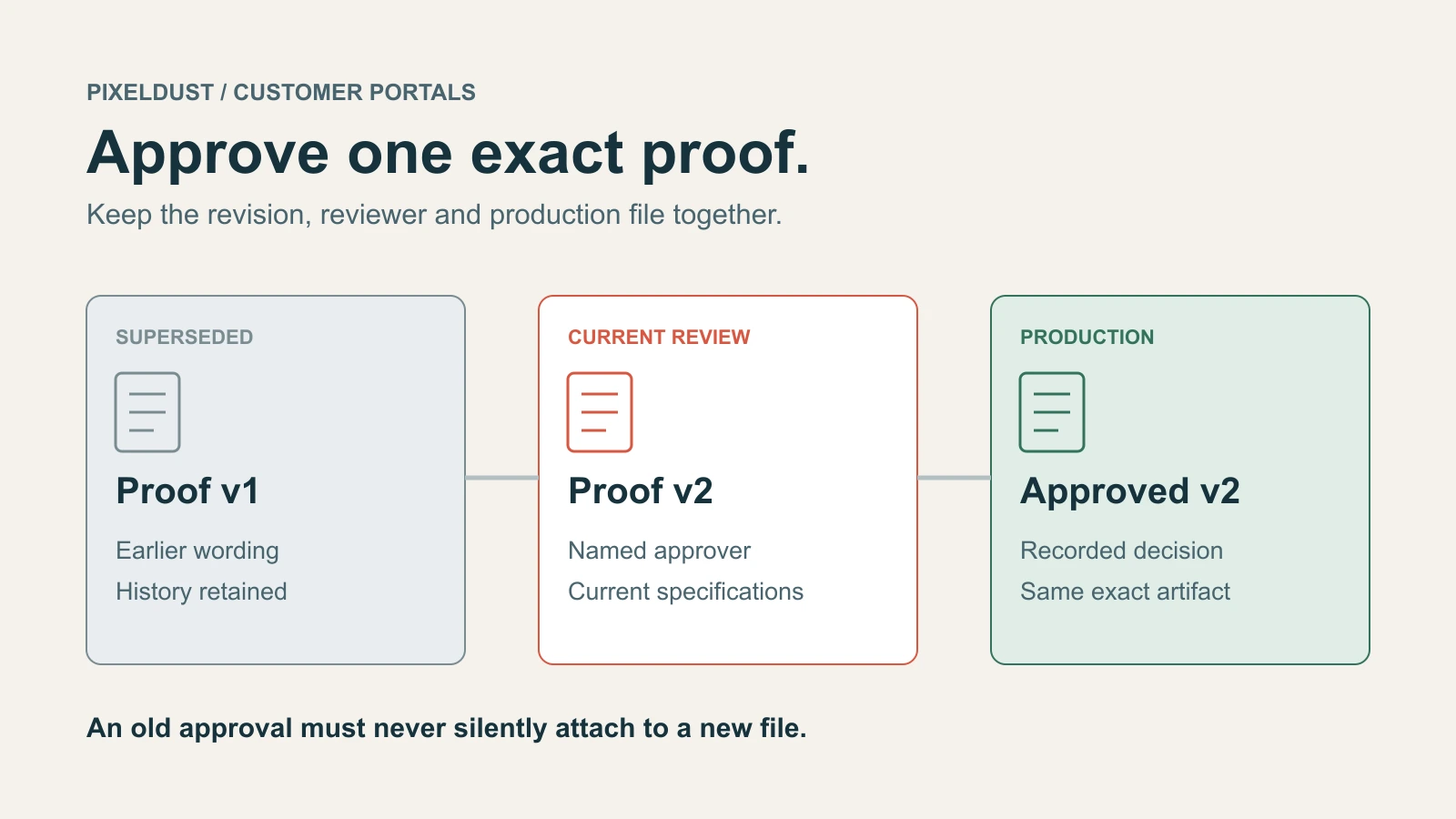
If a customer approves artwork, I want everyone to know exactly what they approved. A reply saying “looks good” is difficult to rely on when several files, revised quantities, and an older email thread are all still in circulation.
A customer portal can help, but the login screen is not the solution. I start with the approval itself: which proof, which specifications, which person, and which next action become valid when someone accepts the work?
One order can contain several different approvals
Local print and merchandise suppliers have an especially relevant example. Texas A&M's licensing information describes licensed vendors and its requirements for branded merchandise. A customer's acceptance of a design does not replace any separate permission or approval the supplier needs to confirm.
Consider a hypothetical Bryan–College Station screen printer handling an order for a community group. The customer changes wording, the shop updates the proof, and someone forwards an earlier attachment to a different organizer. This example is not a Pixeldust client story or a claim about any real order.
I would first distinguish artwork approval, order details, payment status, and any required brand approval. They can be related without being the same state. A single green Approved label should not make unfinished checks disappear.
I attach approval to an immutable proof version
The proof needs a stable identity. I would keep the specific file and its associated revision, with enough information for the customer to recognize what they are reviewing. The record should include the relevant order specifications, not just an isolated image.
When the artwork changes, I create a new version and mark the previous one as superseded. I do not overwrite the file behind an old approval link. Otherwise, the system could display today's artwork beside a decision someone made about yesterday's design.
The approval action should identify the version being accepted. If someone opens an older link after a revision, the page needs to explain that the proof has changed and take them to the current review. Staff should also be able to see the version history when a question arises.
The customer needs a small, understandable task
I would put the current proof, relevant specifications, and the decision together. The customer should be able to approve that version or request a change, with plain language explaining what each action means. Comments need to remain connected to the version they describe.
For our example, the portal might show the approved wording, placement, item choice, and quantity as the business defines them. If a detail is still unresolved, I want the page to say so. A preview is useful, but the supplier must explain its limits, including anything a screen cannot accurately establish.
I would test the review on a phone and provide a readable alternative when a detailed proof needs a larger view. A control that technically works but makes small text impossible to inspect is not a dependable approval experience.
Knowing the customer is not enough
The business needs to decide who may approve an order. The person who requests a quote may not be the person authorized to commit to production. An organization may also need more than one reviewer before a decision is complete.
I would map those roles with the owner rather than assume every invited user has the same authority. OWASP's authorization guidance recommends validating permissions on every request. In a portal, hiding another customer's button is not enough; the server must enforce access to the order, proof, and approval action.
I also plan for changed contacts, revoked invitations, and account recovery. A forwarded link should not automatically grant authority to make a consequential decision. The appropriate access method depends on the workflow and the sensitivity of the files.
Production needs the same approved artifact
The portal should record the decision, the proof version, who acted, and when. If another system manages production, I want that handoff to identify the same artifact and specifications. Staff should not have to guess which attachment an Approved status refers to.
I check repeated clicks, interrupted requests, and a revision arriving while someone is reviewing. The application should reject an approval for a superseded version rather than silently accept a stale decision. Retrying an interrupted action must not create a second production instruction.
Uploaded artwork also needs controls. OWASP's file-upload guidance covers issues such as allowed file types, storage, and access. I would define suitable limits, validation, and retention with the business instead of making an unrestricted public upload folder.
I would prove the workflow before commissioning a platform
Pixeldust Interactive's customer portal development service starts with a complete customer task and the staff operation behind it. For proof approval, I would prototype the actual decision before adding dashboards, account features, or integrations that do not improve that task.
An existing proofing service may already handle the job. I would compare its version history, access controls, export options, ongoing cost, and connection to production before recommending custom development. A small shop with a clear, low-volume process might need a better documented handoff rather than another system to maintain.
Ask a provider to demonstrate an outdated proof, a change request, an unauthorized user, a contact leaving the organization, and a failed production handoff. Then measure time to approval, clarification messages, production holds, and work repeated because the wrong version was used.
For College Station and Bryan suppliers, the useful result is not more activity inside a portal. It is a customer who understands the decision and a team that can produce the exact work that decision authorized.
Describe what customers approve and what your team needs next. I can help determine whether a focused portal or a simpler proofing process fits the business.