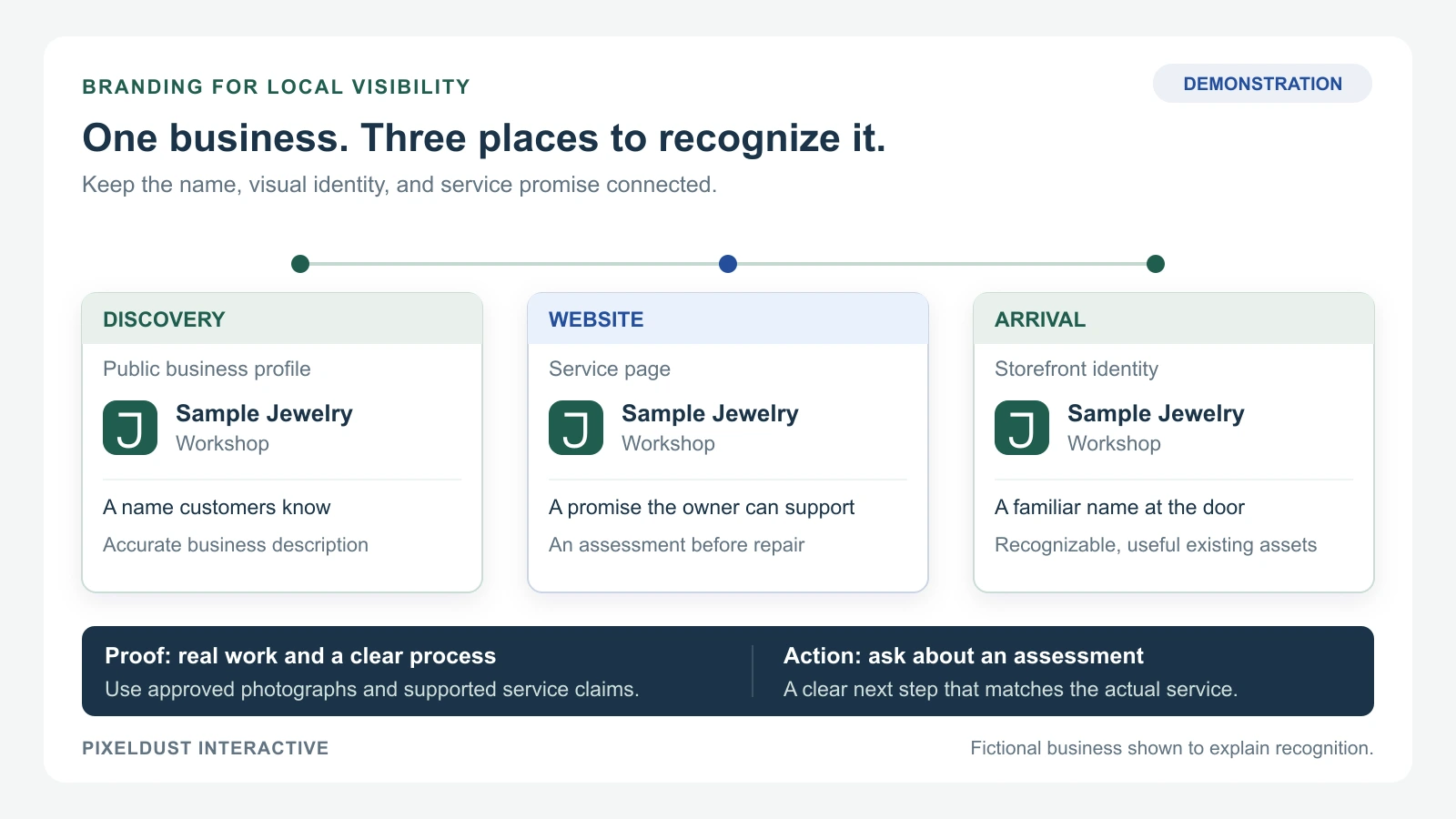
Someone recommends your shop. A customer searches for it, opens the website, and eventually stands outside the door. I want those moments to feel connected. If the name, appearance, or explanation changes at each step, you are asking the customer to decide whether they have found the same business.
For an established local company, I would check that recognition before proposing a new logo. Brand development can make the identity clearer and easier to use. It can also discard something customers already recognize if the project starts with a desire to make everything look new.
I follow one recommendation from the customer's side
The Bryan-College Station Chamber includes retail jewelers, providing real local context for this example. Imagine a hypothetical independent jewelry-repair shop serving Bryan and College Station. This is an illustrative business, not a description of the listed jeweler or a claim about its services.
A customer wants help with a damaged clasp on a meaningful piece. They may be comparing whether the shop handles that kind of work, whether someone will inspect it before giving a price, and whether they feel comfortable bringing the item in. A decorative slogan about timeless excellence answers little of that.
I would put the storefront sign, current business profile, website header, and main service explanation beside each other. Then I would ask an unfamiliar person what the company is called, what help it offers, and whether these materials belong together. I am looking for specific confusion, not asking whether they prefer green or blue.
Keep the part people already know
If the existing name and sign are recognizable and fit the work, I would begin there. The useful project may be a clearer service message, a readable website logo, and a consistent set of digital files. It does not automatically require replacing the identity across the building, packaging, and every customer document.
Google's Business Profile guidelines call for a name reflecting the real-world business as customers know it, with address, hours, and category in their appropriate fields. I would use the actual business identity rather than append a string of repair services and nearby cities to the profile name.
The same principle helps the website. A shortened logo can be useful at a small size, but the full business name should still be clear. I would distinguish the identity from the description: the name tells me who you are; a nearby sentence tells me what you do. They should work together without turning the logo into a miniature brochure.
Where an old name remains familiar, I would agree on a deliberate explanation rather than let two identities compete indefinitely. A real rename needs coordinated customer communication. It is not a design-file replacement performed quietly on a Friday afternoon.
Make the service promise something the owner can defend
For the hypothetical shop, I would ask the owner which repairs are assessed in person, which work is performed there, and which cases need another specialist. Those answers shape the message. I would not write in-house restoration if the actual arrangement is to send certain jobs elsewhere.
A useful opening might explain that the shop inspects the item, discusses suitable options, and confirms the scope before work begins, if that is its approved process. That is more helpful than claiming every repair is simple or promising a turnaround the business cannot consistently support.
I would carry that same considered tone from the profile description into the service page and inquiry confirmation. The words need not be identical. The promise must be. A friendly profile followed by a website full of inflated claims makes the customer reconcile two versions of the business.
Pixeldust Interactive's brand development service covers positioning, messaging, visual identity, and practical digital guidance. For an existing local shop, I would scope that work around the uncertainty customers face. A focused messaging and identity refresh may do more useful work than a complete redesign.
Show evidence that actually belongs to this business
I would choose a small set of genuine photographs that answer a visitor's questions: the public entrance, the person receiving an item if they agree to appear, and approved examples of the shop's work. Google's business-photo guidance describes exterior images as a way to help customers recognize a business on arrival and says images should represent reality.
For jewelry, permission and discretion matter. Before publishing a customer's item, I would agree what may be shown and remove identifying paperwork or personal details from the frame. A before-and-after example should identify the actual work performed and avoid suggesting that every similar-looking item will have the same result.
I would not use an AI-generated workshop as evidence of the shop's premises or equipment. A diagram can explain a process when it is clearly presented as a demonstration. Photographs claiming to show the actual business need to show the actual business.
The proof should sit near the decision it supports. A clear explanation of how an assessment works belongs beside the repair inquiry, not hidden in an unrelated gallery. Customer quotations should retain their meaning, have appropriate permission, and describe genuine experiences rather than become invented endorsements.
Give the next editor a system, then test recognition again
I would hand over the approved business description, service claims, usable logo variants, colors, type choices, and a small photo library with permissions noted. Someone needs to own changes to those materials. Otherwise, a future supplier can unintentionally introduce another name, style, or unsupported promise.
Ask a provider which existing assets they recommend keeping, which customer confusion each change addresses, and how the identity works in a small profile image and a mobile header. I would also ask what is included in the website and profile updates. Brand files alone do not update public pages.
After the changes, I repeat the recognition exercise. Can someone connect the recommendation, profile, website, and entrance? Can they explain what happens next without assuming the repair is already accepted? Staff can also track name confusion, unsuitable inquiries, and repeated questions. Those observations are more useful than treating every new website visit as proof of improved trust.
I would not promise a search ranking from a consistent color palette. My aim is to make a real local business easier to recognize and understand wherever a customer encounters it. Show me where your website and public identity feel disconnected, and I can help determine whether a focused correction or broader brand work is justified.