
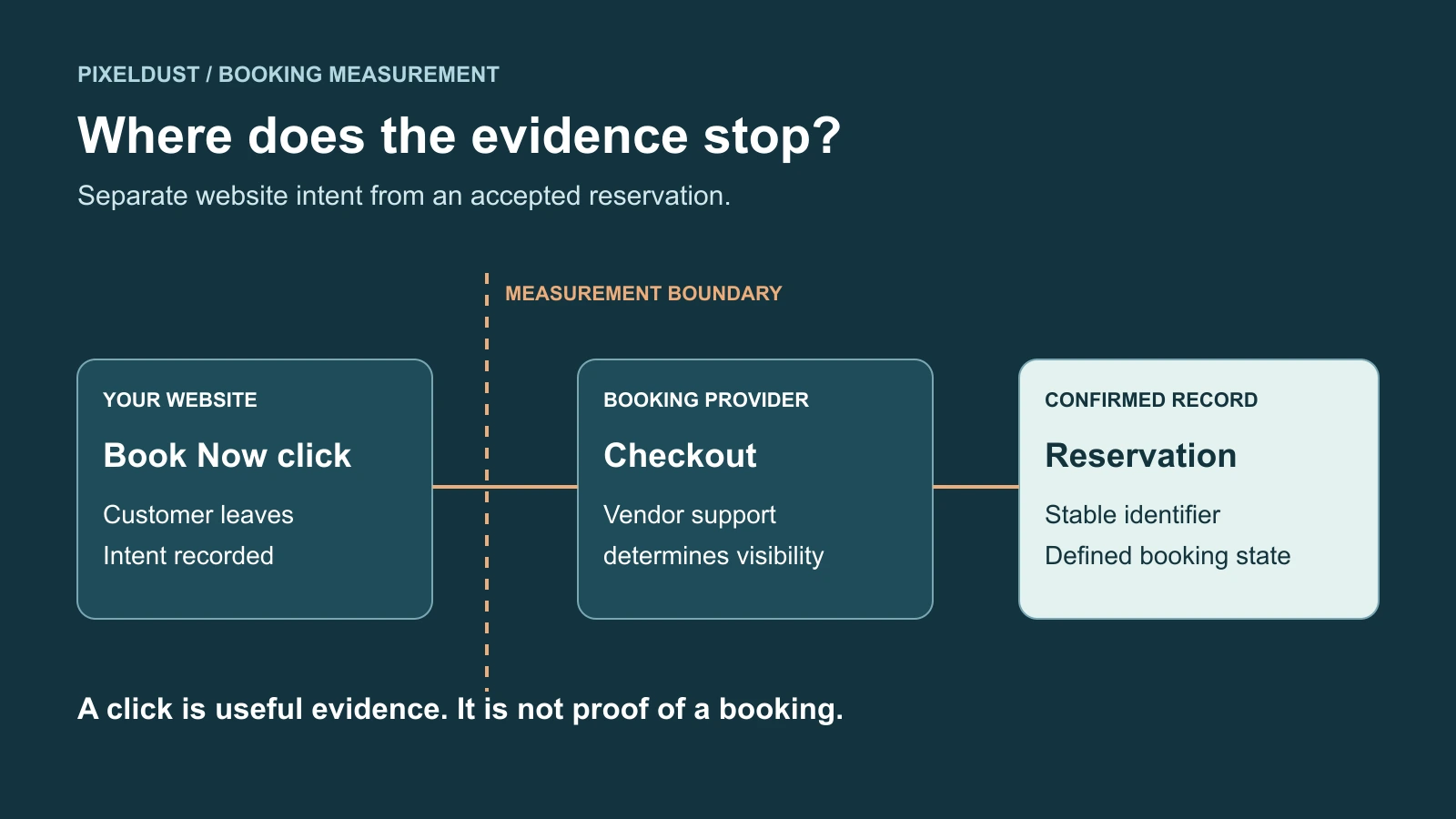
If your website sends a guest to another company to finish a booking, I want the report to admit where its knowledge ends. A Book Now click shows intent to leave the page. It does not establish that a room was reserved, paid for, or kept after cancellation.
Before I recommend more advertising or a new booking engine, I map that boundary. Otherwise, a perfectly ordinary handoff can look like abandonment, and an enthusiastic click count can look like revenue. Both can lead an owner toward the wrong decision.
Draw the journey before opening the analytics settings
Visit College Station's lodging directory lists hotels, motels, and extended-stay properties. It establishes a varied local lodging market, not the performance of any property's website. My example is a hypothetical independent lodging operator using a separate hosted reservation system.
I would draw four steps with the owner: room information on the website, availability search, reservation checkout, and the reservation system's confirmation. Beside each step, record the domain, the provider, and who can change its tracking configuration.
That simple drawing often answers the first practical question. Does the business control both ends of the journey, or does the website hand a visitor to a marketplace where the owner cannot install its analytics tag? Those are different measurement projects and should receive different promises.
Keep three different outcomes separate
I would distinguish an availability search, a click to the reservation provider, and a confirmed reservation. The first two can be useful indicators. I do not rename either one Bookings just to give a dashboard a more satisfying number.
The final event needs an agreed definition from the booking system. Is it a completed reservation, a deposit, or a paid stay? If a room is held while payment remains pending, the website report should not quietly turn that state into collected revenue.
My starting measurement sheet records the event, the exact trigger, the owner, and the report label. For a small property, that may be more useful than a large dashboard. It makes disagreements visible before they become several months of misleading comparisons.
Cross-domain measurement depends on the destination
Google's cross-domain setup guidance describes connecting activity across separate domains using the same web data stream's tag and a linker parameter. I first ask the reservation vendor whether its supported integration can participate. Access to the hotel's website alone is not enough.
Where the integration is supported, I check the actual route to checkout, including redirects. The customer still needs to arrive with their selected dates and room information intact. A tracking change that breaks booking is a failure even if the event appears in a report.
I would not paste analytics code into a vendor field without knowing what the field does. Some providers already fire completion events; others offer only a tag identifier or a constrained integration. Duplicate installations can create confusing results. I want the vendor's implementation instructions and a testable agreement about which system emits each event.
If the business cannot measure inside the destination, I keep the outbound click as an explicitly limited metric and look for a supported reservation export or source report. I would rather present an honest boundary than claim a continuous customer journey the available systems cannot establish.
A confirmation page is not automatically one reservation
A guest may reload the confirmation page or return to it later. For an implemented purchase event, I check that the same reservation is not counted again merely because the page appears twice. Google's transaction-ID guidance explains purchase deduplication using a unique transaction identifier.
I want a stable, non-personal identifier from the actual reservation, not a fresh random value every time the page loads. I also check how a test reservation is identified so it does not quietly contaminate ordinary reporting. An identifier that reveals a guest's email or other personal information is inappropriate for this purpose.
Value needs the same care. I ask whether the reported amount represents a deposit, total room charge, taxes, or another figure. Then I label the report accordingly. A cancellation or refund needs a defined treatment instead of an assumption that every original booking remains a sale forever.
I compare the report with the reservation system
For a controlled test, I would follow one known booking from the website through the vendor's supported test process. I check the starting source, the destination, the completion event, and what happens on reload. Then I compare the result with the corresponding reservation record.
I also test an abandoned checkout and a return without completion. Neither should create a confirmed-reservation event. Browser settings, consent choices, and tracking restrictions can limit observable activity, so I would not promise a one-for-one match between analytics and every operational booking.
The reservation system remains the operational record. Analytics helps explain how observable website journeys contribute. I compare the same reporting period, timezone, status definitions, and value basis before interpreting a gap. An unexplained difference deserves investigation; it is not automatically proof that the website lost business.
Pixeldust Interactive's Google Analytics and conversion tracking setup service can map these events and verify supported handoffs. For a College Station lodging operator, I would begin with one reservation path and one decision the owner needs to make, such as whether a campaign brings completed bookings rather than availability clicks.
Buy the measurement you can use
Ask a provider which domains it can configure, what the booking vendor supports, what proves completion, how duplicates are handled, and where the report will remain incomplete. Have those limits written beside the proposed outcome.
If the property receives few direct bookings or its marketplace already supplies the report the owner needs, custom cross-domain work may not earn its upkeep. I would start with clear outbound measurement and a regular comparison with vendor records. Better measurement should make a business decision more defensible, not make ordinary uncertainty disappear behind a prettier chart.
Show me your website and reservation provider. I can help establish the measurable path, its limits, and the smallest useful tracking setup.