
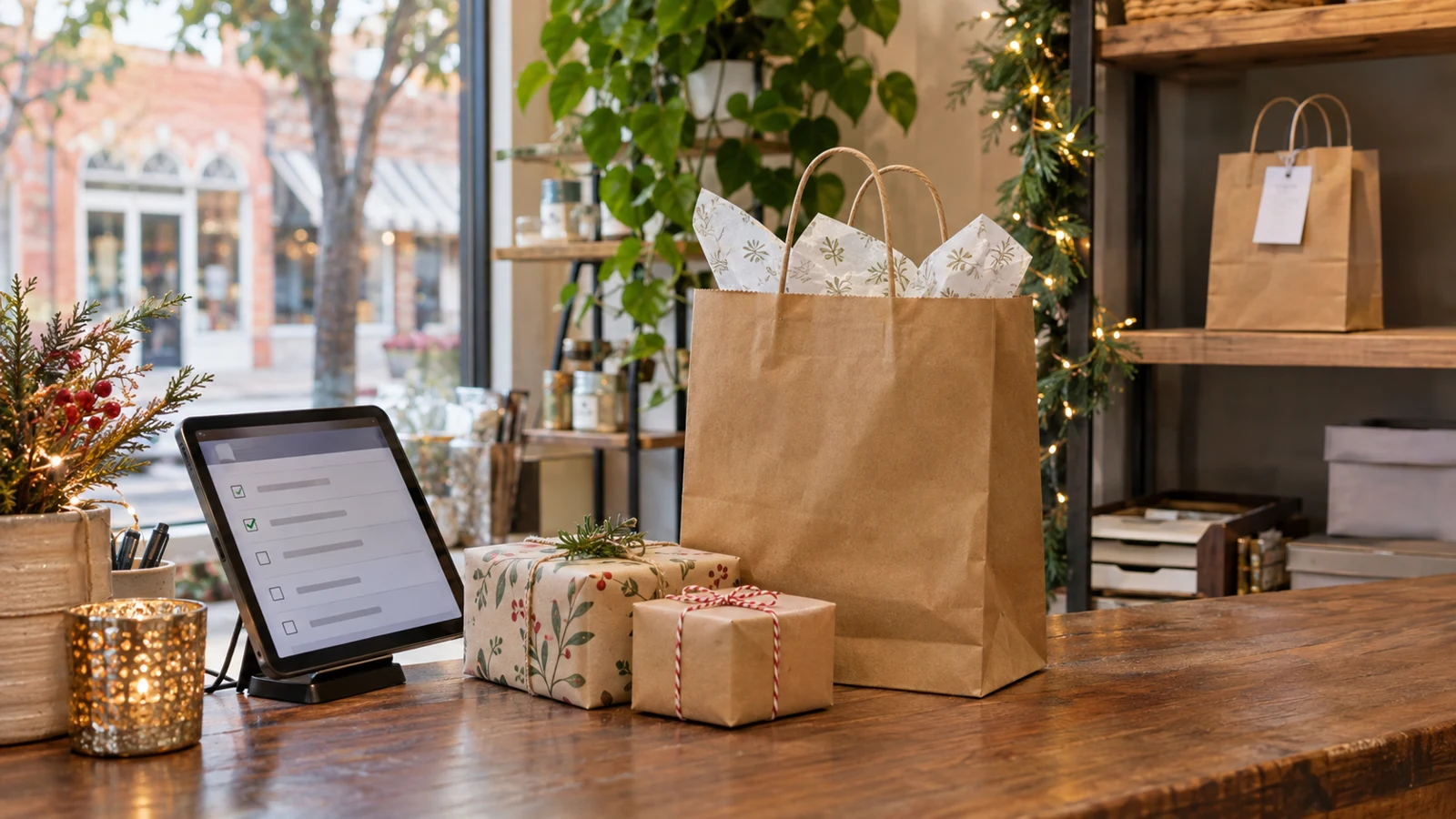
If I am helping a shop add online pickup, I start at the counter. Who notices the order? Who pulls the right item off the shelf? Where does the bag wait? Those questions tell me more about the project than the color of the checkout button.
A customer paying online has completed a transaction. Your staff still have a job to do. My aim is to make that handoff dependable without turning a convenient service into another inbox everyone assumes someone else is watching.
Holiday shopping makes the handoff worth planning
The City of Bryan’s 2026 holiday announcement puts the start of downtown’s seasonal lights on November 20. Destination Bryan lists the Jingle Bell Sip & Shop on November 21, from 3–8 p.m., with participating shops staying open late.
Those events give local retailers a timely reason to check how online and counter service fit together. They do not prove that any particular shop needs ecommerce. I see pickup as useful when customers want to secure an item before making the trip, and the business can reliably prepare it. Special-event opening hours also make a good test: does the website explain when collection is actually available?
I separate “order received” from “come get it”
Consider this illustrative example: a College Station customer orders a gift from a Bryan shop before driving downtown. The payment email arrives immediately. The only employee on duty is helping people in the store, so nobody has checked whether the gift is still on the shelf.
I would make the first message acknowledge the order and explain the preparation window. A separate message should tell the customer the bag is ready. I recommend putting that distinction beside the pickup choice, not hiding it in a policy page.
Shopify’s pickup documentation describes location-specific setup, processing times, pickup instructions, and separate ready-for-pickup and collected stages. I use those supported settings before considering extra code. Enabling them is only the start; staff still need a clear rule for when each stage changes.
The last item deserves an honest answer
For a shop selling the same products online and at the counter, I check how both channels affect available stock. A product existing in the catalog does not establish that its exact size, color, or edition is available at the collection location.
In our example, an online shopper and a walk-in customer could both want the last gift. I would test that situation with the actual point-of-sale connection. I also ask how staff handle damaged items, display stock, and products already set aside. If those changes never reach the inventory system, a new theme will not solve the problem.
My first release might limit pickup to a manageable collection of reliably tracked products. Where counts are uncertain, an inquiry or explicitly unconfirmed reservation request can be more honest than taking payment against an assumption. I would not describe a reservation as a completed purchase.
Give the order a place and a person
I map the staff routine from the moment the order arrives: review it, find the item, check the variant, pack it, label it with a useful order reference, and move it out of saleable shelf stock. Then send the ready message. I want one named role responsible during each shift and a backup when that person is unavailable.
The pickup instructions should identify the correct location, collection hours, what the customer should bring, and how to contact the shop. I avoid promising curbside delivery unless the team can actually leave the counter. Holiday opening hours and pickup staffing may differ; I make that difference visible.
I also agree on how long an uncollected bag will be held, who handles reminders, and what happens if someone requests a cancellation or sends another person to collect it. Staff need an agreed verification method. Customer details should stay behind the counter rather than on publicly visible bag labels.
What I change and what I leave alone
Pixeldust Interactive’s Shopify development service includes storefront, catalog, inventory, pickup, notifications, and staff workflows. My recommendation starts with the existing store: can its supported features do the job with clearer settings, better product information, and a workable handoff?
I would not migrate a functioning store just to add a collection option. An extra app earns its place only if it handles a real gap, such as a necessary scheduling rule, and its plan compatibility, access to customer data, recurring cost, and maintenance are understood. A custom integration creates another system someone must monitor.
For a shop with very few requests, keeping a clear contact route may be sufficient. For a retailer repeatedly fielding availability calls and handling predictable pickup demand, a connected checkout can remove work. The useful comparison includes staff preparation time and exceptions, not just delivery charges saved.
I rehearse the awkward order before launch
I ask someone who did not configure the store to complete the customer journey on a phone. Can they find the pickup option, understand the preparation time, identify the location, and distinguish the payment email from the ready message? Then a staff member follows the order through packing and collection.
My test set includes an out-of-stock variant, a near-closing order, a missed notification, a cancellation before collection, and an order that remains uncollected. If the store sells through several channels, I check each channel’s notification behavior. I want evidence that the right message arrived, not merely that a setting was enabled.
Before hiring a provider, ask who maintains pickup rules, how stock changes reach checkout, what happens if the connection fails, and whether staff receive training and a written fallback. Ask them to demonstrate the difficult cases using your actual setup.
Judge the result at the counter
During a small pilot, I would record preparation time, orders ready within the promised window, stock-related cancellations, customers arriving before notification, and staff corrections. Compare those with the previous process. More online orders are not a complete success if every one creates three phone calls.
That is how I approach local pickup for College Station and Bryan businesses: make the customer promise clear, give staff a routine they can maintain, and expand only when the first version works. The software should help the shop keep its word.
Tell me how your shop currently handles pickup orders. I can help identify the smallest useful improvement in the store, the stock connection, or the staff handoff.