
I’ve spent years reviewing contracts that cost organizations millions in unexpected liabilities.
The pattern is always the same.
Someone signs what looks like standard boilerplate language. The project starts. Then the invoices arrive, the disputes begin, and suddenly you’re defending a position you never agreed to take.
Here’s what I’ve learned: Those “standard” assumptions buried in your contracts are actively transferring risk from the seller to you.
And most buyers never see it coming.
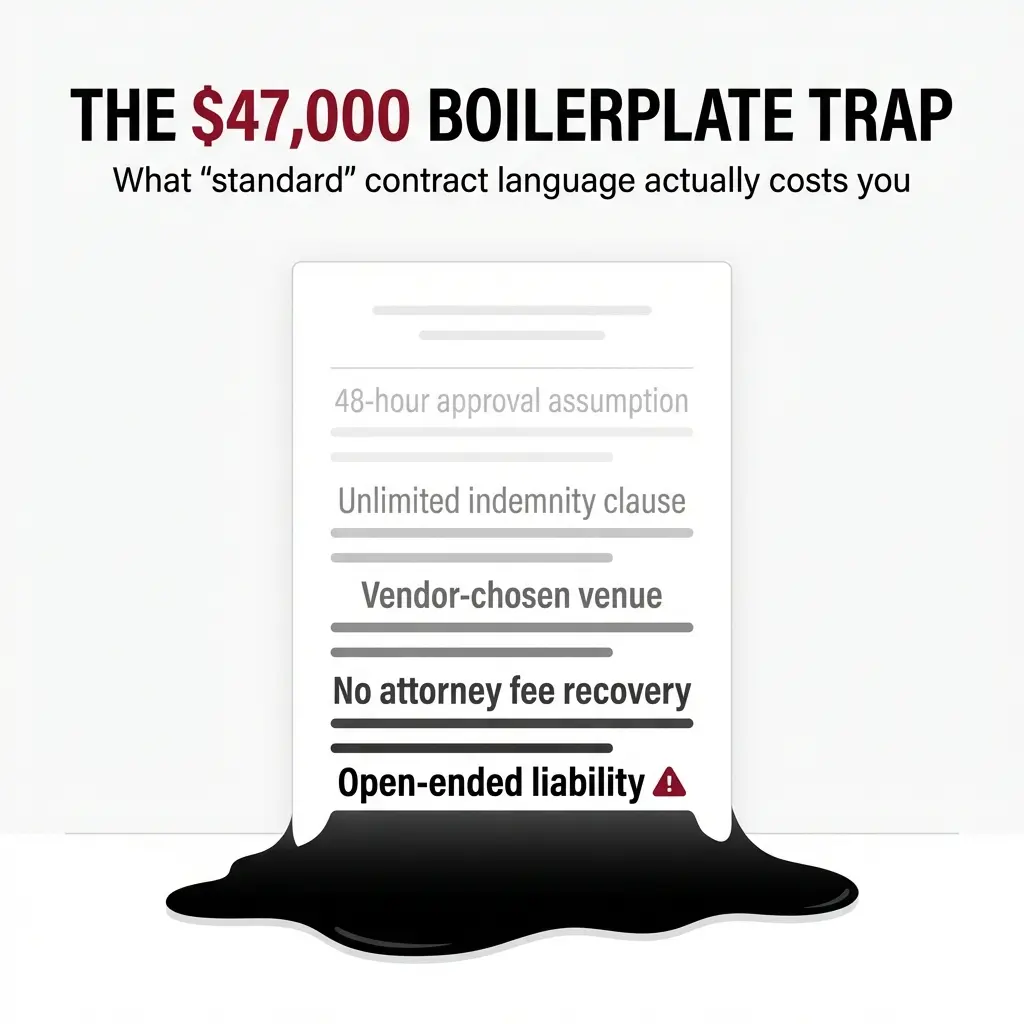
The $47,000 Lesson in Reading the Fine Print
A client once got hit with an additional $47,000 charge because their procurement process required five business days for approvals.
The vendor’s assumption clause specified 48 hours.
The contract supported the vendor’s position. The schedule risk transferred entirely to the buyer. The invoice stood.
This wasn’t a mistake. This was standard contract language working exactly as designed.
The vendor’s legal team wrote assumptions that protected their timeline, their scope, and their budget. The buyer’s team skimmed past it as boilerplate.
One party treated the assumptions list as a strategic document. The other treated it as background noise.
Guess who paid the price.
Why Organizations View Boilerplate as Harmless
I see this misconception everywhere.
Organizations view boilerplate clauses as non-negotiable background noise, when they’re actually critical leverage points that directly impact contract outcomes and organizational risk.
The word “boilerplate” itself creates the problem. It sounds routine. Standard. Safe.
But here’s what actually happens:
Sellers use assumptions to shift risk as standard practice.
Research shows that some contractors purposely underbid projects, planning to recover costs through change orders justified by assumptions. Even well-intentioned vendors use assumptions to protect themselves.
And why wouldn’t they?
If you’re drafting a contract, you write language that protects your interests. You assume the other party will negotiate what matters to them.
The problem is that buyers often don’t.
The Real Cost of Scope Creep
Nearly 52% of projects experience scope creep, leading to an average budget overrun of 27%.
That scope creep often starts with assumptions that looked harmless but created unlimited client obligations.
Here’s how it works:
The vendor lists assumptions about data availability, stakeholder response times, approval processes, and technical environments. Each assumption shifts responsibility to you.
When reality diverges from those assumptions, the vendor has contractual grounds for additional charges.
You’re not paying for scope creep. You’re paying for assumptions you agreed to without realizing their implications.
I’ve seen assumptions that require:
- Client to provide data in specific formats within 24 hours
- All stakeholders to respond to vendor questions within 48 hours
- Technical environments to match exact specifications
- No changes to requirements after project kickoff
- Client to handle all third-party integrations
Each one sounds reasonable in isolation.
Together, they create a framework where almost any delay or complication becomes your financial responsibility.
The Hidden Liability Exposure You Never Agreed To
Indemnity clauses buried in boilerplate can require you to defend vendors against intellectual property infringement claims indefinitely.
This creates open-ended financial exposure.
According to a World Commerce & Contracting Report, the indemnification clause is one of the most heavily negotiated terms of a contract.
Yet it’s often buried in the “boilerplate” section where buyers overlook it.
I’ve reviewed contracts where a seemingly reasonable $50,000 cap on liability becomes catastrophic when actual exposure reaches $500,000.
The cap applied to direct damages. The indemnity clause covered indirect damages with no limit.
The buyer signed both provisions without recognizing the contradiction.
Business owners sign these agreements assuming terms are routine, only to discover too late that they’ve waived their right to a jury trial or limited the types of damages they can recover.
These are protections you never intended to give up.
The Attorney Fee Trap
Boilerplate contracts often include provisions where both parties bear their own attorney fees regardless of who prevails.
This sounds fair until you think through the implications.
If the vendor breaches the contract and you have to sue to enforce your rights, you pay your legal fees even when you win.
This unfairly costs the non-breaching party legal fees when they’ve done nothing wrong. It can be cost-prohibitive, leaving you with little recourse.
The vendor gets to breach the contract knowing you’ll think twice about the cost of enforcement.
I’ve seen businesses abandon legitimate claims because the legal fees would exceed the contract value.
That’s not justice. That’s strategic contract drafting that protects the party with deeper pockets.
The Venue Nightmare
Business owners have been forced to defend themselves hundreds of miles away after signing “standard” agreements with overlooked venue clauses.
You discover too late that any legal dispute must be litigated in another state.
This isn’t accidental.
Vendors choose venues that favor their position. They select jurisdictions where they have relationships, where the law tilts in their direction, or where the inconvenience alone discourages you from pursuing claims.
Geography becomes a weapon.
I’ve watched small businesses decide not to pursue valid breach of contract claims because traveling to another state for depositions and hearings would cost more than the contract was worth.
The venue clause accomplished exactly what it was designed to do.
Why This Keeps Happening
Some business owners never seriously consider risk allocation at all.
They expect their lawyers to draft the language themselves, under the misconception that indemnification clauses and waivers of consequential damages are just boilerplate that can be copied from one contract and pasted into another.
This approach has cost organizations millions.
The truth is that risk allocation is strategic. In a sale of goods agreement, the greatest risk is that the buyer will sue the seller for providing nonconforming merchandise.
That’s why seller’s counsel aggressively pushes for limitation of liability provisions while buyer’s counsel should resist.
Every clause represents a negotiation about who bears what risk.
When you treat boilerplate as non-negotiable background noise, you’re conceding that negotiation before it starts.
What You Can Do About It
I’m not suggesting you become a contracts attorney.
But I am suggesting you stop treating assumptions lists and boilerplate provisions as harmless.
Here’s what changes the outcome:
Read the assumptions list first. Before you review pricing or deliverables, read what the vendor assumes about your responsibilities. Each assumption is a potential cost center.
Question every liability cap. If there’s a cap on direct damages, look for indemnity provisions that create unlimited exposure for indirect damages. Make sure your actual risk is limited.
Negotiate venue and attorney fees. These provisions determine whether you can afford to enforce the contract if something goes wrong. Don’t sign away your practical ability to seek remedies.
Challenge the 48-hour approval assumptions. If your organization needs five business days for approvals, the contract needs to reflect that reality. Otherwise, you’re agreeing to pay for delays that are built into your process.
Get legal review on risk allocation. Not just contract review. Specific analysis of how risk is allocated and whether that allocation matches your understanding of the deal.
The Bottom Line
Standard contract language isn’t neutral.
It’s written by one party to protect their interests and shift risk to the other party.
When you sign without negotiating, you’re accepting that risk transfer as written.
The $47,000 surprise invoice, the unlimited indemnity exposure, the venue clause that makes enforcement impractical—these aren’t accidents or oversights.
They’re features of contracts that work exactly as designed.
The question is whether you’re going to keep treating boilerplate as background noise, or start recognizing it as the strategic document it actually is.
Because I can tell you from experience: the organizations that figure this out stop paying for assumptions they never meant to accept.
The ones that don’t keep getting invoices they never saw coming.