I’ve watched technical contracts fail for reasons that never appeared in the legal terms.
The vendor delivered on time. The code worked. The documentation checked every box. But the relationship still collapsed under the weight of something nobody thought to measure: cultural misalignment.
You can write clauses for delivery timelines, quality standards, and intellectual property. You can’t write a clause that fixes the friction when your team expects daily updates and your vendor thinks weekly check-ins show respect for autonomy.
The Hidden Risk Nobody Puts in the RFP
Here’s what I’ve learned: cultural fit isn’t a soft consideration. It’s a delivery risk that shows up as missed deadlines, scope creep, and teams that can’t make decisions together.
Research from McKinsey found that 50% of executives say cultural fit lies at the heart of value-enhancing mergers, and 25% called its absence the key reason a merger had failed. If culture matters that much when companies combine, why do we pretend it doesn’t matter when we hand critical projects to external partners?
The UK National Outsourcing Association put numbers to this. Clients who rated their outsourcing projects as successful gave organizational culture a score of 3.71 out of 5. The less successful projects? They rated culture at 2.69.
That gap isn’t just about feelings. It’s about outcomes.
What Cultural Misalignment Actually Looks Like
I’m not talking about whether your vendor serves coffee in the break room or celebrates the same holidays. Cultural alignment in vendor relationships shows up in operational rhythms and decision-making patterns.
Here’s where misalignment creates friction:
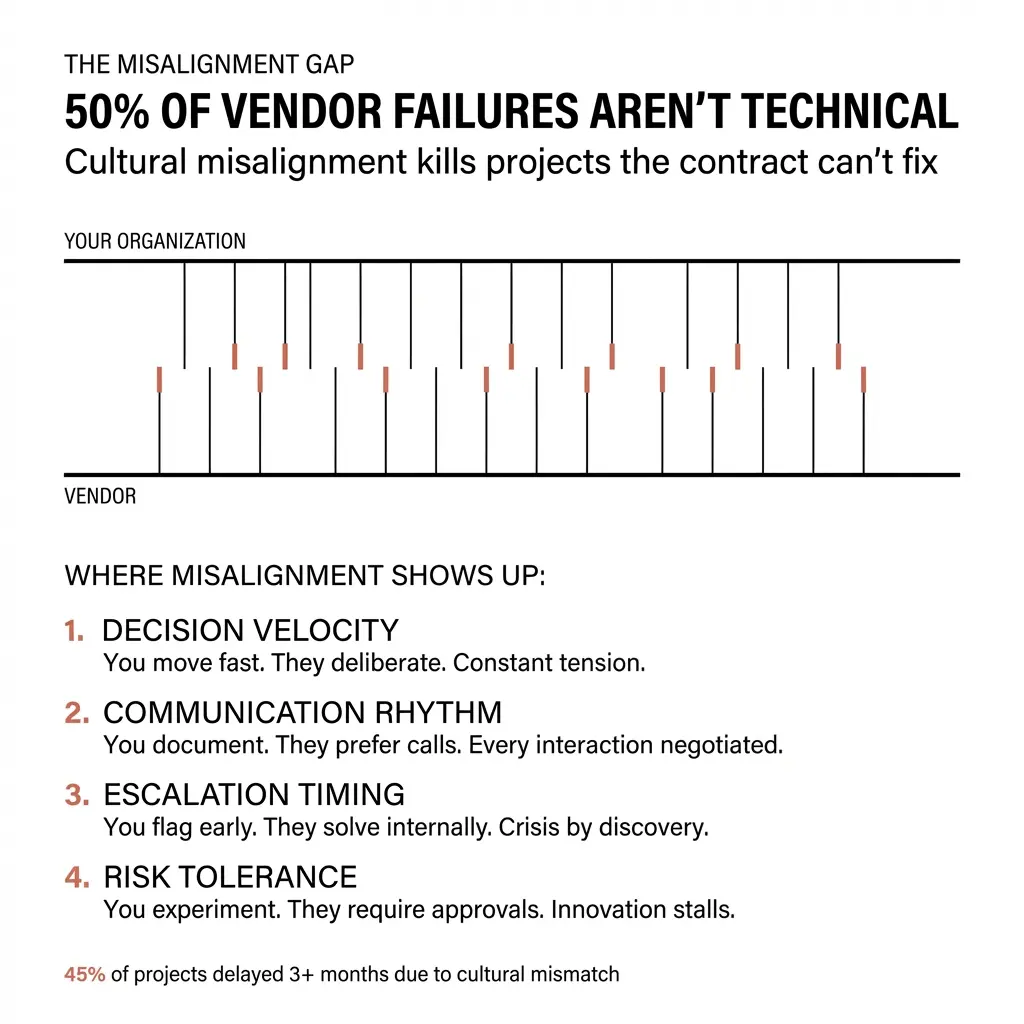
Decision velocity: Your team moves fast and expects vendors to match the pace. Your vendor built their process around deliberation and consensus. Neither approach is wrong, but the mismatch creates constant tension.
One team thinks the other is reckless. The other team thinks their partner is bureaucratic and slow.
Communication cadence: You prefer asynchronous updates and documentation. Your vendor expects real-time collaboration and verbal agreements. Every interaction becomes a negotiation about how to communicate instead of what to communicate about.
Escalation expectations: Your organization escalates problems early and often. Your vendor sees escalation as failure and tries to solve everything internally first. By the time you hear about an issue, it’s already a crisis.
Risk tolerance: Your culture embraces experimentation and accepts some failure as part of innovation. Your vendor operates in a risk-averse environment where any deviation from plan requires multiple approval layers.
These differences don’t show up in technical assessments. They emerge after the contract is signed, when teams try to work together and discover they’re operating from completely different playbooks.
The Cost of Getting This Wrong
In 2025, 45% of software outsourcing projects experienced delays of three months or more due to cultural mismatch.
Three months.
That’s not a minor scheduling hiccup. That’s budget overruns, missed market windows, and teams burning out while trying to bridge gaps that shouldn’t exist.
I’ve seen this pattern repeat: A vendor delivers technically sound work that completely misses the mark because they didn’t understand the business context. Not because they lacked technical skill, but because the cultural gap prevented them from asking the right questions or interpreting feedback correctly.
The research backs this up. Vendors who don’t align with your business culture struggle to understand your needs and expectations. This leads to miscommunication, delays, and poor-quality work. Eventually, you get project failure, budget overruns, and damage to your organization’s reputation.
The domino effect is predictable and expensive.
How to Assess Cultural Fit Before You Sign
You can’t eliminate cultural differences, but you can identify them early and decide if they’re manageable or fatal.
Here’s what I look for:
Decision-Making Architecture
Ask your potential vendor to walk you through how they made their last three significant project decisions. Not what they decided, but how they decided.
Who was in the room? How long did it take? What information did they need? What happened when they hit uncertainty?
Compare their answers to how your organization makes similar decisions. If there’s a massive gap in speed, autonomy, or required consensus, you’ve found a potential friction point.
Communication Patterns
Don’t ask vendors about their communication style. Watch how they communicate during the sales process.
Do they send detailed emails or prefer quick calls? Do they document decisions or rely on verbal agreements? How quickly do they respond to questions? What happens when you push back on something?
The way they sell is probably the way they’ll work with you.
Problem Escalation Philosophy
Present a hypothetical problem and ask how they’d handle it. Something like: “You’re two weeks into a four-week sprint and realize a core assumption was wrong. What happens next?”
Listen for when they’d tell you, who they’d involve, and what they’d need from your team. If their answer is “we’d figure it out and get back on track,” and your expectation is “you’d tell us immediately so we could decide together,” you have a fundamental mismatch.
Risk and Experimentation Tolerance
Ask about their biggest project failure and what they learned. Not to judge the failure, but to understand how they talk about risk.
Do they frame it as a learning experience or a mistake to avoid? Do they take ownership or deflect to circumstances? How did their organization respond?
This tells you whether they’ll be comfortable with your approach to innovation and uncertainty.
Cross-Functional Collaboration Experience
Find out how they’ve worked with teams outside their core discipline. If you’re hiring a development vendor, ask about their experience working with product, design, and business stakeholders.
Vendors who’ve only worked in technical silos will struggle in environments where they need to collaborate across functions. It’s not a skill gap, it’s a cultural adaptation they haven’t made.
Building Alignment Into the Engagement
Even with good cultural fit, you need to make alignment explicit and ongoing.
Start with a working agreement that covers the operational norms your contract doesn’t address. Document your expectations for communication frequency, decision-making authority, escalation triggers, and feedback cycles.
Make this a living document. Review it monthly and adjust based on what’s working and what’s creating friction.
Create regular cultural checkpoints separate from project status meetings. Use these to surface misalignments before they become crises. Ask questions like:
What’s working well in how we’re collaborating?
Where are we experiencing friction?
What assumptions are we making about each other that might not be accurate?
Establish clear escalation paths that both teams understand and agree to use. Don’t wait for problems to discover you have different thresholds for when to raise issues.
Assign cultural liaisons on both sides. These are people who understand both organizations well enough to translate context, interpret feedback, and flag potential misunderstandings before they cascade.
When Misalignment Is Already Happening
If you’re already in a vendor relationship that’s struggling with cultural friction, you have options beyond termination.
Name the problem directly. Most teams dance around cultural issues because they feel subjective or personal. They’re not. Frame the conversation around observable patterns: “We’ve noticed that decisions are taking longer than expected. Let’s talk about what’s causing that.”
Identify the specific gaps. Is it communication style? Decision speed? Risk tolerance? You can’t fix “culture” as a vague concept, but you can address concrete operational differences.
Experiment with adaptations. Maybe you need a daily standup instead of weekly status reports. Maybe you need to give the vendor more autonomy in certain areas and more structure in others. Test changes and measure whether they reduce friction.
Sometimes the relationship isn’t salvageable. If you’ve tried to bridge the gaps and the friction is getting worse instead of better, acknowledge that early separation is better than prolonged dysfunction.
The Real ROI of Cultural Assessment
A leading technology firm implemented a Supplier Cultural Fit Assessment and saw marked improvement in supplier performance metrics within one year. On-time delivery improved. Quality scores went up. The assessment didn’t just enhance relationships, it reduced conflicts and improved overall project outcomes.
That’s the return. Not better relationships for their own sake, but better delivery because the relationship enables rather than impedes the work.
Research funded by the United States Air Force found that buyers consistently attributed outsourcing success to cultural fit. When government procurement, known for its focus on technical specifications and compliance, recognizes culture as a success factor, that tells you something.
What This Means for Your Next Vendor Selection
Add cultural assessment to your vendor evaluation criteria with the same weight you give technical capability and cost.
Build time into your selection process to observe how potential vendors operate, not just what they promise. Reference checks should include questions about cultural compatibility, not just delivery track record.
Recognize that the cheapest or most technically impressive vendor might cost you more in the long run if the cultural gap creates constant friction.
Make cultural alignment a shared responsibility. Your organization needs to be clear about its own culture and willing to adapt where it makes sense. This isn’t about finding vendors who mirror you exactly, it’s about finding partners who can work productively within your operational reality.
The vendors who succeed long-term aren’t always the most skilled. They’re the ones who understand how you work and can adapt their approach to complement rather than conflict with your rhythms.
That’s not something you can write into a contract. But it’s definitely something you can assess, measure, and optimize for.
Your next vendor relationship will either amplify your team’s effectiveness or drain energy managing misalignment. The technical work is hard enough without adding cultural friction to the mix.
Choose partners who can do both: deliver the work and work the way you need them to.