
I’ve watched executives sign IT contracts they shouldn’t have signed.
The vendor presentation was compelling. The sales team answered every question. The timeline felt urgent. So they signed.
Six months later, the project is 46% over schedule, 75% over budget, and delivering 39% less value than predicted. Only 0.5% of IT projects meet all three critical success measures: on time, on budget, and delivering intended benefits.
The problem isn’t the technology. It’s the decision-making framework.
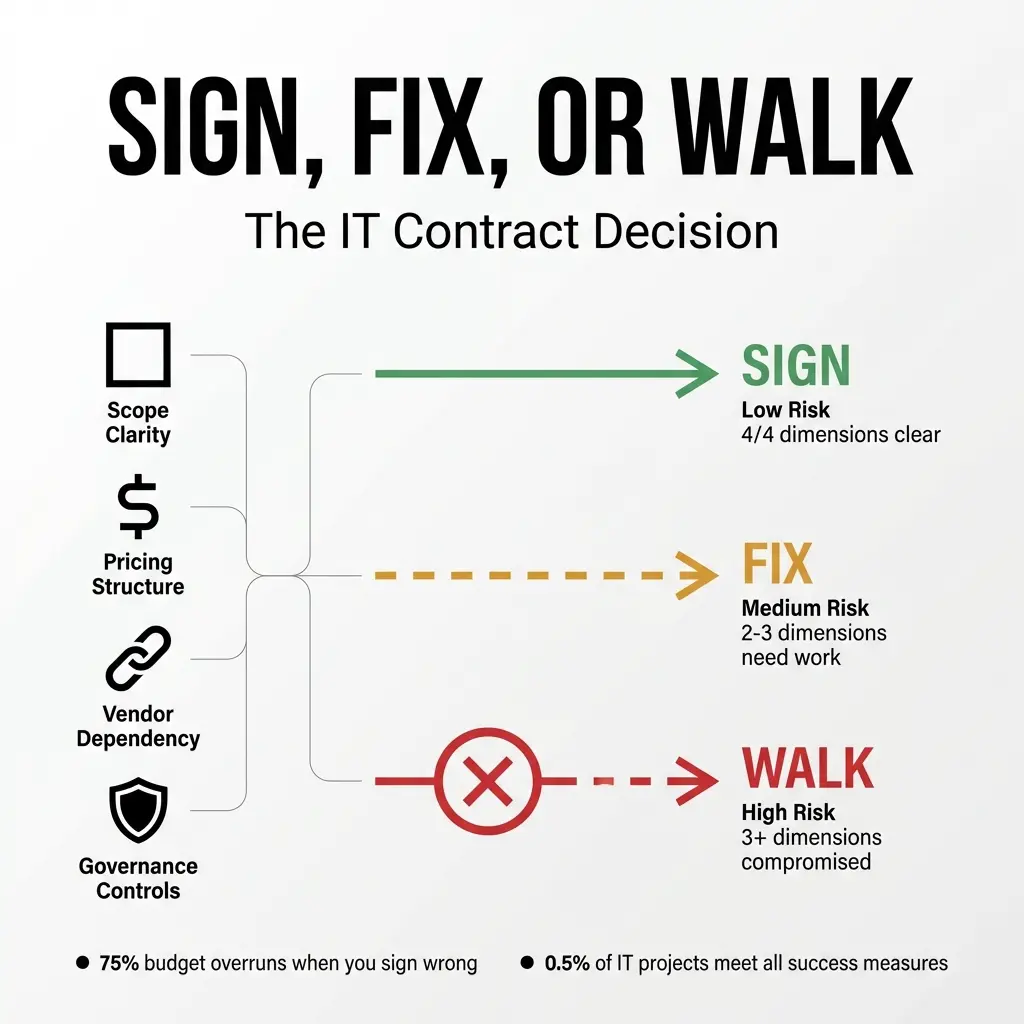
Most executives don’t receive a structured risk recommendation before signing a software contract. They get a pitch deck, a reference call, and pressure to move fast. What they need is a rational model that tells them whether to sign as-is, fix specific risk concentrations, or walk away entirely.
The Real Cost of Emotional Decision-Making
Here’s what I’ve learned: speed increases risk in contract negotiations.
When you rush through vendor selection, you skip the due diligence that protects your budget and reputation. You miss the hidden dependencies. You overlook the pricing traps. You accept governance structures that give you no leverage when things go wrong.
And things go wrong often.
At least one in six IT projects turns into a “black swan” with a cost overrun of 200% and a schedule overrun of 70%. These aren’t minor budget adjustments. These are career-defining failures.
The pattern is predictable. Sales-driven urgency overrides risk assessment. Emotional commitment to a vendor relationship replaces objective evaluation. By the time you realize the contract has structural problems, you’ve already lost your negotiation power.
Why Traditional Decision Methods Fail
I’ve seen executives rely on three approaches when evaluating IT contracts:
Capital budgeting models that treat software like physical assets, ignoring the unique uncertainties of technology investments.
Investment experience from previous projects, even though every vendor, every technology stack, and every integration environment is different.
Gut instinct based on how well the sales team performed or how impressive the demo looked.
None of these methods work. Traditional capital budgeting, investment experience, and intuition have not been effective in IT investment decision-making due to significant uncertainties including consumer responses, market conditions, regulatory changes, and technology standards.
You need a framework that addresses the actual risk factors in IT contracts: scope clarity, pricing structure, vendor dependency, and governance controls.
The Four Risk Dimensions That Matter
Every IT contract carries risk. The question is whether that risk is manageable, fixable, or fatal.
I’ve identified four dimensions that determine your actual exposure:
Scope Clarity
Can you articulate exactly what you’re buying and what success looks like?
Vague requirements lead to scope creep. Ambiguous deliverables create disputes. Unclear success criteria make it impossible to hold vendors accountable. When 80% of project failures are attributed to poor communication and collaboration, scope clarity becomes your first line of defense.
Low risk: Detailed specifications, documented requirements, measurable outcomes.
Medium risk: General objectives with room for interpretation, phased deliverables that allow for adjustment.
High risk: Exploratory projects, undefined requirements, success criteria that depend on factors outside vendor control.
Pricing Structure
How does the vendor make money, and what incentives does that create?
Fixed-price contracts shift risk to the vendor but create incentives to cut corners. Time-and-materials contracts shift risk to you but provide flexibility. Consumption-based pricing aligns incentives but introduces budget unpredictability.
The worst contracts hide the true cost structure. I’ve seen organizations discover 10% to 25% in “toxic spend” during procurement reviews: licenses assigned but never used, expensive tiers purchased when lighter versions would suffice, automatic renewals that compound waste year after year.
Low risk: Transparent pricing, clear cost drivers, predictable scaling economics.
Medium risk: Tiered pricing with understood breakpoints, consumption models with spending caps.
High risk: Opaque fee structures, complex licensing models, penalties buried in fine print.
Vendor Dependency
What happens if this relationship doesn’t work out?
Over 75% of enterprises lack full visibility into application deployments and access controls across their cloud environments. This makes exit planning difficult and allows hidden vendor entrenchment to take root.
Vendor lock-in restricts your ability to adapt your technology stack as business needs evolve. Switching costs become prohibitively expensive over time. You lose leverage in renewal negotiations because both parties know you can’t easily leave.
Low risk: Standard APIs, portable data formats, documented migration paths, competitive alternatives.
Medium risk: Proprietary features with workarounds, data export capabilities with some friction.
High risk: Unique architecture, custom integrations, data formats that require transformation, no viable alternatives.
Governance Controls
Who makes decisions when things go wrong?
Contracts without clear escalation paths, change management procedures, and dispute resolution mechanisms leave you powerless when problems arise. You need defined service levels, performance metrics, and consequences for non-compliance.
The challenge is that 89% of CIOs say it’s either very or somewhat challenging to ensure efficiency in IT spending, 72% say the same about negotiating best prices, and 83% struggle with increased prices from vendors. Without strong governance controls, you’re negotiating from weakness.
Low risk: Clear SLAs, defined escalation procedures, regular performance reviews, exit clauses.
Medium risk: Standard terms with some flexibility, periodic check-ins, informal escalation paths.
High risk: Vague commitments, no performance metrics, vendor-favorable dispute resolution, restrictive change procedures.
The Decision Framework: Sign, Fix, or Walk
Once you’ve assessed risk across these four dimensions, you need a decision model.
Here’s mine:
Low Risk: Sign As-Is
When all four dimensions show low risk, you can move forward confidently.
The scope is clear. The pricing is transparent. You can exit if needed. Governance protects your interests.
You still need standard contract review, but you don’t need extensive negotiation or risk mitigation. Sign the contract and focus your energy on implementation.
Medium Risk: Fix Before Signing
When one or two dimensions show elevated risk, you have negotiation leverage.
Identify the specific risk concentrations. If pricing structure is the problem, negotiate caps or tiers. If vendor dependency concerns you, require data portability commitments. If governance is weak, add performance metrics and escalation procedures.
The key is addressing risks while you still have leverage. Once you sign, your negotiating power drops dramatically. Vendors know switching costs and organizational inertia work in their favor.
This is where independent IT risk reviews create value. An external assessment gives you specific, defensible reasons to request changes. You’re not being difficult. You’re responding to identified risks.
High Risk: Walk Away
When three or more dimensions show high risk, or when any single dimension presents existential risk, you should walk away.
I know this feels impossible when you’ve invested time in vendor selection, when leadership expects a decision, when the sales team has built relationships across your organization.
But consider the alternative. Projects with budgets over $1 million are 50% more likely to fail than projects with budgets below $350,000. For large IT projects, functionality issues and schedule overruns are the top two causes of failure.
Walking away protects your budget, your schedule, and your credibility. It’s not a failure of decision-making. It’s the decision-making working correctly.
When to Conduct Independent Risk Reviews
The best time for risk assessment is during contract negotiation, before you sign.
This timing gives you maximum leverage. You can request changes, walk away from bad terms, or negotiate protections. The vendor still wants your business and will make reasonable accommodations to close the deal.
After you sign, your options narrow. You’re managing problems instead of preventing them. You’re asking for concessions instead of negotiating from strength.
I recommend independent reviews for any contract that meets these criteria:
• Total contract value exceeds $500,000
• Project duration extends beyond 12 months
• Technology is critical to core business operations
• Vendor dependency is difficult to reverse
• Your organization lacks internal expertise to evaluate technical risks
The cost of an independent review is typically 1-3% of contract value. The cost of a failed project is 75% budget overrun, 46% schedule overrun, and 39% less value than predicted.
Building Organizational Discipline
Individual contract decisions matter, but organizational discipline matters more.
Only 58% of organizations fully understand the value of project management. This means 42% of companies undervalue the importance of project management as a crucial component for project success.
You need a repeatable process that applies this framework consistently:
Standardize your due diligence. Create a checklist that evaluates scope clarity, pricing structure, vendor dependency, and governance controls for every significant IT contract.
Require risk categorization. Force explicit classification as low, medium, or high risk. Make someone accountable for that assessment.
Separate vendor selection from contract approval. Liking a vendor’s technology doesn’t mean accepting their contract terms. These are separate decisions.
Build in approval gates. High-risk contracts should require executive sign-off. Medium-risk contracts should require documented risk mitigation plans.
Track outcomes. Measure whether your risk assessments predicted actual project performance. Refine your framework based on results.
The Real ROI of Structured Decision-Making
I’ve seen this framework prevent disasters.
An executive team was ready to sign a multi-million dollar cloud migration contract. The vendor had strong references. The technology looked solid. The timeline was aggressive but achievable.
An independent risk review identified high vendor dependency with no realistic exit strategy, vague performance commitments, and pricing that would escalate dramatically as data volumes grew.
The executive team went back to negotiate. They added data portability requirements, defined specific performance metrics, and restructured pricing to cap exposure. The vendor resisted initially but ultimately agreed because they wanted the business.
Two years later, that company needed to pivot their cloud strategy. Because they had negotiated exit provisions and data portability, they could make that change without catastrophic switching costs.
That’s the ROI. Not just avoiding failures, but preserving strategic flexibility.
What This Means for You
You don’t need to become a contract expert or a technology specialist.
You need a framework that translates technical and legal complexity into a clear decision: sign, fix, or walk away.
That framework starts with four questions:
• Is the scope clear enough to hold the vendor accountable?
• Does the pricing structure align incentives and protect our budget?
• Can we exit this relationship if it doesn’t work?
• Do governance controls give us leverage when problems arise?
If you can answer yes to all four, sign the contract. If you can answer yes to two or three, fix the gaps before signing. If you can only answer yes to one or none, walk away.
This approach shifts IT contract decisions from emotional reactions to rational evaluations. It creates accountability for risk assessment. It protects your budget, your schedule, and your credibility.
Most importantly, it gives you back your negotiating power while you still have it.