
I’ve watched too many Agile proposals arrive on executive desks promising flexibility, speed, and innovation while quietly leaving scope undefined and accountability vague.
The pitch sounds good. The methodology feels modern. But when you sign a fixed-price contract based on Agile promises, you’re often buying a framework that can justify scope creep, timeline extensions, and budget overruns under the banner of “iterative development.”
I’m not anti-Agile. I’m anti-ambiguity.
The real problem is that fixed-price contracts lock parties into solutions envisioned at contract inception, while Agile methodologies thrive on adaptation. This tension creates a paradox that most organizations handle poorly.
But here’s what I’ve learned: Agile can work within fixed contracts when you structure it correctly from the start.
You need governance checkpoints, not governance theater. You need metrics that predict outcomes, not just track activity. And you need contract language that translates Agile ceremonies into executive accountability.
The Hidden Cost of Undefined Scope
The data on this is brutal.
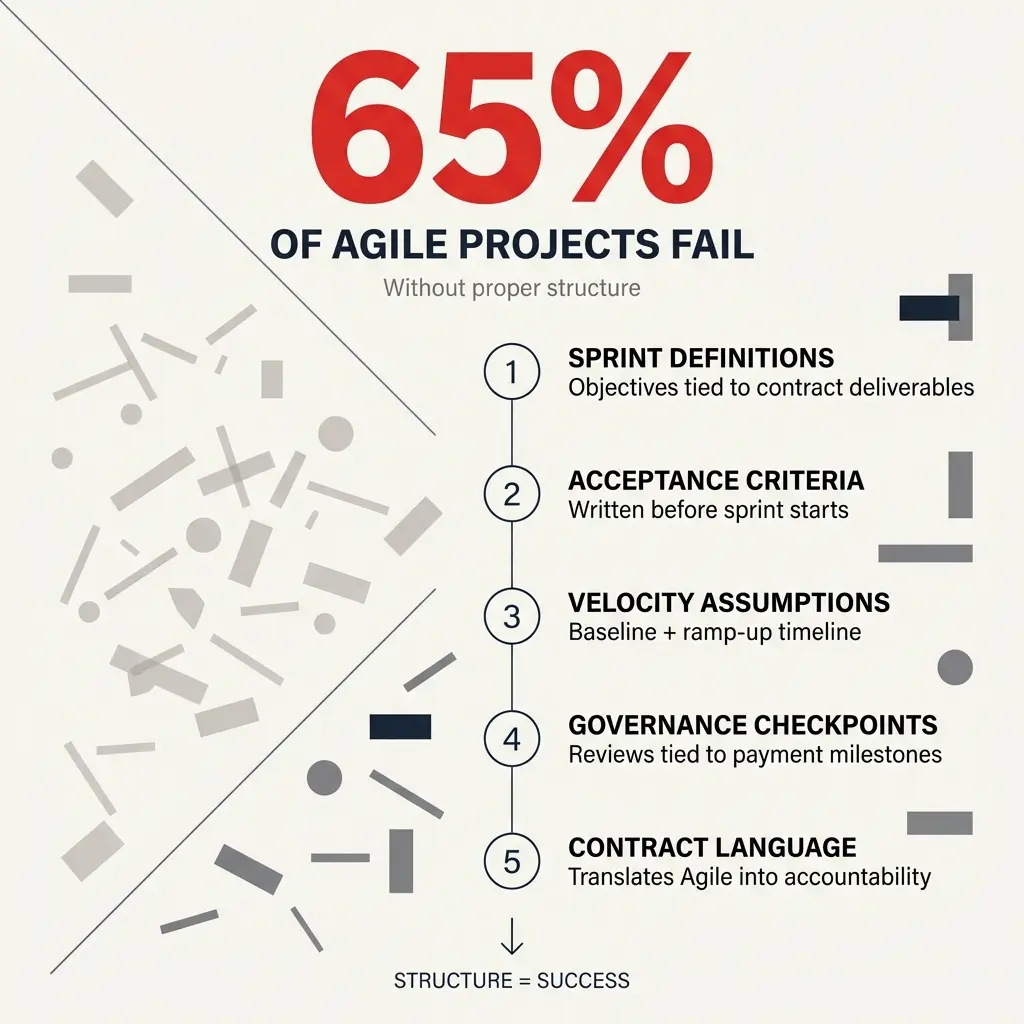
65% of software projects adopting Agile requirements engineering practices fail to deliver on time, within budget, and to a high standard of quality.
Let me repeat that. 65% fail.
The most common cause is unclear or incomplete project requirements at the start. Teams fill this ambiguity with additional requests during execution. What begins as “flexible scope” becomes uncontrolled scope creep.
I’ve seen this pattern repeatedly. A vendor proposes Agile delivery. The contract emphasizes collaboration and adaptation. Three months in, the project is behind schedule because “we’re still refining the requirements” or “the backlog is evolving based on stakeholder feedback.”
Translation: nobody defined what done looks like before work started.
The uncomfortable truth is that projects with clear requirements documented before development started were 97% more likely to succeed. This directly contradicts one of Agile’s four pillars: “Working Software over Comprehensive Documentation.”
So where does that leave you?
Sprint Definitions That Create Accountability
The solution isn’t to abandon Agile. It’s to require structure within the framework.
Start with sprint definitions that include three non-negotiable elements:
1. Sprint objectives tied to contract deliverables
Every sprint should connect to a specific contract milestone. Not “improve user experience” or “enhance system performance.” Those are vague. You need “deliver user authentication module per Section 3.2 of SOW” or “complete data migration for Phase 1 as defined in Appendix A.”
This creates a clear line from daily work to contract obligations.
2. Acceptance criteria written before the sprint starts
Acceptance criteria are the bridge between flexibility and control. They define what complete means for each user story or feature.
Well-written acceptance criteria reduce development cycles by 25-30% by eliminating ambiguity and rework. The major benefit is accountability. Teams know what they need to accomplish individually and collectively to consider work complete.
Require vendors to document acceptance criteria in the proposal. Not after the contract is signed. Not during sprint planning. Before you commit budget.
3. Definition of Done that matches contract quality standards
Your contract probably includes quality requirements. Security standards. Performance benchmarks. Compliance obligations.
The Definition of Done for each sprint should explicitly reference these contract requirements. If your SOW requires 99.9% uptime, the Definition of Done should include uptime testing. If you need Section 508 compliance, it should include accessibility validation.
This prevents the scenario where a vendor declares work “done” by Agile standards but incomplete by contract standards.
Velocity Assumptions That Enable Predictability
Velocity is often misunderstood. It’s not a productivity metric. It’s a predictability tool.
Stable velocity means a team is predictable in their delivery. After a few sprints, uncertainty reduces and a team becomes more predictable. This is where velocity becomes an excellent instrument for forecasting.
But most Agile proposals don’t include velocity assumptions. They talk about “iterative delivery” without committing to a pace.
I require vendors to provide velocity projections in their proposals. Specifically:
Baseline velocity for the proposed team composition
How many story points or features can this specific team deliver per sprint? Base this on their historical performance with similar projects and technologies.
If they can’t provide this data, that’s a red flag. It means they’re guessing about capacity.
Ramp-up timeline to stable velocity
New teams need time to establish rhythm. Ask vendors to specify when they expect to reach stable velocity. Sprint 2? Sprint 4?
This creates realistic expectations and prevents the excuse of “we’re still finding our groove” in month six.
Velocity range for planning purposes
No team maintains perfect consistency. But teams with consistent cycle times across many issues are more predictable in delivering work.
Ask for a velocity range (for example, 30-40 story points per sprint) rather than a single number. This acknowledges normal variation while maintaining accountability.
Leaders who adopt frameworks that capture true predictors of delivery improve planning accuracy by more than 30%.
Governance Checkpoints That Preserve Executive Control
Agile ceremonies (sprint planning, daily standups, retrospectives) are designed for team-level coordination. They don’t provide executive-level governance.
You need additional checkpoints that translate Agile progress into business accountability.
Increment reviews tied to payment milestones
Structure your contract so payment is tied to demonstrated working software at defined intervals. Not sprints completed. Not story points delivered. Working software that meets acceptance criteria.
This approach breaks large complex procurements into multiple tightly scoped and successive increments. The contractor’s team works with you to define incremental scope. What the team learns during this process informs the next increment’s contract.
This hybrid model preserves both agility and predictability.
Burn-down tracking against contract scope
Agile teams track burn-down at the sprint level. You need burn-down tracking at the contract level.
How much of the total contracted scope remains? At the current velocity, when will it be complete? Are we on track to deliver within the fixed price?
Require monthly burn-down reports that show progress against the entire contract, not just the current sprint.
Change control process for backlog modifications
Agile backlogs evolve. That’s expected. But in a fixed-price contract, you need to distinguish between:
• Refinement (clarifying existing scope)
• Reprioritization (changing the order of existing scope)
• Addition (adding new scope that requires contract modification)
Establish a change control board that reviews significant backlog changes. Define thresholds that trigger formal contract amendments versus changes that fall within the agreed flexibility.
Contract Language That Translates Agile Into Accountability
Your contract needs specific language that addresses Agile delivery within a fixed-price structure.
Here’s what I include:
“The Contractor shall maintain a product backlog prioritized by the Government. All backlog items must include acceptance criteria approved by the Government before development begins. The Contractor shall deliver working software that meets these acceptance criteria at the end of each sprint.”
This establishes that you control prioritization and approve acceptance criteria. The vendor doesn’t get to define what complete means.
“The Contractor shall maintain stable sprint velocity within 20% of the baseline velocity established in the proposal. If velocity falls below this threshold for two consecutive sprints, the Government may require a corrective action plan.”
This creates accountability for maintaining pace. It prevents the scenario where velocity drops and the vendor shrugs and says “that’s Agile.”
“Changes to the product backlog that add scope beyond the initial contract requirements shall be processed through the formal change control process. Refinement and reprioritization of existing scope do not constitute changes.”
This protects you from vendors who try to renegotiate the contract by claiming every clarification is “new scope.”
“The Definition of Done for all deliverables shall include compliance with all quality, security, and performance requirements specified in Section X of this contract.”
This ensures contract requirements override team-level definitions of complete.
The Modular Contracting Middle Ground
If you’re uncomfortable with a single large fixed-price Agile contract, consider modular contracting.
This approach breaks procurement into multiple tightly scoped increments. You award a fixed-price contract for Increment 1. The team delivers working software. You evaluate results. Then you define and award Increment 2 based on what you learned.
This process repeats until the end of the project.
The benefits are significant:
• You can adjust direction between increments based on actual results
• You limit financial exposure to smaller contract values
• You maintain the option to change vendors if performance is poor
• You preserve Agile’s learning benefits while maintaining budget control
The tradeoff is administrative overhead. You’re managing multiple procurements instead of one. But for large, complex projects where requirements uncertainty is high, this overhead is worth the risk reduction.
What This Looks Like In Practice
I recently worked with an agency procuring a case management system. The initial proposal was pure Agile. Flexible scope. Collaborative development. Iterative delivery.
It sounded great until we asked specific questions.
What’s the baseline velocity for your proposed team? They didn’t know.
How many features can you deliver in the first three months? They couldn’t say.
What happens if priorities change mid-project? Everything was negotiable.
We restructured the procurement using the framework I’ve outlined here. We required:
• Sprint objectives tied to contract milestones
• Acceptance criteria documented in the proposal
• Velocity projections with historical data
• Monthly governance reviews with burn-down tracking
• Contract language that defined change control thresholds
The vendors who couldn’t provide this structure self-selected out. The vendors who remained demonstrated they understood how to deliver Agile within executive accountability frameworks.
We awarded a fixed-price contract. The project delivered on time and within budget. The team maintained velocity within 15% of their projection. We processed three formal scope changes through change control. Everything else was refinement and reprioritization within the original scope.
That’s what Agile contract alignment looks like when done correctly.
The Bottom Line
Agile is not an excuse for undefined scope, shifting priorities, or budget uncertainty.
It’s a framework that can be structured for executive control when you require the right governance elements from the start.
Sprint definitions create accountability. Velocity assumptions enable predictability. Governance checkpoints preserve control. Contract language translates Agile ceremonies into business obligations.
The vendors who resist this structure are the ones who want to use Agile as cover for poor planning and undefined requirements.
The vendors who embrace this structure are the ones who understand that true agility comes from disciplined execution within clear boundaries.
You can have both flexibility and accountability. But only if you demand it before the contract is signed.