
I’ve reviewed hundreds of vendor proposals over the years. The promises always sound the same.
“We’ll assign our top-tier talent to your project.”
“You’ll have access to our senior architects and engineers.”
“Our team is fully committed to your success.”
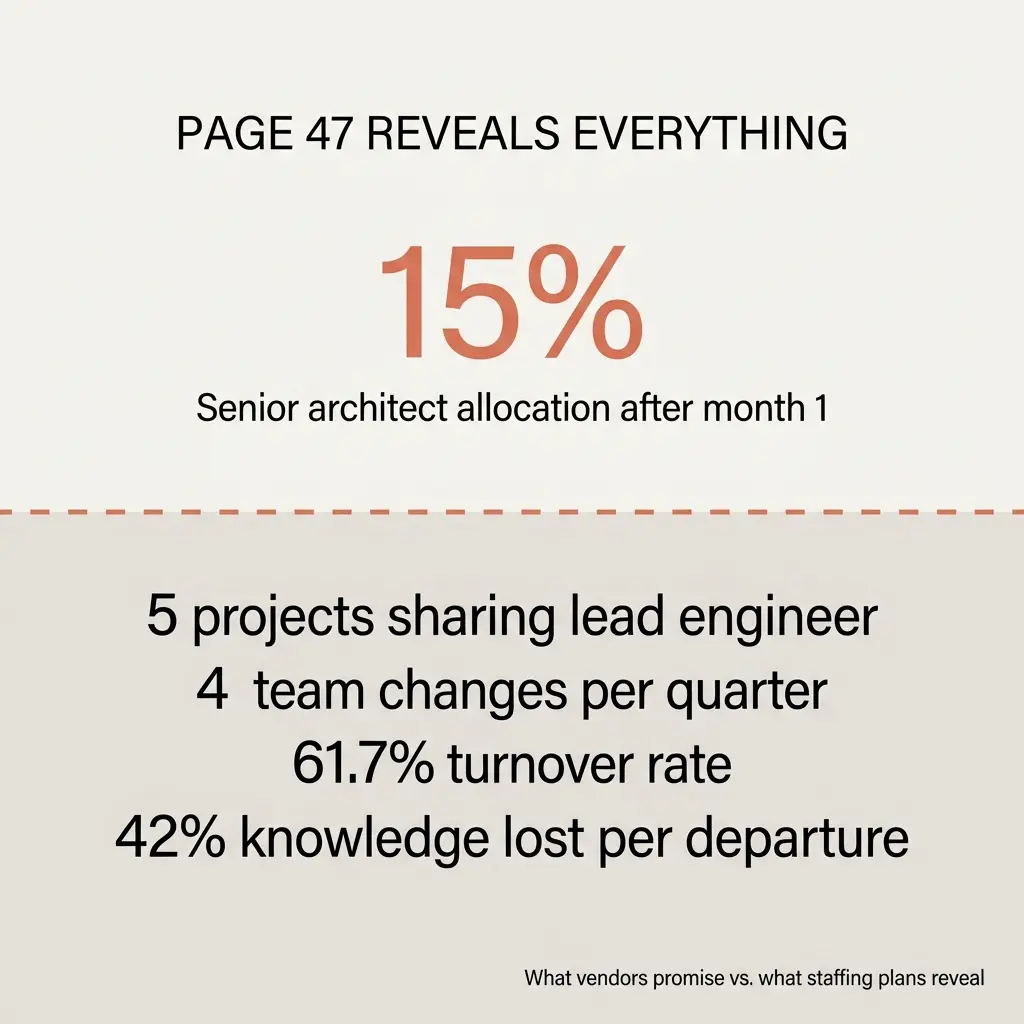
Then you dig into the actual staffing plan buried on page 47 of the proposal, and you find something different. The senior architect is allocated at 15% for the first month, then drops to 5%. The lead engineer you met during the pitch is shared across four other projects. The team composition changes every quarter.
This is the gap between what vendors promise and what they actually deliver.
The staffing plan is where commitment becomes visible. It’s where you see whether a vendor is truly invested in your project or just trying to win the contract.
Why Staffing Plans Matter More Than You Think
Most executives focus on vendor capabilities, pricing, and timelines. The staffing plan gets a quick glance and a nod.
That’s a mistake.
According to the Project Management Institute’s 2025 report, only 35% of projects worldwide finish successfully meeting all goals and timelines. More than 30% of software projects terminate before completion.
The staffing plan is often the reason why.
When key personnel leave mid-project, you lose institutional knowledge and momentum. When team members are spread too thin across multiple projects, your deadlines slip. When vendors hire from the bottom of the talent pool to meet low-price contracts, you get poor quality and high turnover.
I’ve seen projects derail because the vendor’s staffing plan was built on optimistic assumptions rather than realistic commitments.
The Three Tests Every Staffing Plan Must Pass
Before you sign any vendor contract, run the staffing plan through these three tests. They’ll reveal whether you’re getting real commitment or just pretty promises.
Test 1: Allocation Percentages and Timeline Consistency
Open the staffing plan and look at the allocation percentages for each team member.
What percentage of their time is dedicated to your project? How does that percentage change over the project timeline?
Red flags to watch for:
- Senior resources allocated at 25% or less
- Key personnel dropping to 10% or lower after initial phases
- No explanation for why allocations decrease over time
- Different team members rotating in and out without clear transition plans
- Vague language like “as needed” or “flexible allocation”
I ask vendors to explain every allocation change. If the senior architect drops from 40% to 10% after the design phase, I want to know who’s maintaining architectural oversight during implementation.
If they can’t answer clearly, that’s your answer.
The best staffing plans show consistent allocation of key personnel throughout the project lifecycle. They account for knowledge transfer during transitions. They explain why certain roles ramp up or down based on project phases.
Test 2: Turnover Risk and Replacement Strategy
Here’s an uncomfortable truth: people leave.
The median annual turnover for outsourced service desk agents is 61.7%, compared to just 35.2% for insourced agents. Gartner states that the professional services industry could see turnover rates as high as 24% in the years to come.
When employees leave, 42% of the expertise and skills they perform in their position are only known to them and cannot be filled in by a replacement.
Questions to ask your vendor:
- What’s your actual turnover rate for the past 12 months?
- How many people left mid-project in the last year?
- What’s your process when someone on my project gives notice?
- How long does knowledge transfer take?
- Who covers the role during the transition period?
Performance targets should never exceed 2% monthly or 24% annually turnover. If a vendor can’t provide these numbers, or if they’re significantly higher, you’re looking at a stability problem.
I also look for specific replacement clauses in the contract. What happens if the lead engineer leaves in month three? Does the vendor provide a replacement at the same skill level? How quickly? Who pays for the knowledge transfer time?
Vendors with strong retention programs will share their strategies openly. They’ll talk about career development, project continuity incentives, and team stability metrics.
Vendors with high turnover will change the subject.
Test 3: Cross-Training and Knowledge Distribution
Single points of failure destroy projects.
If only one person knows how the authentication system works, you’re in trouble when that person leaves. If the database architecture lives in one engineer’s head, you’re exposed.
Look at the staffing plan and identify critical knowledge areas. Then ask the vendor how that knowledge is distributed across the team.
What you want to see:
- At least two people familiar with each critical system or component
- Regular knowledge sharing sessions built into the project schedule
- Documentation requirements tied to specific deliverables
- Pair programming or shadowing for complex areas
- Clear escalation paths when primary resources are unavailable
International Data Corp. estimated the average enterprise wastes $2.5 to $3.5 million per year due to ineffective knowledge systems. For firms with 1,000 employees, productivity losses due to knowledge loss reach $2.4 million annually.
You can’t eliminate knowledge loss completely, but you can reduce it dramatically with proper staffing structure.
The Hidden Costs of Inconsistent Staffing
Poor staffing plans carry real financial consequences.
A recent Gartner study found that poor contract management can drain up to 9.2% of annual revenue. When you don’t have guarantee clauses in staffing vendor contracts, you waste time and money on bad hires without compensation.
But the costs go beyond direct financial impact.
Timeline slippage: When key personnel are only partially allocated or frequently change, projects take longer. Dependencies pile up. Decision-making slows down. What should take three months takes six.
Quality degradation: Teams without consistent staffing produce inconsistent work. Code reviews get skipped. Design decisions lack context. Technical debt accumulates.
Internal team burnout: Your internal team spends extra time bringing new vendor resources up to speed, explaining context repeatedly, and filling gaps when vendor resources are unavailable.
I’ve watched projects where the internal team worked 60-hour weeks because the vendor’s staffing plan fell apart. The vendor still got paid. The internal team burned out.
What Good Staffing Plans Look Like
You know a strong staffing plan when you see it.
The allocations make sense for the work being done. Senior resources are involved enough to provide real guidance but not so thinly spread that they’re ineffective. Junior resources have proper supervision and mentorship.
The timeline shows realistic ramp-up and ramp-down periods. People don’t disappear suddenly. Transitions are planned and documented.
The vendor can explain their retention strategies and provide actual turnover data. They have backup plans for key roles. They’ve thought through knowledge transfer and documentation.
Most importantly, the staffing plan aligns with the project’s actual needs rather than the vendor’s resource availability.
When I find a vendor with a solid staffing plan, I pay attention. It signals they’ve done this before and learned from experience.
Contract Clauses That Protect You
Once you’ve evaluated the staffing plan, make sure your contract includes these protections:
Minimum allocation guarantees: Specify the minimum percentage of time key personnel must dedicate to your project. Include penalties if allocations fall below agreed levels without your approval.
Replacement timeframes: Define how quickly the vendor must provide a replacement if someone leaves. Typically, guarantee periods should be 90 days with replacement candidates or prorated refunds.
Approval rights: Reserve the right to approve any staffing changes, especially for senior or specialized roles. The vendor shouldn’t be able to swap people without your input.
Knowledge transfer requirements: Specify documentation standards and knowledge transfer processes. Make these deliverables with acceptance criteria.
Turnover penalties: Consider including penalties if the vendor’s turnover on your project exceeds agreed thresholds. This creates a financial incentive for stability.
One out of three organizations conduct little to no vendor due diligence, and an estimated 51% of companies have experienced a data breach due to third-party access. Don’t be part of that statistic.
Questions To Ask Before You Sign
Here are the specific questions I ask during vendor negotiations:
- Can you show me the actual resumes of the people who will work on this project?
- What percentage of their time will be dedicated to our project, and how does that change over time?
- What’s your turnover rate for the past 12 months, specifically for projects similar to ours?
- How many people left mid-project in the last year, and what was the impact?
- What happens if someone on our project leaves? Walk me through your replacement process.
- How do you ensure knowledge isn’t concentrated in single individuals?
- What documentation and knowledge transfer processes are built into your methodology?
- Can we include staffing stability metrics in our contract with associated penalties?
The vendor’s response to these questions tells you everything you need to know.
Strong vendors welcome these questions. They have data to share and processes to explain. They’re confident in their staffing approach because they’ve invested in building stable teams.
Weak vendors get defensive. They deflect with vague assurances. They resist putting staffing commitments in writing.
Moving Forward
The staffing plan is where vendor promises meet reality.
You can have the best technology, the most competitive pricing, and the most impressive case studies. But if the staffing plan is built on part-time allocations, high turnover, and vague commitments, your project is at risk.
I’ve learned to spend as much time evaluating the staffing plan as I do evaluating technical capabilities. The people doing the work matter more than the methodology they follow.
Before you sign your next vendor contract, open that staffing plan and run it through the three tests. Look at allocations. Ask about turnover. Check for knowledge distribution.
Then make sure your contract includes the protections you need.
The vendors who can’t meet these standards aren’t the ones you want to work with anyway.