I’ve reviewed hundreds of Statements of Work over the years, and I can spot an overestimated SOW from across the room. The vendor quotes six months when the work should take three. The budget balloons to $500K when similar projects cost $300K. The scope feels padded with vague language that protects them while exposing you.
You’re not imagining it.
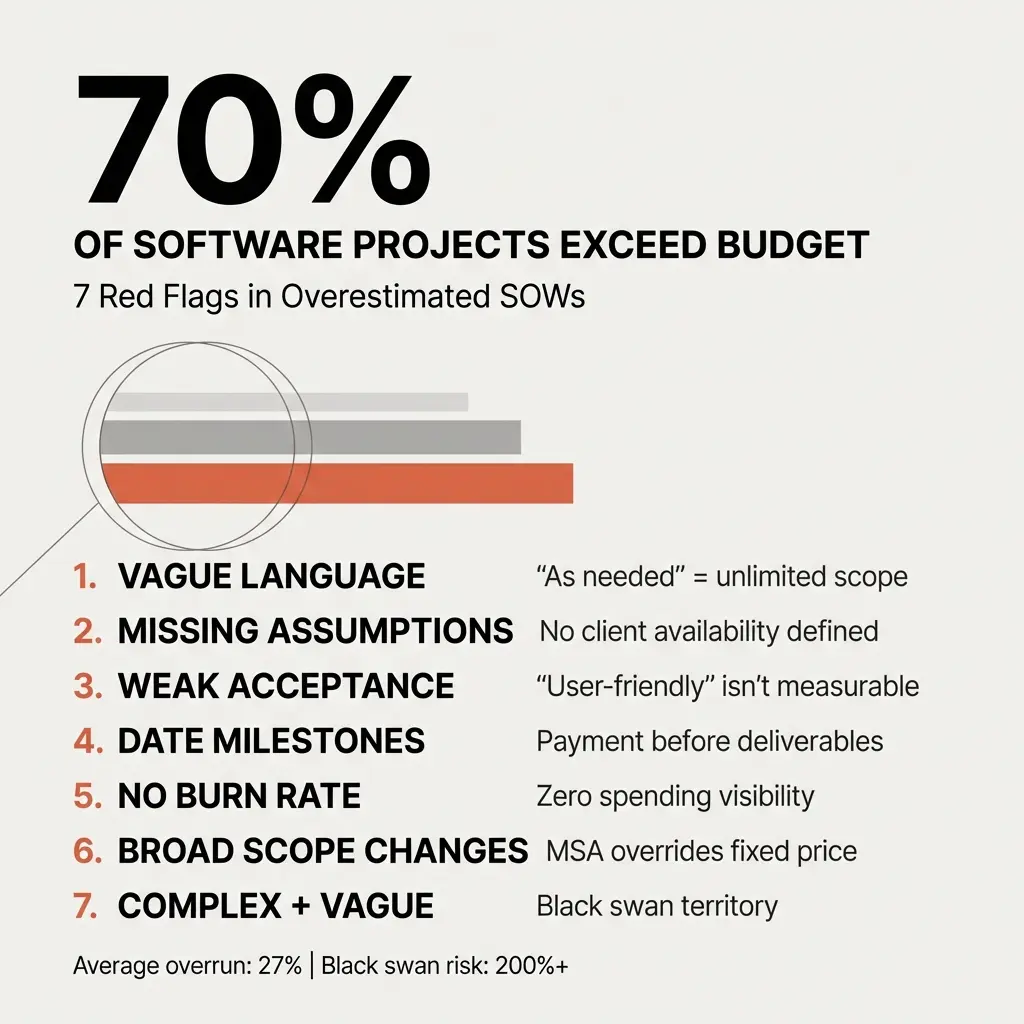
The numbers back up your suspicion. IT projects run 45% over budget on average while delivering 56% less value than predicted. Around 70% of software projects exceed their initial budget, with an average overrun of 27%. When your SOW already feels inflated before you sign, you’re setting yourself up for disaster.
Here’s how I investigate SOWs that trigger my overestimation alarm—and what you should look for before committing your budget.
Start With the Language: Vague Phrases Hide Inflated Estimates
The first place I look is the scope section. Overestimated SOWs rely on ambiguous language that lets vendors interpret work broadly while you interpret it narrowly.
Watch for these red flags:
“As needed” appears anywhere in the deliverables. This phrase gives vendors permission to define necessity after you’ve signed. What you think means “occasional support” becomes “weekly meetings we’ll bill for.”
“Industry standard” shows up without definition. Standards vary wildly across industries, companies, and even teams. Without specifics, vendors can claim their interpretation as standard while inflating hours.
“Where applicable” or “as appropriate” scatter throughout requirements. These qualifiers let vendors decide what applies after the contract starts. You think you’re getting comprehensive testing. They think applicable means “basic smoke tests.”
“Reasonable efforts” or “best practices” replace concrete commitments. These terms sound professional but mean nothing enforceable. Vendors can claim they made reasonable efforts even when deliverables fail.
I once reviewed an SOW where “industry-standard security implementation” appeared six times. When I asked the vendor to define it, they quoted OWASP Top 10 compliance, PCI DSS standards, and SOC 2 requirements. The client expected basic authentication. The estimate included 200 hours for security work that wasn’t needed.
Your investigation step: Highlight every vague phrase in your SOW. Ask the vendor to replace each one with specific, measurable language. If they resist, the estimate probably includes padding for their interpretation flexibility.
Review Assumptions: Missing Details Create Hidden Costs
Assumptions sections reveal how vendors justify their estimates. Strong SOWs list explicit assumptions about what you’ll provide, when you’ll provide it, and what happens if assumptions prove wrong.
Overestimated SOWs either skip assumptions entirely or bury them in boilerplate that protects vendor interests.
I look for these assumption gaps:
Client availability assumptions. Does the SOW assume you’ll respond to questions within 24 hours? Provide feedback within 48 hours? Attend weekly status meetings? When these assumptions are missing, vendors pad estimates to account for delays they expect but don’t document.
Data readiness assumptions. Does the vendor assume you’ll provide clean, structured data on day one? If your data needs cleanup and the SOW doesn’t address it, the estimate either includes hidden data work or sets you up for change orders later.
Third-party dependency assumptions. Does the project rely on APIs, integrations, or external systems? Strong SOWs assume these dependencies work as documented. Weak SOWs assume nothing, then inflate estimates to cover potential integration problems.
Decision-making assumptions. Does the vendor assume you have authority to approve deliverables? If your organization requires multiple approval layers and the SOW doesn’t account for it, the timeline and cost estimates are fantasy.
Companies lose an average of $420,000 yearly due to communication breakdowns in organizations with just 100 employees. Ambiguous assumptions create expensive misunderstandings that benefit vendors through change orders.
Your investigation step: Create a two-column document. List every assumption the vendor should make about your organization, resources, and processes. Compare it to their assumptions section. Gaps indicate areas where their estimate includes padding or where you’ll face surprise costs.
Demand Clear Definition of “Done”: Acceptance Criteria Expose Estimate Padding
This is where I find the most overestimation. Deliverables without objective, testable acceptance criteria let vendors define success after they’ve collected payment.
“Functional website” means nothing. “Website that loads in under 2 seconds, displays correctly on Chrome, Firefox, and Safari, and passes WCAG 2.1 AA accessibility standards” means something.
The difference between these definitions is hundreds of hours and tens of thousands of dollars.
Well-written acceptance criteria reduce development cycles by 25-30% by eliminating ambiguity and preventing rework. When your SOW lacks specific acceptance criteria, the estimate either includes padding for vendor interpretation or sets you up for endless revision cycles.
I evaluate acceptance criteria using these tests:
The measurement test. Can you measure whether the deliverable meets the criteria without subjective judgment? “User-friendly interface” fails this test. “Interface that allows users to complete checkout in 3 clicks or fewer” passes.
The binary test. Can you answer “yes” or “no” to whether criteria are met? “High-quality code” fails. “Code that passes automated test suite with 90% coverage and zero critical security vulnerabilities” passes.
The independence test. Can a third party verify the criteria without asking the vendor for clarification? If you need the vendor to explain what “optimized performance” means, the criteria fail.
The completeness test. Do the criteria cover functionality, performance, security, and usability? Incomplete criteria let vendors deliver technically functional work that’s practically unusable.
I reviewed an SOW recently where the only acceptance criterion for a data migration was “successful data transfer.” The vendor quoted $150K. When I pushed for specific criteria—zero data loss, validation reports, rollback procedures, performance benchmarks—they revised the estimate to $95K. The padding was there all along.
Your investigation step: For each deliverable, write acceptance criteria that pass all four tests. If the vendor’s estimate drops when you add specificity, the original estimate included padding for ambiguity.
Examine Milestones: Dates Without Deliverables Hide Cost Risks
Milestone-based payments protect you from paying for incomplete work. But milestones tied only to dates instead of specific outputs give vendors your money before they deliver value.
I see this pattern constantly in overestimated SOWs:
- Milestone 1: Project kickoff (20% payment)
- Milestone 2: 30 days after start (30% payment)
- Milestone 3: 60 days after start (30% payment)
- Milestone 4: Project completion (20% payment)
This structure pays vendors for showing up and waiting, not for delivering results. By milestone 3, you’ve paid 80% for work you can’t verify.
Strong milestones tie payments to verified deliverables:
- Milestone 1: Approved technical architecture document and project plan (15% payment)
- Milestone 2: Completed development environment with passing test suite (25% payment)
- Milestone 3: User acceptance testing completion with signed approval (35% payment)
- Milestone 4: Production deployment with 30-day stability period (25% payment)
This structure ensures you pay for value received. It also reveals estimate padding because vendors can’t collect milestone payments until they deliver verifiable work.
Research shows that 52% of projects experience scope creep, with 43% significantly impacting schedule, budget, and quality. Organizations lose $97 million per $1 billion invested due to poor scope management. Date-based milestones accelerate scope creep because vendors collect payment before scope boundaries are tested.
Your investigation step: Rewrite every milestone to require specific, verifiable deliverables before payment. If the vendor resists or the estimate increases, they were counting on collecting payment before proving value delivery.
Verify Governance and Financial Controls: Missing Oversight Enables Overruns
Overestimated SOWs often lack the governance mechanisms that would expose the padding. Without burn-rate visibility, spending caps, and approval gates, vendors can consume budget without accountability.
I look for these control mechanisms:
Weekly burn-rate reporting. You should receive reports showing hours consumed, budget spent, and remaining capacity. Without this visibility, you discover overruns when it’s too late to correct course.
Spending caps by phase. Each project phase should have a maximum budget. When vendors hit 80% of phase budget, work stops until you approve additional spending. This prevents vendors from quietly consuming contingency funds.
Change order procedures. The SOW should define exactly how scope changes are requested, evaluated, priced, and approved. Loose change order language lets vendors reclassify planned work as changes to inflate billing.
Escalation procedures. When issues arise, you need defined escalation paths with response timeframes. Without these procedures, vendors can let problems fester while the meter runs.
The statistics are brutal: 66% of enterprise software projects have cost overruns. Only one in 200 IT projects meets all three success measures—on time, on budget, delivering intended benefits. Missing governance controls contribute directly to these failure rates.
Your investigation step: List every financial control and governance mechanism your organization needs. Compare your list to the SOW. Each missing control represents an opportunity for the vendor to consume budget without accountability.
Compare SOW Against Master Services Agreement: Conflicts Hide Vendor Protections
This investigation step catches sophisticated overestimation tactics. Vendors promise fixed-price work in the SOW while the Master Services Agreement (MSA) includes language that converts fixed-price to time-and-materials under certain conditions.
I review both documents side by side, looking for conflicts:
Scope change definitions. The SOW might promise fixed pricing, but the MSA defines scope changes so broadly that normal project evolution triggers time-and-materials billing.
Force majeure clauses. MSAs often include extensive force majeure language that lets vendors pause work, extend timelines, and increase costs for circumstances beyond their control. When these clauses are broad, your fixed-price SOW becomes flexible-price reality.
Intellectual property rights. Some MSAs give vendors ownership of work product until final payment. If the project goes over budget and you can’t pay, you lose access to partially completed work you’ve already funded.
Liability limitations. MSAs typically cap vendor liability at the contract value or less. When the SOW is overestimated and the project fails, your recovery options are limited by MSA terms you agreed to months earlier.
Research confirms that organizations can end up paying over market rate or locked into unfavorable terms when service agreements aren’t properly reviewed. Once you sign, you have little option but to let the arrangement run its course.
Your investigation step: Read your MSA completely. Highlight any language that could override SOW promises. Ask your legal team to identify conflicts. If the MSA undermines SOW protections, the vendor is counting on MSA language to justify overruns.
Calculate the Black Swan Risk: Some Overruns Are Catastrophic
Average overruns are concerning. Catastrophic overruns destroy budgets and careers.
Research reveals that one in six projects is a black swan—with cost overruns averaging 200% and schedule overruns near 70%. These aren’t minor estimate misses. They’re projects that spiral completely out of control.
When your SOW already feels overestimated, you’re not just risking normal overruns. You’re risking black swan territory where the project consumes multiples of the quoted budget.
I assess black swan risk by examining:
Technical complexity without specificity. When the SOW describes complex technical work using vague language, the vendor doesn’t understand the problem well enough to estimate it. Uncertainty breeds catastrophic overruns.
Integration dependencies without ownership. Projects that rely on multiple third-party systems without clear integration ownership create compounding risk. When something breaks, everyone points fingers while costs accumulate.
Performance requirements without testing criteria. “Fast” and “scalable” mean nothing without specific metrics and testing procedures. Vendors discover performance problems late, then spend months optimizing at your expense.
Security requirements without standards. Security work expands infinitely without defined standards. Vendors can always find another vulnerability to address, another test to run, another compliance requirement to meet.
Your investigation step: Rate your project’s black swan risk using these factors. If multiple factors apply and your SOW feels overestimated, you’re looking at potential catastrophic overruns, not just padding.
What I Do When Investigation Confirms Overestimation
You’ve investigated. The SOW is definitely overestimated. Now what?
I take these steps:
Document specific findings. Create a detailed analysis showing exactly where estimates are inflated—vague language, missing assumptions, weak acceptance criteria, date-based milestones, missing controls.
Request revised SOW with specificity. Ask the vendor to revise the SOW addressing each finding. Replace vague language with measurable terms. Add missing assumptions. Define clear acceptance criteria. Tie milestones to deliverables.
Compare revised estimate to original. When vendors add specificity, estimates often drop 20-40%. The gap between original and revised estimates reveals how much padding existed.
Consider alternative vendors. If the vendor resists adding specificity or the revised estimate stays inflated, get competitive bids. Market pressure reveals true costs quickly.
Negotiate risk-sharing mechanisms. Propose shared-savings arrangements where cost reductions benefit both parties. Vendors confident in their estimates accept risk-sharing. Vendors protecting padding resist it.
Phase the work. Break the project into smaller phases with gates between them. Prove the vendor can deliver phase one on budget before committing to phases two and three.
Organizations that scrutinize SOWs before signing protect themselves from the 70% overrun rate that plagues software projects. The time you invest in investigation saves multiples in prevented overruns.
When to Get Independent Assessment
Sometimes you need outside expertise to confirm what you suspect. Your internal team lacks software development experience. The vendor’s reputation makes you question your judgment. The budget is large enough that mistakes are career-threatening.
Independent SOW assessment provides objective analysis of estimate accuracy, scope clarity, risk exposure, and contract fairness.
I recommend independent assessment when:
- The project budget exceeds $100K and represents significant organizational investment
- Your team lacks experience evaluating software development SOWs
- The vendor relationship is new without established trust
- The SOW includes unfamiliar technologies or methodologies
- Stakeholders disagree about whether the estimate is reasonable
- The timeline feels aggressive relative to the scope
- Previous projects with this vendor experienced overruns
Pre-signature risk reviews identify ambiguous language, unrealistic timelines, and cost risks before you commit. The review cost is typically 1-3% of the project budget. The savings from preventing overruns or renegotiating inflated estimates average 15-25%.
You’re investigating an SOW because something feels wrong. Trust that instinct. The data shows your suspicion is probably correct—most software projects exceed their estimates, many dramatically so.
The investigation framework I’ve outlined gives you systematic tools to evaluate whether your SOW is overestimated and what to do about it. Use these tools before you sign. After signature, your options narrow considerably.
Your budget deserves protection. Your project deserves clarity. Your organization deserves vendors who estimate honestly rather than padding for their protection.
Investigate now. The cost of investigation is minimal. The cost of signing an overestimated SOW is substantial.