
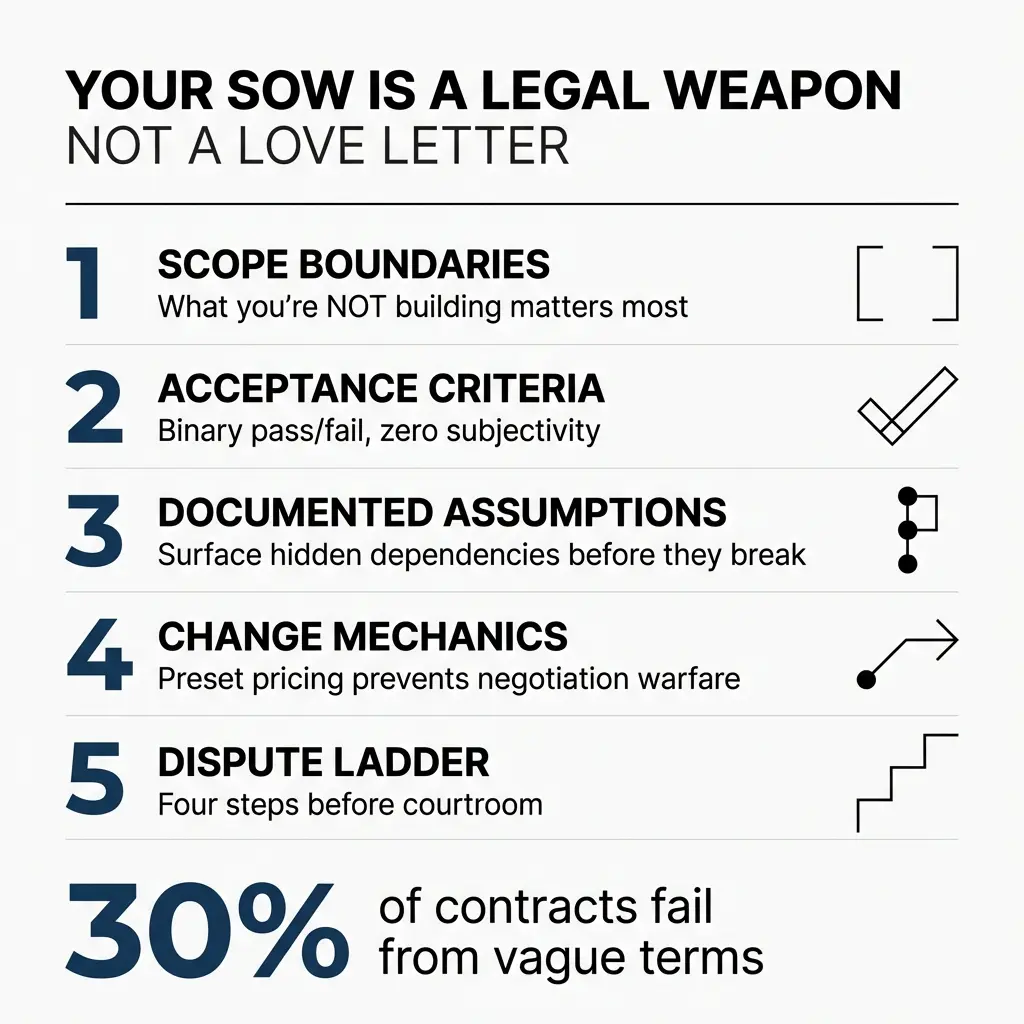
Most software Statements of Work read like love letters written during the honeymoon phase of a project.
Everyone’s optimistic. Everyone’s collaborative. Everyone assumes good faith.
Then the project hits a wall. Scope expands. Deadlines slip. Payments stop. And suddenly that friendly SOW becomes the only thing standing between you and a legal nightmare.
Here’s what I’ve learned: your SOW needs to be written for the worst day of the project, not the best.
The statistics back this up. An estimated 12 million lawsuits are filed against small businesses every year in the United States. And 30% of organizations report having experienced contractual disputes over poorly defined terms.
This isn’t theoretical risk. This is business reality.
The Problem: SOWs Are Written for Collaboration, Not Conflict
Most SOWs I see follow the same pattern. They outline deliverables in broad strokes. They mention timelines. They reference “industry best practices” without defining what that means.
This works great until it doesn’t.
When disputes arise, vague language becomes a weapon. Courts apply the doctrine of contra proferentem, which means ambiguous contract terms get construed against the drafter. If you wrote the SOW and left room for interpretation, you’re the one who pays.
The financial impact is staggering. Ambiguity in contract descriptions triggers disputes that result in cost overruns typically ranging from 15% to 25%, with dispute resolution times averaging around 11.8 months. Dispute resolution fees can average roughly 28.5% of the contested amounts.
You can’t afford to be vague.
Start With Scope Boundaries That Hold Up Under Scrutiny
Scope creep isn’t just a project management problem. It’s a legal one.
According to the Project Management Institute, 52% of projects experience scope creep, with 43% of those significantly impacting schedule, budget, and quality. More troubling: organizations lose $97 million per $1 billion invested due to poor scope management.
Your SOW needs to do more than list what’s included. It needs to explicitly state what’s excluded.
Define the Positive Scope
Start with what you’re actually building. Use specific, measurable language:
- Not this: “Develop a user-friendly dashboard with reporting capabilities”
- This: “Build a web-based dashboard containing five pre-defined report types: monthly revenue summary, customer acquisition funnel, product performance metrics, user engagement analytics, and system health status”
Notice the difference. The second version gives you something to point to in court.
Define the Negative Scope
This is where most SOWs fail. You need an explicit exclusions section that lists what you’re not doing:
- Custom report creation beyond the five specified types
- Integration with third-party analytics platforms
- Mobile application development
- Data migration from legacy systems
- User training or documentation beyond standard technical specs
When someone asks for “just one more feature,” you point to this section. When you’re in mediation, this list becomes your shield.
Create Scope Boundaries for Each Phase
Don’t just define scope for the entire project. Break it down by phase or milestone:
- Phase 1 scope: Database schema design and API endpoint specification
- Phase 2 scope: Backend development and unit testing
- Phase 3 scope: Frontend implementation and integration testing
This compartmentalization protects you. If Phase 2 expands, it doesn’t automatically drag Phase 3 with it.
Write Acceptance Criteria That Remove Subjectivity
I’ve seen projects collapse because nobody defined what “done” actually meant.
The data supports this. 70% of digital transformation failures trace back to issues with requirements. That means 49% of all digital transformation projects fail because acceptance criteria were unclear or missing.
Your SOW needs acceptance criteria that a third party could evaluate without asking questions.
Make Criteria Measurable and Binary
Every acceptance criterion should have a clear pass/fail outcome:
- Weak: “Dashboard loads quickly”
- Strong: “Dashboard initial load completes within 2 seconds on a standard broadband connection (25 Mbps) when tested with 1,000 database records”
The strong version gives you specific numbers to test against. There’s no room for “quickly enough” debates.
Link Acceptance to Payment Milestones
Structure your payment schedule around objective acceptance criteria:
- Milestone 1 (25%): Client confirms database schema meets specifications outlined in Appendix A
- Milestone 2 (25%): All API endpoints return correct data formats per technical specification document, verified through automated test suite with 100% pass rate
- Milestone 3 (25%): Frontend displays all five report types with data accuracy verified against test dataset
- Final payment (25%): System passes user acceptance testing protocol defined in Appendix B
This structure does two things. It protects your cash flow. And it creates a clear record of what was accepted and when.
Define the Acceptance Process
Don’t leave the acceptance process to chance. Spell it out:
- Developer notifies client that milestone is ready for review
- Client has 5 business days to test against acceptance criteria
- Client provides written acceptance or detailed rejection with specific criteria failures
- If rejected, developer has 5 business days to remediate identified issues
- Process repeats until acceptance or escalation per dispute resolution clause
This timeline prevents indefinite “testing” periods that delay payment and create ambiguity about project status.
Document Your Assumptions Before They Become Disputes
Every project runs on assumptions. The client assumes you understand their business. You assume they’ll provide timely feedback. Everyone assumes the third-party API will work as documented.
When assumptions break, projects break with them.
Your SOW needs an explicit assumptions section that surfaces these hidden dependencies:
Technical Assumptions
- Client’s existing database uses PostgreSQL 12 or higher
- Client will provide API credentials for all required third-party services within 3 business days of contract signing
- Client’s hosting environment supports Node.js 16+ and has SSL certificate configured
- All provided data will be in UTF-8 encoding
Process Assumptions
- Client will provide feedback on deliverables within 5 business days of submission
- Client has authority to approve designs and functionality without additional stakeholder review
- Client will make subject matter experts available for 2-hour consultation sessions within 48 hours of request
Scope Assumptions
- Current requirements document dated [DATE] represents complete and final specifications
- No additional features or modifications will be requested during development phases
- All content, images, and branding materials will be provided by client
Here’s the critical part: tie assumption failures to your change order process.
Add this language: “If any assumption documented in Section X proves incorrect or changes during project execution, the affected work will be addressed through the change order process defined in Section Y, including timeline and budget adjustments.”
This gives you a contractual path forward when reality diverges from expectations.
Build Change Mechanics That Prevent Scope Creep
Change orders aren’t admissions of poor planning. They’re acknowledgments that software projects evolve.
The question isn’t whether changes will happen. The question is whether you have a process that protects both parties when they do.
Define What Triggers a Change Order
Be explicit about what constitutes a change:
- Any addition, deletion, or modification to deliverables listed in scope section
- Any revision to acceptance criteria after client approval
- Any new integration or third-party service not specified in original scope
- Any change to technical specifications or design documents after approval
- Any failure of documented assumptions
This list prevents the “but it’s just a small change” conversations that lead to unpaid work.
Create a Change Order Process
Your SOW needs a step-by-step change management workflow:
- Request: Either party submits written change request describing proposed modification
- Assessment: Developer provides impact analysis within 3 business days, including timeline and cost implications
- Approval: Client approves or rejects in writing within 5 business days
- Documentation: Approved changes are documented in signed change order that becomes part of contract
- Execution: Work proceeds only after change order is fully executed
This process does something important: it creates a paper trail. When you’re in litigation, that trail of documented changes and approvals becomes evidence of what was agreed to and when.
Set Change Order Pricing Structure
Don’t negotiate rates during change requests. Lock them in upfront:
- Change orders will be billed at $[RATE] per hour for development work
- Minimum charge of [X] hours per change order to account for context switching and documentation
- Rush changes (requested completion in less than [X] days) incur 1.5x rate multiplier
This removes pricing negotiations from the emotional moment when changes are needed.
Add Dispute Resolution Language That Keeps You Out of Court
The best SOW is one that never sees a courtroom. But you need language that creates off-ramps before litigation.
Build an Escalation Ladder
Create a mandatory dispute resolution sequence:
- Direct negotiation: Project leads meet within 5 business days to resolve issue
- Executive escalation: If unresolved, executives from both parties meet within 10 business days
- Mediation: If still unresolved, parties engage neutral mediator within 20 business days, splitting mediation costs equally
- Arbitration or litigation: Only after exhausting above steps
This ladder serves two purposes. It encourages resolution before legal costs mount. And it demonstrates good faith effort to resolve disputes, which courts appreciate.
Specify Governing Law and Venue
Don’t leave jurisdiction to chance:
- This agreement is governed by the laws of [STATE]
- Any legal action must be filed in [COUNTY], [STATE]
- Prevailing party in any dispute is entitled to reasonable attorney fees
The attorney fees clause is particularly important. It discourages frivolous disputes and provides some cost recovery if you’re forced to defend your position.
The Real Cost of Prevention vs. Cure
Writing a litigation-ready SOW takes more time upfront. You’ll spend hours defining scope boundaries, crafting acceptance criteria, and documenting assumptions.
But consider the alternative.
Only 0.5% of IT projects meet all three success measures: budget, timeline, and intended benefits. Projects that fail on one or more measures exceed budgets by 75%, overrun schedules by 46%, and generate 39% less value than predicted.
The cost of ambiguity prevention is trivial compared to the cost of resolving disputes it creates.
I’ve watched developers lose tens of thousands of dollars because their SOW said “responsive design” instead of “mobile-optimized layouts for iOS and Android devices with screen sizes from 375px to 428px width.”
I’ve seen projects stall for months because “user-friendly interface” meant something different to the client than it did to the developer.
Your SOW is your first line of defense. It’s not just a project planning document. It’s a legal instrument that defines rights, responsibilities, and remedies.
Write it like someone’s going to challenge every word. Because someday, someone might.
Start With Your Next SOW
You don’t need to overhaul every contract you’ve ever written. Start with the next one.
Take your standard SOW template and add:
- An explicit exclusions section that’s as detailed as your inclusions
- Measurable, binary acceptance criteria for every deliverable
- A comprehensive assumptions section with change order triggers
- A documented change management process with preset pricing
- A dispute resolution ladder that keeps you out of court
Yes, it will take longer to write. Yes, clients might push back on the specificity.
But when that project hits turbulence—and most do—you’ll have a document that protects your interests while providing a clear path forward.
That’s worth the extra effort.