
I’ve watched software projects collapse under the weight of their own contracts.
The failure often has nothing to do with technical capability or team talent. It comes down to something simpler and more insidious: the pricing model creates incentives that guarantee bad outcomes.
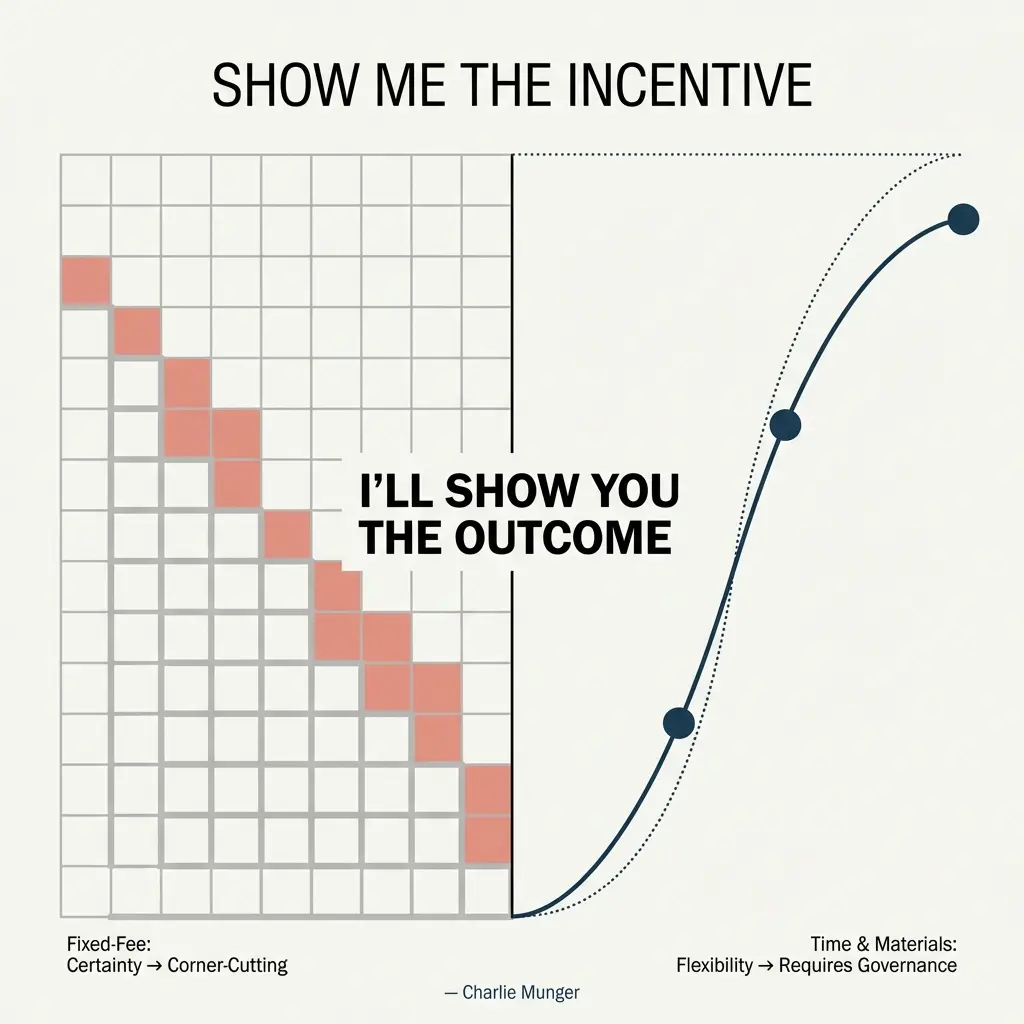
Charlie Munger said it best: “Show me the incentive and I’ll show you the outcome.” When you sign a software development contract, you’re doing more than setting a budget. You’re establishing a behavioral framework that will shape every decision your vendor makes for the next 6-12 months.
The question isn’t which pricing model is “better.” The question is which incentive structure aligns with your project’s reality.
The Hidden Tax in Fixed-Fee Contracts
Fixed-fee contracts promise budget certainty. You know exactly what you’ll pay before a single line of code gets written.
But that certainty comes with a hidden cost.
Development partners build substantial contingency buffers into fixed-price quotes—often 20-30% premiums to cover unforeseen challenges. You’re paying for risks that may never materialize. If the project proceeds smoothly, you’ve simply overpaid.
Think of it as insurance you can’t cancel. The vendor prices in every possible complication because under a fixed-fee structure, any unexpected problem becomes their financial liability.
This creates a fundamental tension. The vendor needs to protect their margin. You need a quality product. These goals diverge the moment something unexpected happens.
And something unexpected always happens.
When Vendors Cut Corners to Survive
Here’s what I’ve learned from examining failed projects: when vendors lock price and timeline under fixed-fee contracts, they protect their margin by cutting corners.
Less testing. Skipping refactoring. Assigning junior developers to your project.
The goal shifts from “best product” to “hit the deadline.” According to research from multiple development firms, in 9 out of 10 cases of “successfully delivered” fixed-price projects, you’ll discover technical debt, scalability challenges, poor test coverage, or outdated frameworks.
The project gets delivered on time and on budget. Six months later, you’re spending twice as much fixing what should have been built correctly the first time.
A 2017 peer-reviewed study published in the International Journal of Project Management found that fixed-price contracts connect with a higher risk of project failure compared to time-and-materials contracts. The research suggests contract type influences critical behaviors—fixed-price contracts encourage selecting the lowest-priced provider rather than the highest-skilled.
You get what you incentivize.
The Zero-Sum Game Dynamic
Fixed-price contracts frame the relationship as a zero-sum game.
If an unexpected problem arises, it’s either the vendor’s loss or, via a change order, yours. This adversarial dynamic erodes trust and makes a true partnership impossible.
I’ve seen this play out repeatedly. A client discovers a critical feature gap three months into development. Under a fixed-fee contract, the vendor cannot afford to be a partner when needs change unless the contract gets modified.
The change request process begins. Formal documentation. Budget negotiations. Timeline extensions. Administrative friction that inflates the budget and slows the project to a crawl.
According to McKinsey research, 17% of large IT projects go so badly that they threaten the very existence of the company—often because they cannot adapt to changing business needs under rigid fixed-fee structures.
When projects end, both sides often feel they’ve lost. Clients frustrated with rigidity and budget overruns. Vendors frustrated with unprofitability.
Time and Materials: Freedom With Risk
Time-and-materials contracts flip the incentive structure.
You pay for actual hours worked at agreed-upon rates. This creates flexibility to adapt as you learn what the product actually needs to do.
But it introduces a different risk: without strong governance, tasks, scope, and timelines can creep.
Pure time-and-materials without caps can incentivize slower work. When every hour saved is an hour not billed, vendors have little financial incentive to improve efficiency.
Industry data shows that without proper controls, 9 out of 10 projects experience budget overruns. Large IT projects commonly run up to 80% over budget and take 20% longer than scheduled.
The solution isn’t to abandon time-and-materials. The solution is to implement the governance discipline that makes it work.
What Strong Governance Actually Looks Like
Time-and-materials contracts require active management.
You need effective time tracking and frequent monitoring. Strong project managers must track tasks, hours, and changes in real-time with clear criteria for adding or removing features.
Here’s what that means in practice:
- Weekly sprint reviews where you evaluate progress against business objectives
- Clear acceptance criteria for every feature before development begins
- Budget thresholds that trigger mandatory review and approval
- Regular velocity tracking to identify efficiency trends
- Transparent time logs that show exactly where hours go
This requires internal capacity. You can’t treat a time-and-materials project as hands-off. You’re trading budget certainty for flexibility, but you’re also taking on the responsibility of active partnership.
If you don’t have the internal resources to manage this level of engagement, time-and-materials becomes a liability.
When Fixed-Fee Actually Works
Fixed-price contracts can work well for projects with extremely low uncertainty and a well-understood, repeatable process.
Simple five-page marketing websites. Well-documented API integrations. Migrating a legacy system with clearly defined functionality.
These projects have minimal discovery. The scope is clear. The technical approach is proven. The vendor can estimate accurately because they’ve built the same thing multiple times.
But for any complex project with meaningful uncertainty—like building a new product—the model itself introduces the massive risk of building the wrong thing perfectly.
You lock the scope before you understand what you actually need. The vendor delivers exactly what was specified. Six months later, you realize the specifications were wrong.
The contract was fulfilled. The project failed.
The Decision Framework
Here’s how I evaluate which pricing model to use:
Choose fixed-fee when:
- The scope is completely defined and unlikely to change
- You’ve built similar projects before and know exactly what you need
- The technical approach is proven and low-risk
- You lack internal capacity for active project management
- Budget certainty matters more than flexibility
Choose time-and-materials when:
- You’re building something new with meaningful uncertainty
- Requirements will evolve as you learn from user feedback
- You have strong internal project management capacity
- You need the flexibility to pivot based on market conditions
- You value partnership over contractual protection
The wrong choice doesn’t just waste money. It creates structural incentives that make failure inevitable.
The Hybrid Approach Nobody Talks About
You don’t have to choose between pure fixed-fee and pure time-and-materials.
The most successful projects I’ve seen use a hybrid structure that aligns incentives while managing risk.
Start with a fixed-fee discovery phase. This gives you a defined scope and technical architecture without committing to full development.
Then move to time-and-materials for implementation with a monthly budget cap. This provides flexibility within defined boundaries.
Include performance incentives tied to delivery milestones. This gives the vendor a reason to optimize efficiency rather than maximize hours.
Build in quarterly reviews where you can adjust scope and budget based on what you’ve learned.
This structure acknowledges reality: software development is a discovery process where requirements evolve as you build.
What This Means for Your Next Project
The pricing model you choose will predict your project’s outcome more accurately than the vendor’s technical capabilities.
Before you sign a contract, ask yourself:
Do I know exactly what I need? If yes, fixed-fee might work. If no, you’re setting yourself up for expensive change orders.
Do I have the internal capacity to actively manage this project? If yes, time-and-materials gives you flexibility. If no, you need more structure.
What happens when requirements change? Because they will. How does your pricing model handle that reality?
Where does the financial risk of uncertainty belong? With you or with the vendor? There’s no right answer, but there is an honest one.
The contract you sign today creates the incentive structure that will shape every decision for the next year. Choose the model that aligns with your project’s maturity, scope clarity, and internal governance strength.
Everything else is just hoping for the best.