
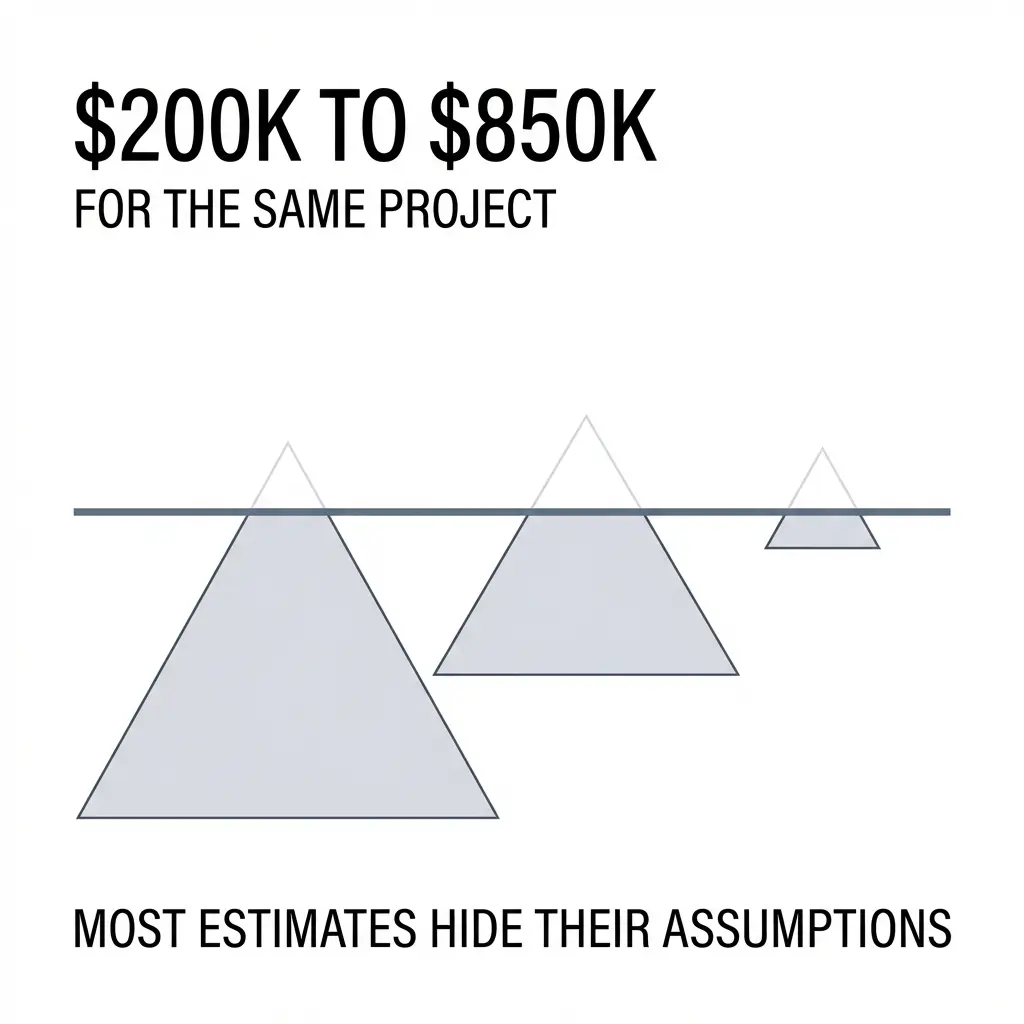
I’ve watched executives squirm through vendor selection meetings where three proposals for the same project range from $200K to $850K. Everyone asks the same question: “Which one is real?”
The answer is usually buried in assumptions you can’t see.
Most organizations treat vendor estimates like mystery boxes. They compare totals, maybe question a few line items, then pick based on gut feel or past relationships. But large IT projects run 45% over budget and deliver 56% less value than predicted. That’s not bad luck. That’s bad benchmarking.
I’m going to show you how to normalize vendor estimates against market data, complexity factors, and delivery model assumptions. The goal is not to hire the cheapest vendor. It’s to ensure the estimate reflects the true complexity and risk of the work.
Why Vendor Estimates Vary So Wildly
Three vendors look at your project brief. One quotes $300K, another $550K, and the third comes in at $425K. You assume they’re pricing different scopes.
They’re not.
They’re pricing different assumptions. One vendor assumes your team handles QA. Another bakes in 20% contingency for scope creep. The third is pricing offshore resources at $65/hour while the first uses onshore staff at $250/hour.
The estimates diverge because vendors make different calls on:
- Role composition – How many senior vs. junior resources
- Margin expectations – 15% vs. 35% markup
- Technology stack – Open source vs. enterprise licensing
- Delivery model – Onshore, offshore, or hybrid
- Risk buffer – Explicit contingency or hidden padding
You can’t judge fairness by comparing totals. You need to normalize the inputs.
Step 1: Break Estimates Into Comparable Units
Start by converting every proposal into cost per role per hour. This is your baseline unit of comparison.
Most vendors bury this data in project phases or deliverables. You need to extract it. Ask for:
- Hours by role (developer, architect, PM, QA)
- Blended rate or individual role rates
- Assumptions about team composition
If a vendor won’t provide this breakdown, that’s a red flag. Suppliers often have a better understanding of their true costs but are reluctant to share this information.
Once you have hourly rates, compare them against market benchmarks. Software development hourly rates in 2025 vary dramatically: Enterprise-class firms charge $400+ per hour, while Eastern European alternatives offer comparable expertise at $30-$65 per hour.
This doesn’t mean you should always choose the lowest rate. It means you should understand what you’re paying for.
Step 2: Normalize For Complexity And Risk
A $400K estimate for a greenfield mobile app is different from a $400K estimate for integrating legacy ERP systems. Complexity drives cost in ways that raw hours don’t capture.
I use a complexity multiplier based on:
- Technical debt – Are you building new or fixing old?
- Integration points – How many systems need to talk to each other?
- Regulatory requirements – HIPAA, SOC 2, GDPR compliance
- Team coordination – Distributed teams cost 15-25% more
- Project duration – Every additional year increases cost overruns by 15%
If one vendor’s estimate looks low, they’re probably underestimating complexity. If another looks high, they might be padding for risk you don’t actually face.
The key is to ask vendors to justify their complexity assumptions. Don’t accept “this is how we always price it.” Make them show their work.
Step 3: Account For Hidden Costs And Margin
Vendor estimates rarely include the full cost of ownership. Hidden expenses can inflate total AI ownership costs by 200-400% compared to initial quotes when you factor in integration, customization, infrastructure scaling, and operational overhead.
I always add these line items to vendor proposals:
- Internal team time – Your people aren’t free
- Infrastructure costs – Cloud, licensing, third-party tools
- Change management – Training, documentation, adoption support
- Ongoing maintenance – Post-launch support and updates
Then there’s margin. Most vendors aim for 25-35% gross margin on services work. If you’re paying enterprise rates but getting offshore delivery, someone is pocketing the difference.
You don’t need to eliminate margin. You need to know it exists and negotiate accordingly.
Step 4: Use Market Data To Challenge Outliers
Once you’ve normalized estimates, you’ll spot outliers. One vendor is 40% higher on senior developer hours. Another has zero budget for QA. A third assumes 6 months of work that the others quote at 9.
This is where benchmarking becomes negotiation leverage.
Fact-based negotiation grounds discussions in objective, verifiable data. You’re not saying “you’re too expensive.” You’re saying “your senior developer rate is $385/hour, but market benchmarks for this type of work range from $250-$350. Help me understand the premium.”
Most vendors will adjust. Some will justify the difference with better talent, faster delivery, or lower risk. Either way, you’ve shifted the conversation from “take it or leave it” to “explain the value.”
Step 5: Watch For Pricing Model Traps
Modern vendors love consumption-based pricing. Pay per user, per transaction, per API call. It sounds flexible until you realize 65% of IT leaders report unexpected charges from these models.
I’ve seen organizations get quoted $50K for a SaaS platform, then hit $180K in year one because nobody modeled actual usage.
When evaluating consumption-based estimates:
- Ask for usage scenarios at 50%, 100%, and 150% of projected volume
- Get hard caps on overage charges
- Model what happens if you scale faster than expected
- Understand how pricing changes with feature adoption
The goal is to eliminate surprises. If a vendor can’t model different scenarios, they’re guessing.
Step 6: Build Your Own Benchmark Database
You can’t benchmark effectively without data. Most organizations don’t track vendor performance in a way that informs future decisions.
Start building a simple database that captures:
- Original estimate vs. actual cost
- Estimated timeline vs. actual delivery
- Vendor rates by role and geography
- Project complexity factors and outcomes
After 3-5 projects, you’ll have enough data to spot patterns. You’ll know which vendors consistently underestimate. You’ll see which complexity factors drive the biggest variances. You’ll have your own benchmarks instead of relying on industry averages.
Organizations that excel centralize contracts, track performance metrics, and leverage data-driven insights to strengthen their negotiating position. This isn’t extra work. It’s the work that saves you from the next $500K overrun.
What Good Benchmarking Actually Looks Like
I worked with a company evaluating three vendors for a customer portal rebuild. Initial estimates ranged from $380K to $720K.
After normalizing for role costs, complexity, and delivery model, the real range was $480K to $550K. The low bid was missing integration work. The high bid was padding for risks the client didn’t actually face.
They didn’t pick the cheapest option. They picked the vendor whose assumptions matched reality and whose estimate accounted for the actual complexity of the work.
The project came in 8% under budget and delivered on time.
That’s what good benchmarking buys you. Not the lowest price, but the right price for the right scope with the right level of risk.
The Real Cost Of Skipping This Work
Here’s what happens when you don’t benchmark vendor estimates:
You pick based on relationships or gut feel. The project starts. Three months in, the vendor says they need more budget because “the scope was more complex than we thought.” You’re over a barrel because switching vendors now costs more than paying the overrun.
Sound familiar?
17% of IT projects go so badly that they threaten the very existence of the company, with budget overruns of more than 200%. These disasters happen more often than statistical models predict because organizations skip the hard work of validating estimates before signing contracts.
Benchmarking is not about squeezing vendors. It’s about ensuring both sides understand what they’re committing to. Good vendors appreciate this. They’d rather negotiate a realistic estimate upfront than manage scope creep and change orders for 18 months.
Start Small, Build Momentum
You don’t need a sophisticated procurement analytics platform to start benchmarking vendor estimates. You need a spreadsheet and a willingness to ask uncomfortable questions.
Pick your next vendor selection process. Break the estimates into role costs. Compare them against market data. Ask vendors to explain their assumptions. Track the results.
After three projects, you’ll have your own benchmark database. After five, you’ll negotiate from a position of data-driven confidence instead of hope.
The vendors who resist this process are the ones you should avoid. The ones who welcome it are the partners you want.
Your job is not to trust vendor estimates. It’s to validate them.