
I’ve reviewed hundreds of software contracts over the past decade. The pattern repeats itself with eerie consistency.
A vendor proposes an “Agile approach” with a fixed budget. The executive team signs off. Six months later, the project balloons by 50% to 60%. The vendor points to the contract. The backlog was always there. You just didn’t read it carefully enough.
Here’s what I’ve learned: the backlog is where financial risk hides in plain sight.
The Agile Promise vs. The Contract Reality
Agile methodology promised to solve the problems of traditional waterfall projects. Flexibility. Iterative delivery. Continuous feedback.
But something broke in translation when Agile met enterprise contracts.
Customers expect fixed price, fixed scope, fixed time agreements. Vendors pitch Agile flexibility. The contract tries to bridge both worlds. The result is a hybrid document that creates ambiguity at exactly the wrong moment: before you sign.
Research confirms this disconnect. Customers struggle to change their contracting approaches to suit Agile projects. The old habits persist. Fixed-price thinking meets iterative delivery. The gap between expectation and execution becomes a financial trap.
What Your Jira Backlog Actually Tells You
Most executives never look at the Jira backlog before signing. They review the statement of work. They check the budget. They verify the timeline.
The backlog sits in a separate system. Technical. Detailed. Easy to ignore.
That’s the mistake.
Your Jira backlog contains the actual scope of work. The contract references it. The vendor estimates from it. The developers build from it. Everything flows from those epics, stories, and tasks.
When I audit backlogs before contract signature, I look for three specific patterns:
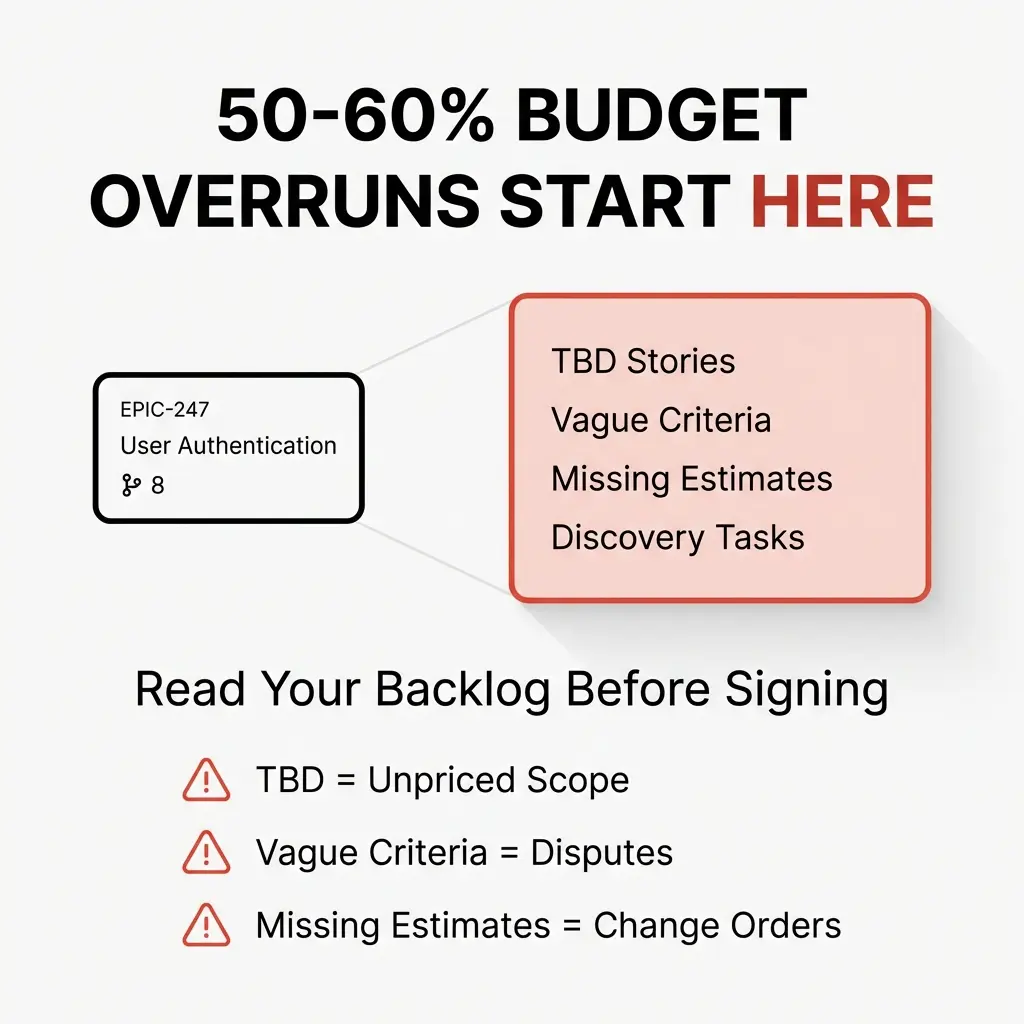
1. TBD Stories and Deferred Discovery
You’ll see stories labeled “TBD,” “To Be Determined,” or “Details pending.” Sometimes they’re tagged as “discovery” or “research” tasks.
Each one represents unpriced scope.
The vendor knows something needs to happen in that area. They don’t know what. They haven’t estimated it. They’ve parked it in the backlog with a placeholder.
After you sign, those placeholders expand. Discovery reveals complexity. Complexity requires more stories. More stories mean more budget.
2. Vague Acceptance Criteria
Good user stories follow a format: “As a [user], I want
Bad stories read like wishlists. “Improve performance.” “Enhance user experience.” “Optimize database.”
When acceptance criteria are vague, the definition of done becomes negotiable. The vendor delivers something. You reject it because it doesn’t meet your expectations. They claim it meets the story. You’re now in a change order negotiation.
The research backs this up. 66% of organizations report frequent project delays caused by unclear requirements. Those delays convert directly into cost overruns.
3. Estimation Patterns That Don’t Add Up
Look at how the vendor estimated the backlog. Do story points align with hours? Do epics break down into reasonable chunks? Does the total match the contract budget?
I’ve seen backlogs where 40% of stories carry no estimates. Or where estimates cluster suspiciously at round numbers. Or where the sum of story points implies 3,000 hours of work but the contract only budgets for 2,000.
The math reveals intent.
If the backlog estimates exceed the contract budget, you’re buying a partial solution. The vendor plans to deliver what fits in the budget and then negotiate change orders for the rest.
The Structural Problem With Agile Scope
Here’s the uncomfortable truth: Agile projects structurally hide scope expansion.
Traditional projects estimate everything upfront. Scope creep is visible. You started with 100 requirements. Now you have 120. The delta is obvious.
Agile projects start with a minimal backlog and grow through refinement. Every sprint planning session adds stories. Every retrospective identifies improvements. From a metrics perspective, every project starts smaller than it ends.
Backlog grooming looks identical to scope creep.
The vendor calls it “discovery” and “refinement.” You call it “work that wasn’t in the original estimate.” Both are correct. The contract language determines who pays.
Most projects experience 10-25% scope growth from initial specifications. That’s not an anomaly. That’s the baseline expectation.
If your contract doesn’t explicitly account for this growth, you’ll pay for it through change orders.
The Change Order Mechanism
Change orders are where unpriced scope converts into invoices.
The pattern is predictable. The vendor delivers the initial backlog. New requirements emerge. The vendor proposes a change order. You negotiate. The project continues.
Approximately 35% of fixed-price projects experience scope disputes. Average change order costs reach 15-25% of the original contract value.
That’s not bad luck. That’s the business model.
Buyers discover that the initial contract value was only the starting point. Change orders fill the gap between the product that was sold and the solution you actually need.
The financial exposure is significant. A project that starts at $2 million can quickly increase by 50% to 60% when gaps emerge.
Why This Happens (And Keeps Happening)
I don’t think most vendors set out to deceive clients. The problem is structural.
Sales teams need to win contracts. Lower estimates win more often. They optimize the initial proposal to be competitive.
Delivery teams inherit those optimistic estimates. They discover the actual complexity. They surface the gaps through the backlog refinement process.
The contract becomes a negotiation tool. What’s in scope? What’s out of scope? Who decides?
The statistics are sobering. Just one in every 200 IT projects meets all three success measures: on time, on budget, and delivering intended benefits. Projects that miss one or more of these targets exceed budgets by 75% on average.
Even more striking: one in six IT projects experiences a cost overrun of 200% on average, with schedule overruns of nearly 70%. These aren’t rare black swan events. They follow a predictable power-law distribution.
The tail risk is fatter than most executives realize.
The Agile Adoption Paradox
You might assume that adopting Agile methodology prevents these problems. The data suggests otherwise.
Nearly half of all respondents in a recent BCG survey said that more than 30% of their technology projects suffer from delays or budget overruns. Here’s the critical finding: there was no correlation between agile methodology and project success.
64% of respondents said their IT teams already used some version of agile software development tools. Yet the problems persist.
Going Agile doesn’t automatically prevent overruns. The methodology is neutral. The contract structure and backlog transparency determine outcomes.
The Cost of Catching Problems Late
There’s a reason I advocate for pre-signature backlog analysis. The cost of fixing problems escalates exponentially over time.
A requirements error costs $1 if you find it during the requirements phase. $10 during design. $100 during programming. $1,000 during testing. $10,000 or more if it reaches production.
That exponential curve applies to contract gaps too.
Catch ambiguous scope before you sign, and you negotiate from strength. Discover it six months into delivery, and you’re negotiating change orders under time pressure with a vendor who already has your deposit.
The financial leverage shifts entirely.
What Independent Backlog Analysis Reveals
When I analyze a backlog before contract signature, I’m looking for alignment between three documents:
The statement of work (what you think you’re buying)
The contract budget (what you’re paying)
The Jira backlog (what the vendor plans to build)
These three should tell the same story. Often they don’t.
The SOW describes business outcomes. The budget assumes a certain level of effort. The backlog contains technical tasks that may or may not deliver those outcomes within that budget.
The gaps reveal risk.
I quantify that risk. How many stories lack acceptance criteria? What percentage of the backlog carries no estimates? How much scope sits in “Phase 2” or “Future Enhancements” that the business actually needs in Phase 1?
This analysis gives you negotiating leverage before you sign. You can require the vendor to clarify vague stories. You can insist on complete estimates. You can adjust the budget to match the actual scope.
Or you can walk away.
Practical Steps Before You Sign
You don’t need to become a Jira expert. You need to ask the right questions and verify the answers.
Request full backlog access before signing. If the vendor resists, that’s a red flag. The backlog should be transparent.
Count the TBD stories. Any story marked as “to be determined” or “discovery” represents unpriced scope. Get estimates or remove them from the contract scope.
Review acceptance criteria. Every story should have clear, testable conditions for “done.” Vague criteria lead to disputes.
Verify the math. Sum the estimated hours or story points. Compare to the contract budget. If there’s a gap, address it before signing.
Define the change order process. Assume scope will grow. Negotiate rates, approval processes, and caps upfront.
Consider independent analysis. A third-party backlog audit costs a fraction of a typical change order and reveals risks before you commit.
The Real Question
The question isn’t whether your Agile project will encounter scope growth. It will. The question is whether that growth is transparent, priced, and manageable.
Your Jira backlog contains the answer. You just need to read it before you sign.
Most executives delegate this review to their technical teams. That’s reasonable. But someone on your side needs to connect the backlog to the contract and verify alignment.
The vendors who resist this scrutiny are the ones you should avoid. The vendors who welcome it are the ones who’ve priced the work honestly.
Transparency is the filter.
I’ve watched too many projects start with optimism and end in disputes over what was “really” in scope. The backlog was always there. The ambiguity was always there. The financial risk was always there.
You just needed to look at it before signing.
The next time a vendor proposes an Agile approach with a fixed budget, ask to see the Jira backlog. Read it carefully. Count the TBDs. Check the acceptance criteria. Verify the estimates.
That 30-minute review might save you 30% of your project budget.
The backlog doesn’t lie. It just waits for someone to read it.